

Close Menu
    Facebook X (Twitter) Instagram
    SciTechDaily
    • Biology
    • Chemistry
    • Earth
    • Health
    • Physics
    • Science
    • Space
    • Technology
    Facebook X (Twitter) Pinterest YouTube RSS
    SciTechDaily
    Home»Technology»Scientists Discover Key to Safer Energy Storage Devices
    Technology

    Scientists Discover Key to Safer Energy Storage Devices

    By GIST (Gwangju Institute of Science and Technology)May 9, 2022No Comments3 Mins Read
    Facebook Twitter Pinterest Telegram LinkedIn WhatsApp Email Reddit
    Share
    Facebook Twitter LinkedIn Pinterest Telegram Email Reddit
    General Battery Energy Storage Concept
    Modern energy storage devices, such as supercapacitors and batteries, depend heavily on temperature and risk dangerous thermal runaway if they overheat. Effective thermal management, requiring an understanding of how properties like heat capacity (Cp) change during use, is essential for safe operation. Researchers have identified key changes in the thermal properties of energy storage devices during use, leading to improved thermal management strategies.

    Researchers uncover critical changes in the thermal properties of energy storage devices during operation, paving the way towards better thermal management.

    Modern energy storage devices, such as supercapacitors and batteries, have highly temperature-dependent performance. If a device gets too hot, it becomes susceptible to ‘thermal runaway.’ Thermal runaway—or uncontrolled overheating—can ultimately result in dangerous explosions or fires. Adopting a well-informed thermal management strategy is required for the stable and safe operation of devices. To do this, it is necessary to understand how certain thermal properties, like heat capacity (Cp), dynamically change during charging and discharging.

    Recently, researchers from the Gwangju Institute of Science and Technology (GIST) investigated the thermal properties of electric double-layer capacitors (EDLCs)—a type of supercapacitor having high power and long life—for a technical foundation in thermal measurement and revealed significant information. “Using the 3ω hot-wire method, we were able to measure the change in heat capacity of EDLCs in real-time in a microscopic electrode-electrolyte volume, which is an active site for the adsorption and desorption of ions,” explains Prof. Jae Hun Seol, who led the study.

    The study was made available online on February 5, 2022, and will be published in Volume 188, Issue 122632 of International Journal of Heat and Mass Transfer on June 1, 2022.
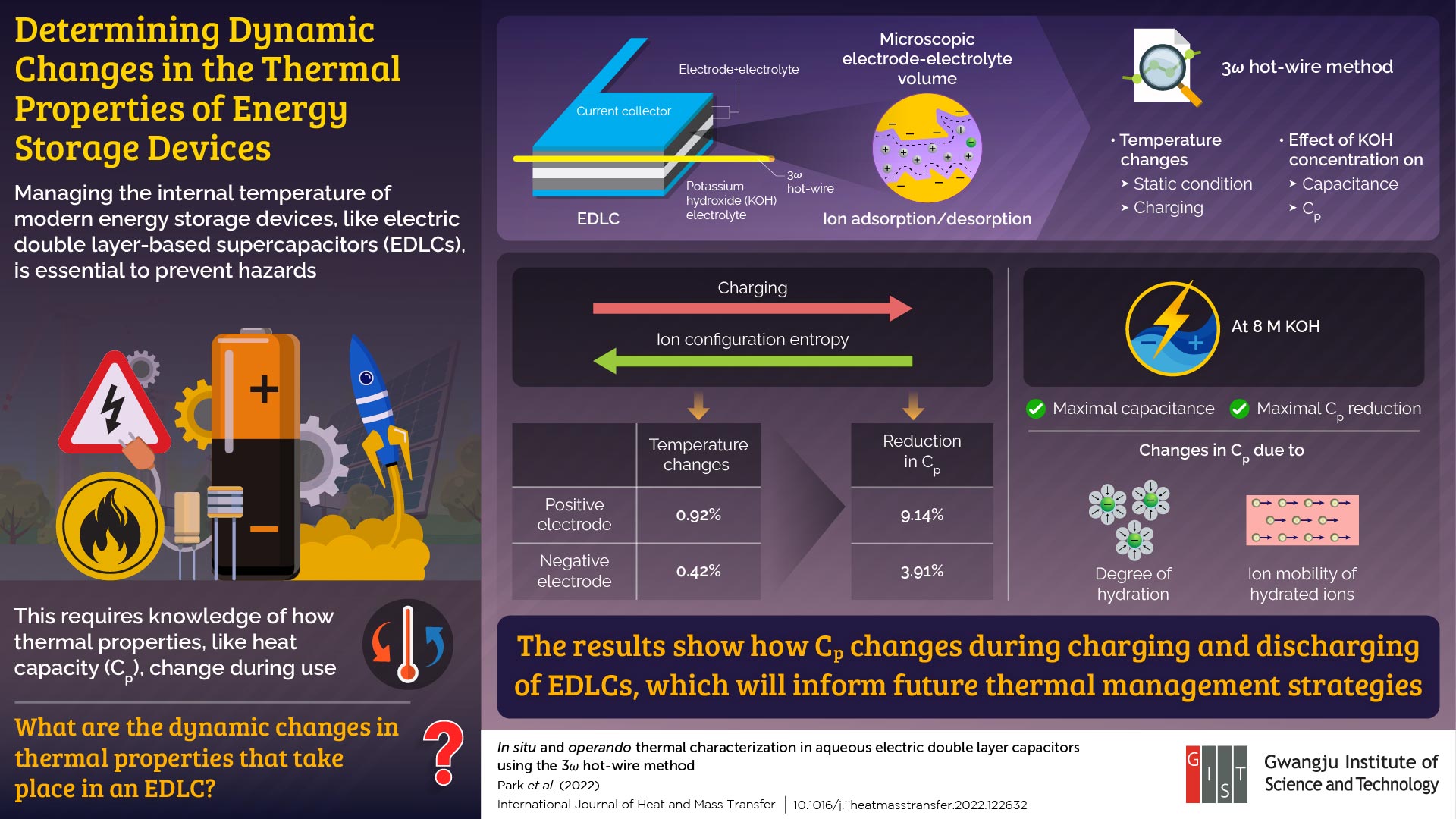
    Determining Dynamic Changes in the Thermal Properties of Energy Storage Devices
    Effectively managing the thermal properties of energy storage devices is the key to avoiding thermal runaway and ensuring safety. Recently, scientists from the Gwangju Institute of Science and Technology uncovered key changes to the thermal properties of electric double-layer capacitors during charging and discharging, which will help inform future thermal management strategies. Credit: Gwangju Institute of Science and Technology (GIST)

    The research team conducted experiments both in situ (under static conditions) and operando (during charging). They found that the temperatures of the positive and negative electrodes changed by 0.92% and 0.42% during charging, which corresponded to 9.14% and 3.91% reductions in their respective Cp. “According to thermodynamic theory, the ionic configuration entropy (a measure of randomness) of a system decreases during adsorption, i.e., charging. This also affects the free energy of the system. Together, this leads to a decrease in Cp,” explains Prof. Seol.

    Impact of Ionic Configuration and Electrolyte Concentration on Heat Capacity

    The team also varied the concentration of the electrolyte, potassium hydroxide, to see how it affected EDLC performance. They found that the EDLC displayed maximum capacitance and Cp reduction when the electrolyte concentration was 8 M. They attributed this to variations in the degree of hydration of ions and their ionic mobility.

    “An important aspect of this study is that charging and discharging also alters Cp of EDLCs,” says Prof. Seol. “These findings will extend our understanding of the underlying thermal physics of EDLCs.”

    Indeed, these results can be considered a major step towards future effective thermal management strategies, which will create safer and more reliable energy storage devices.

    Reference: “In situ and operando thermal characterization in aqueous electric double layer capacitors using the 3ω hot-wire method” by Yeongcheol Park, Jaehoon Kim, Changho Kim, Seung-Mo Lee, Chul Kang and Jae Hun Seol, 5 February 2022, International Journal of Heat and Mass Transfer.
    DOI: 10.1016/j.ijheatmasstransfer.2022.122632

    Never miss a breakthrough: Join the SciTechDaily newsletter.
    Follow us on Google and Google News.

    Battery Technology Energy
    Share. Facebook Twitter Pinterest LinkedIn Email Reddit

    Related Articles

    Rival Emerges to Lithium-Ion Batteries: New Potassium Metal Technology

    New Battery Can Self-Charge Without Losing Energy

    Next-Generation Energy Storage Breakthrough: Fast-Charging, Long-Running, Flexible

    New Aqueous Lithium-Ion Battery – Low Cost & Improved Safety

    Iron-Air Batteries Promise Higher Energy Density Than Lithium-Ion Batteries

    New Aluminum Batteries Increase the Range of UUVs Tenfold

    MIT Engineers Look Toward All-Solid Lithium Batteries

    Engineers Design Calcium-Based Multi-Element for Liquid Batteries

    Power Conserving Chip May Increase Smartphone Battery Life

    Leave A Reply Cancel Reply

    • Facebook
    • Twitter
    • Pinterest
    • YouTube

    Don't Miss a Discovery

    Subscribe for the Latest in Science & Tech!

    Trending News

    Breakthrough Bowel Cancer Trial Leaves Patients Cancer-Free for Nearly 3 Years

    Natural Compound Shows Powerful Potential Against Rheumatoid Arthritis

    100,000-Year-Old Neanderthal Fossils in Poland Reveal Unexpected Genetic Connections

    Simple “Gut Reset” May Prevent Weight Gain After Ozempic or Wegovy

    2.8 Days to Disaster: Scientists Warn Low Earth Orbit Could Suddenly Collapse

    Common Food Compound Shows Surprising Power Against Superbugs

    5 Simple Ways To Remember More and Forget Less

    The Atomic Gap That Could Cost the Semiconductor Industry Billions

    Follow SciTechDaily
    • Facebook
    • Twitter
    • YouTube
    • Pinterest
    • Newsletter
    • RSS
    SciTech News
    • Biology News
    • Chemistry News
    • Earth News
    • Health News
    • Physics News
    • Science News
    • Space News
    • Technology News
    Recent Posts
    • After 37 Years, the World’s Longest-Running Soil Warming Experiment Uncovers a Startling Climate Secret
    • NASA Satellite Captures First-Ever High-Res View of Massive Pacific Tsunami
    • ADHD Isn’t Just a Deficit: Study Reveals Powerful Hidden Strengths
    • Scientists Uncover “Astonishing” Hidden Property of Light
    • Scientists Discover Stem Cells That Could Regrow Teeth and Bone
    Copyright © 1998 - 2026 SciTechDaily. All Rights Reserved.
    • Science News
    • About
    • Contact
    • Editorial Board
    • Privacy Policy
    • Terms of Use

    Type above and press Enter to search. Press Esc to cancel.