
Close Menu
    Facebook X (Twitter) Instagram
    SciTechDaily
    • Biology
    • Chemistry
    • Earth
    • Health
    • Physics
    • Science
    • Space
    • Technology
    Facebook X (Twitter) Pinterest YouTube RSS
    SciTechDaily
    Home»Biology»Scientists Discover Unexpected Role of Alzheimer’s Protein in Cell Division
    Biology

    Scientists Discover Unexpected Role of Alzheimer’s Protein in Cell Division

    By Pohang University of Science & Technology (POSTECH)April 13, 20261 Comment3 Mins Read
    Facebook Twitter Pinterest Telegram LinkedIn WhatsApp Email Reddit
    Share
    Facebook Twitter LinkedIn Pinterest Telegram Email Reddit
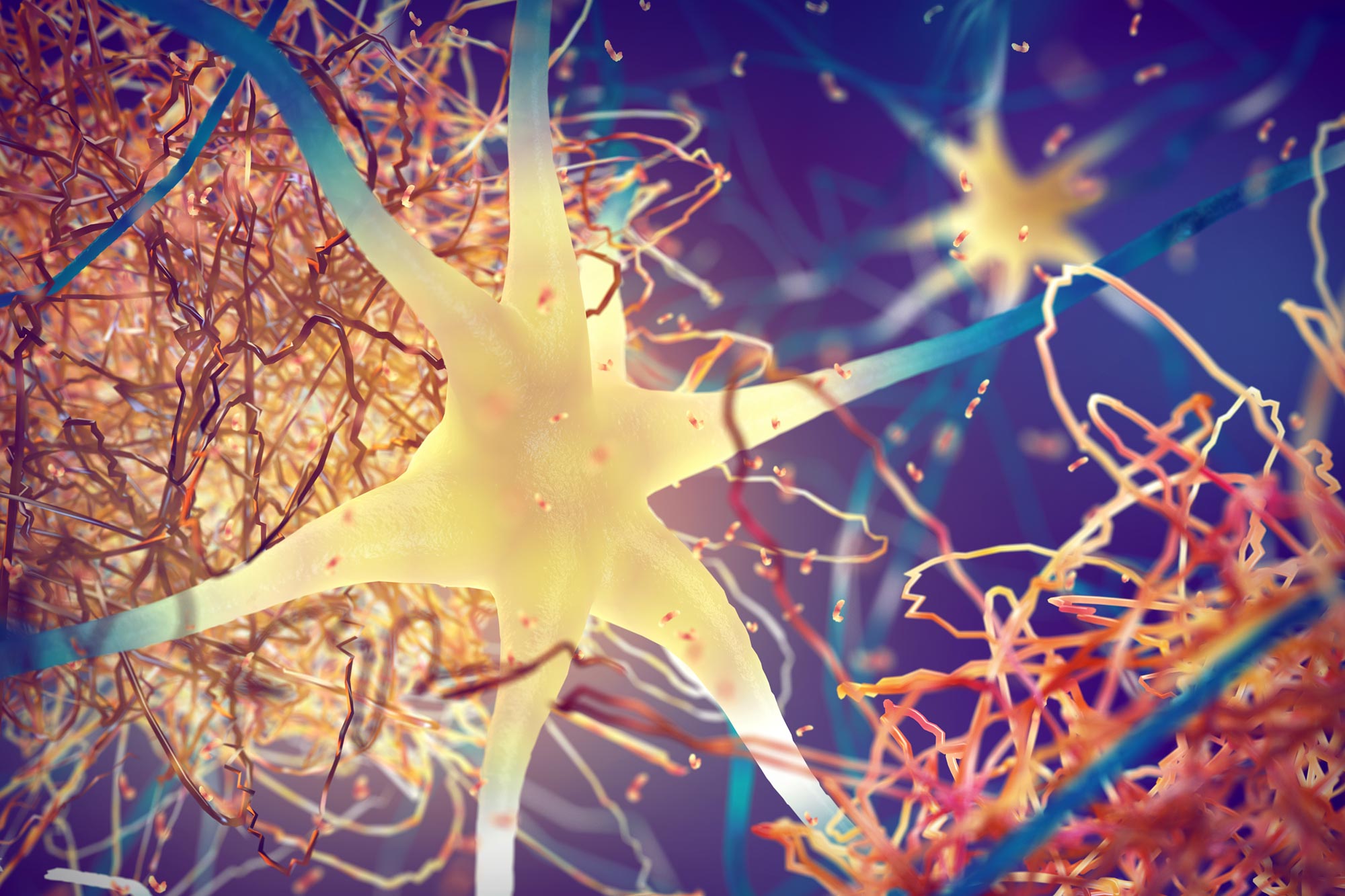
    Amyloid Plaques Forming Between Brain Neurons
    Researchers have uncovered a potential new role for tau, a protein best known for its link to Alzheimer’s disease, in the precise mechanics of cell division. Credit: Shutterstock

    A familiar Alzheimer’s protein may have a hidden role in cell division.

    Processes such as wound healing, hair growth, and the continual renewal of cells all rely on cell division. In this process, chromosomes must be evenly distributed between two daughter cells. Even small mistakes can lead to abnormalities within the cell.

    Researchers at POSTECH (Pohang University of Science and Technology) have identified new evidence that a protein called tau may play a key role in maintaining this precision. Their findings were published in Nature Communications.

    Tau is widely studied for its involvement in Alzheimer’s disease. In healthy neurons, it helps stabilize microtubules, which are thin structural fibers inside cells. In Alzheimer’s patients, however, tau can clump together abnormally. Recent studies have also shown that tau can gather molecules into small droplet-like structures known as condensates. Until now, its interaction with DNA has not been well understood, prompting the team to investigate further.

    How Chromosomes Are Separated

    During cell division, chromosomes are guided and separated by spindle microtubules, which pull them into two new cells. For this to happen correctly, chromosomes must attach accurately to these microtubules. To explore whether tau plays a role in this step, the researchers conducted experiments using individual DNA molecules.

    Their results showed that tau binds to DNA and forms condensates. It can move along DNA strands and draw nearby strands together, suggesting a role in organizing chromosome structure.
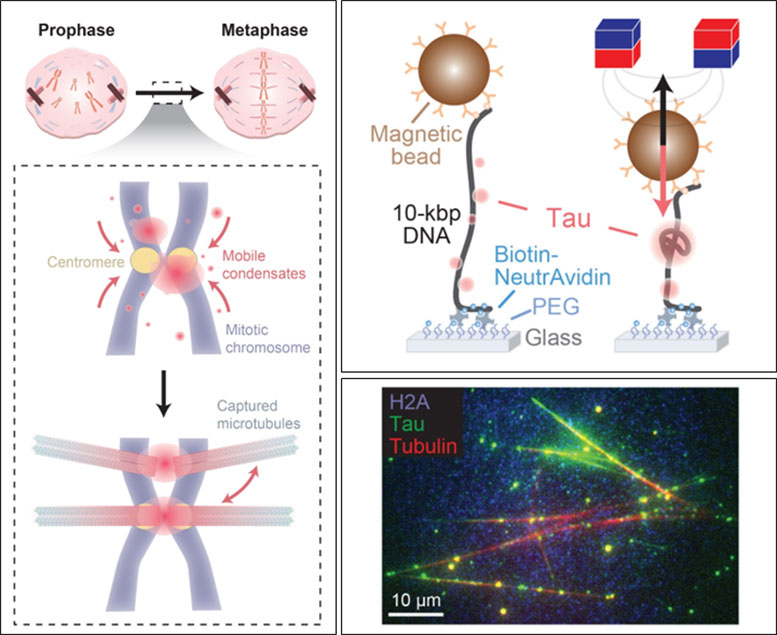
    Tau–DNA Condensates Facilitate Chromosome–Microtubule Connections During Cell Division
    (Left) Tau protein facilitating the attachment between microtubules and chromosomes during cell division. (Upper right) Analysis of tau–DNA condensate formation using single-molecule tweezers. (Lower right) Microtubules captured by tau–DNA condensates. Credit: POSTECH

    Using high-resolution fluorescence imaging, the team confirmed that these tau–DNA condensates act as connection points that can capture microtubules. This behavior was observed both in controlled laboratory conditions and in living cells.

    The study also found that phosphorylation, a chemical change to tau, can influence this process. When cells produced a form of tau similar to that seen in Alzheimer’s disease, chromosomes often failed to align properly during division. This indicates that even minor changes in tau can disrupt the accuracy of cell division.

    Broader Implications for Disease Research

    The researchers believe these findings could open new directions for studying infertility, congenital conditions, and neurodegenerative diseases such as Alzheimer’s.

    Professor Minju Shon, who led the study, said, “This work suggests that tau can directly interact not only with microtubules but also with DNA, potentially linking the two structures. It also shows that tau may be involved in the early stages when chromosomes first establish connections with spindle microtubules during cell division.”

    Reference: “Tau condensation on DNA mediates microtubule attachment suggesting a mitotic role for centromere-localized tau” by Celine Park, Jaehun Jung, Yuri Hong, Haeun Yoo, Keunsang Yang, Jaehyeon Shin, Minsik Kim, Chan Lim, Ayoung Jeong, Seokyun Hong, Jun Young Baek, Sang-Hyun Rah, Chaelin Lee-Eom, Minseok Seo, Yoori Kim, Jae-Hyung Jeon, Jong-Bong Lee, Dong Soo Hwang and Min Ju Shon, 7 January 2026, Nature Communications.
    DOI: 10.1038/s41467-025-67888-x

    This research was supported by the Basic Science Research Program of the National Research Foundation of Korea (NRF), funded by the Ministry of Science and ICT (Outstanding Young Researcher Program and Basic Research Laboratory Program).

    Never miss a breakthrough: Join the SciTechDaily newsletter.
    Follow us on Google and Google News.

    Alzheimer's Disease Biophysics Cell Biology Genetics Molecular Biology Pohang University of Science & Technology
    Share. Facebook Twitter Pinterest LinkedIn Email Reddit

    Related Articles

    Scientists Overturn 20 Years of Textbook Biology With Stunning Discovery About Cell Division

    Mechanical Forces Shape Animal “Origami” Precisely Despite “Noise” and Genetic Variation

    CRISPR-HOT: New Genetic Tool Can Label Specific Genes and Cells

    VGP Project Releases Fifteen New Genomes

    Scientists Sequence Largest Genome to Date, the Axolotl Genome

    Geneticists Fully Decode a New Genome for Regeneration Research

    Scientists Discover a Gene for Brain Size

    Researchers Identify Molecular Factors that Push the Domino of Life into Motion

    Key Differences in Seemingly Synonymous Parts of the Genetic Code

    1 Comment

    1. Kayden Aaron Waltower on April 14, 2026 2:31 pm

      Eda the owl lady

      Reply
    Leave A Reply Cancel Reply

    • Facebook
    • Twitter
    • Pinterest
    • YouTube

    Don't Miss a Discovery

    Subscribe for the Latest in Science & Tech!

    Trending News

    Artificial Sweeteners May Harm Future Generations, Study Suggests

    Splashdown! NASA Artemis II Returns From Record-Breaking Moon Mission

    What If Consciousness Exists Beyond Your Brain

    Scientists Finally Crack the 100-Million-Year Evolutionary Mystery of Squid and Cuttlefish

    Beyond “Safe Levels”: Study Challenges What We Know About Pesticides and Cancer

    Researchers Have Found a Dietary Compound That Increases Longevity

    Scientists Baffled by Bizarre “Living Fossil” From 275 Million Years Ago

    Your IQ at 23 Could Predict Your Wealth at 27, Study Finds

    Follow SciTechDaily
    • Facebook
    • Twitter
    • YouTube
    • Pinterest
    • Newsletter
    • RSS
    SciTech News
    • Biology News
    • Chemistry News
    • Earth News
    • Health News
    • Physics News
    • Science News
    • Space News
    • Technology News
    Recent Posts
    • Researchers Expose Hidden Chemistry of “Ore-Forming” Elements in Biology
    • Geologists Reveal the Americas Collided Earlier Than We Thought
    • 20x Difference: Study Reveals True Source of Airborne Microplastics
    • Scientists Uncover Hidden Force Powering Yellowstone’s Supervolcano
    • This Metal Melts in Your Hand – and Scientists Just Discovered Something Strange
    Copyright © 1998 - 2026 SciTechDaily. All Rights Reserved.
    • Science News
    • About
    • Contact
    • Editorial Board
    • Privacy Policy
    • Terms of Use

    Type above and press Enter to search. Press Esc to cancel.