
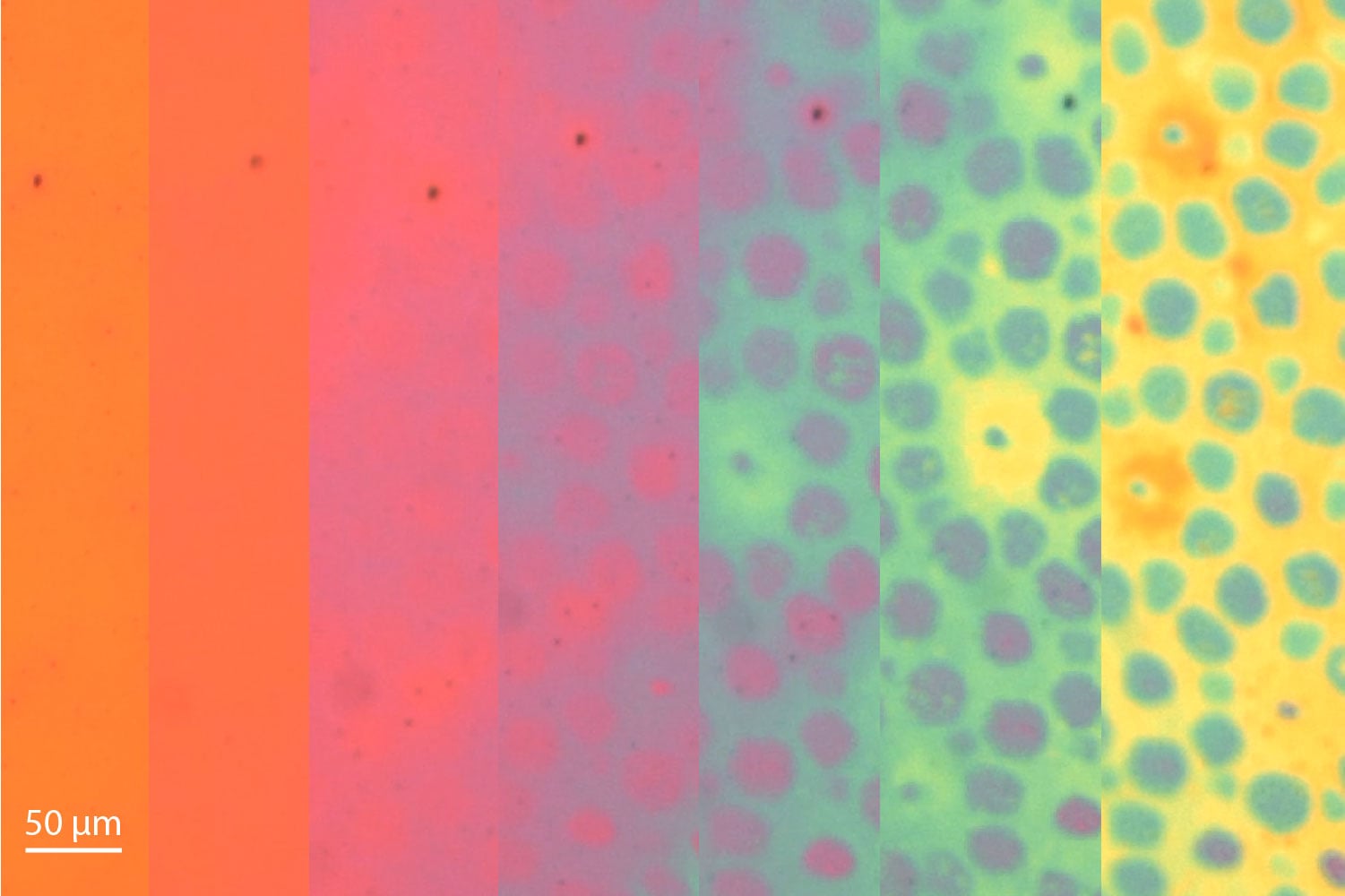
Inspired by the remarkable camouflage abilities of octopus and cuttlefish, Stanford researchers have developed a soft material that can rapidly shift its surface texture and color at extremely fine scales.
Octopus and cuttlefish are masters of disguise. Many species can quickly shift both the color and surface texture of their skin, and scientists have long tried to reproduce that trick using manmade materials. In a paper published in Nature, Stanford researchers report a major advance: a flexible material that swells into new textures and colors within seconds, forming patterns with details finer than a human hair.
“Textures are crucial to the way we experience objects, both in how they look and how they feel,” said Siddharth Doshi, a doctoral student in materials science and engineering at Stanford and first author on the paper. “These animals can physically change their bodies at close to the micron scale, and now we can dynamically control the topography of a material – and the visual properties linked to it – at this same scale.”
The team says the approach could improve dynamic camouflage for people and robots, and it may enable flexible, color-changing displays for wearable technologies. The findings also broaden the possibilities in nanophotonics, a field that precisely shapes how light behaves to support advances in electronics, encryption, biology, and more.
“There’s just no other system that can be this soft and swellable, and that you can pattern at the nanoscale,” said Nicholas Melosh, a professor of materials science and engineering and a senior author on the paper. “You can imagine all kinds of different applications.”
Precise, reversible patterns
To create dynamic textures in a soft material, the team paired electron-beam lithography, a patterning method commonly used in advanced semiconductor manufacturing, with a water-absorbing polymer film that expands as it takes in moisture. By directing an electron beam onto selected regions of the film, they could tune how strongly each area swelled, creating intricate designs that appeared only when the material became wet.
The discovery that an electron beam could change the polymer’s absorbency and create patterns of different colors and textures originally came as somewhat of a surprise. In an earlier project, Doshi had used a scanning electron microscope – which uses a focused beam of electrons to create a high-resolution image – to examine nanostructures the team had created on top of a polymer film. Typically, those samples would be discarded after imaging, but Doshi decided to reuse them instead of creating new ones. In the next set of tests, the regions of the film that had been imaged with the electron scanning microscope behaved differently and turned a different color.
“We realized that we could use these electron beams to control topography at very fine scales,” Doshi said. “It was definitely serendipitous.”
The electron-beam patterning is so precise that the team was able to create a nanoscale replica of Yosemite National Park’s El Capitan rock formation. When dry, the film is perfectly flat, but as soon as water is added, the monolith’s shape rises up from the surface. They also fashioned fine-scale textures that change how light is scattered depending on the amount of water added to the film. This allowed the researchers to create surface finishes ranging from glossy to matte, producing a more realistic appearance than smartphone or computer displays are currently capable of. All of the films are easily returned to their flat state by adding an alcohol-like solvent to remove the water.
The team demonstrated that the same technique can be used to design and reveal complex, switchable color patterns. The researchers put thin, metallic layers on each side of the patterned polymer film to create Fabry-Pérot resonators, which isolate specific wavelengths of light based on the distance between the metal layers. As the polymer films swell to different widths, they display a variety of colors. With the same electron-beam patterning and the right mix of water and solvent, the single-colored sheet becomes a riot of colorful spots and splotches.
“By dynamically controlling the thickness and topography of a polymer film, you can realize a very large variety of beautiful colors and textures,” said Mark Brongersma, a professor of materials science and engineering and a senior author on the paper. “The introduction of soft materials that can expand, contract, and alter their shape opens up an entirely new toolbox in the world of optics to manipulate how things look.”
Dynamic possibilities
When the researchers combined different films into a multilayer device, they were able to independently manipulate both color and texture at the same time, camouflaging with a background pattern nearly as adeptly as an octopus (although not without some trial and error).
Currently, getting the films to accurately match a background pattern requires the researchers to manually adjust the combination of water and solvent to get the right topography and colors. In the future, the team is hoping to integrate a computer vision system, which would be able to automatically adjust the level of swelling to make the films blend in with a variety of backgrounds.
“We want to be able to control this with neural networks – basically an AI-based system – that could compare the skin and its background, then automatically modulate it to match in real time, without human intervention,” Doshi said.
The researchers are also interested in applications beyond visual camouflage. Fine-scale changes in texture could, for example, be used to increase or decrease friction, which could help determine if a small robot will cling to a surface or slide past it. Nanoscale structures can change how cells respond, so there may be bioengineering uses for these techniques as well. They are even working with artists at Stanford to create an exhibit using these materials as an artistic medium.
“Small changes in the properties of soft materials over micron distances are finally possible, which will open up all sorts of possibilities,” Melosh said. “I think there are a lot of exciting things coming up.”
Reference: “Soft photonic skins with dynamic texture and colour control” by Siddharth Doshi, Nicholas A. Güsken, Gerwin Dijk, Johan Carlström, Jennifer E. Ortiz-Cárdenas, Peter Suzuki, Bohan Li, Polly M. Fordyce, Alberto Salleo, Nicholas A. Melosh and Mark L. Brongersma, 7 January 2026, Nature.
DOI: 10.1038/s41586-025-09948-2
This work was funded by a Stanford Graduate Fellowship, Meta PhD Fellowship, the Wu Tsai Human Performance Alliance at Stanford University and the Joe and Clara Tsai Foundation, the German National Academy of Sciences Leopoldina, the Department of Energy, the Air Force Office of Sponsored Research, and the National Science Foundation.
Never miss a breakthrough: Join the SciTechDaily newsletter.
Follow us on Google and Google News.