
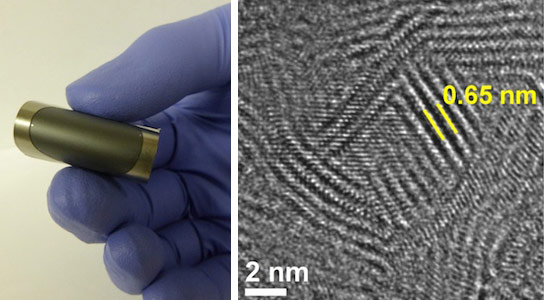
Rice University scientists create dual-purpose film for energy storage based on molybdenum disulfide that is efficient as both a catalyst for hydrogen production and for energy storage.
Rice University scientists who want to gain an edge in energy production and storage report they have found it in molybdenum disulfide.
The Rice lab of chemist James Tour has turned molybdenum disulfide’s two-dimensional form into a nanoporous film that can catalyze the production of hydrogen or be used for energy storage.
The versatile chemical compound classified as a dichalcogenide is inert along its flat sides, but previous studies determined the material’s edges are highly efficient catalysts for hydrogen evolution reaction (HER), a process used in fuel cells to pull hydrogen from water.
Tour and his colleagues have found a cost-effective way to create flexible films of the material that maximize the amount of exposed edge and have potential for a variety of energy-oriented applications.
The Rice research appears in the journal Advanced Materials.
Molybdenum disulfide isn’t quite as flat as graphene, the atom-thick form of pure carbon, because it contains both molybdenum and sulfur atoms. When viewed from above, it looks like graphene, with rows of ordered hexagons. But seen from the side, three distinct layers are revealed, with sulfur atoms in their own planes above and below the molybdenum.
This crystal structure creates a more robust edge, and the more edge, the better for catalytic reactions or storage, Tour said.
“So much of chemistry occurs at the edges of materials,” he said. “A two-dimensional material is like a sheet of paper: a large plain with very little edge. But our material is highly porous. What we see in the images are short, 5- to 6-nanometer planes and a lot of edges, as though the material had bore holes drilled all the way through.”
The new film was created by Tour and lead authors Yang Yang, a postdoctoral researcher; Huilong Fei, a graduate student; and their colleagues. It catalyzes the separation of hydrogen from water when exposed to a current. “Its performance as a HER generator is as good as any molybdenum disulfide structure that has ever been seen, and it’s really easy to make,” Tour said.
While other researchers have proposed arrays of molybdenum disulfide sheets standing on edge, the Rice group took a different approach. First, they grew a porous molybdenum oxide film onto a molybdenum substrate through room-temperature anodization, an electrochemical process with many uses but traditionally employed to thicken natural oxide layers on metals.
The film was then exposed to sulfur vapor at 300 degrees Celsius (572 degrees Fahrenheit) for one hour. This converted the material to molybdenum disulfide without damage to its nano-porous sponge-like structure, they reported.
The films can also serve as supercapacitors, which store energy quickly as static charge and release it in a burst. Though they don’t store as much energy as an electrochemical battery, they have long lifespans and are in wide use because they can deliver far more power than a battery. The Rice lab built supercapacitors with the films; in tests, they retained 90 percent of their capacity after 10,000 charge-discharge cycles and 83 percent after 20,000 cycles.
“We see anodization as a route to materials for multiple platforms in the next generation of alternative energy devices,” Tour said. “These could be fuel cells, supercapacitors, and batteries. And we’ve demonstrated two of those three are possible with this new material.”
Co-authors of the paper are Rice graduate students Gedeng Ruan and Changsheng Xiang. Tour is the T.T. and W.F. Chao Chair in Chemistry as well as a professor of materials science and nanoengineering and of computer science.
The Peter M. and Ruth L. Nicholas Postdoctoral Fellowship of Rice’s Smalley Institute for Nanoscale Science and Technology and the Air Force Office of Scientific Research Multidisciplinary University Research program supported the research.
Reference: “Edge-Oriented MoS2 Nanoporous Films as Flexible Electrodes for Hydrogen Evolution Reactions and Supercapacitor Devices” by Yang Yang, Huilong Fei, Gedeng Ruan, Changsheng Xiang and James M. Tour, 29 October 2014, Advanced Materials.
DOI: 10.1002/adma.201402847
C
Never miss a breakthrough: Join the SciTechDaily newsletter.
Follow us on Google and Google News.