
Close Menu
    Facebook X (Twitter) Instagram
    SciTechDaily
    • Biology
    • Chemistry
    • Earth
    • Health
    • Physics
    • Science
    • Space
    • Technology
    Facebook X (Twitter) Pinterest YouTube RSS
    SciTechDaily
    Home»Space»Curiosity Rover Drills Second Rock Target
    Space

    Curiosity Rover Drills Second Rock Target

    By Guy Webster, Jet Propulsion LaboratoryMay 21, 2013No Comments2 Mins Read
    Facebook Twitter Pinterest Telegram LinkedIn WhatsApp Email Reddit
    Share
    Facebook Twitter LinkedIn Pinterest Telegram Email Reddit
    Curiosity Drills into Second Rock Target
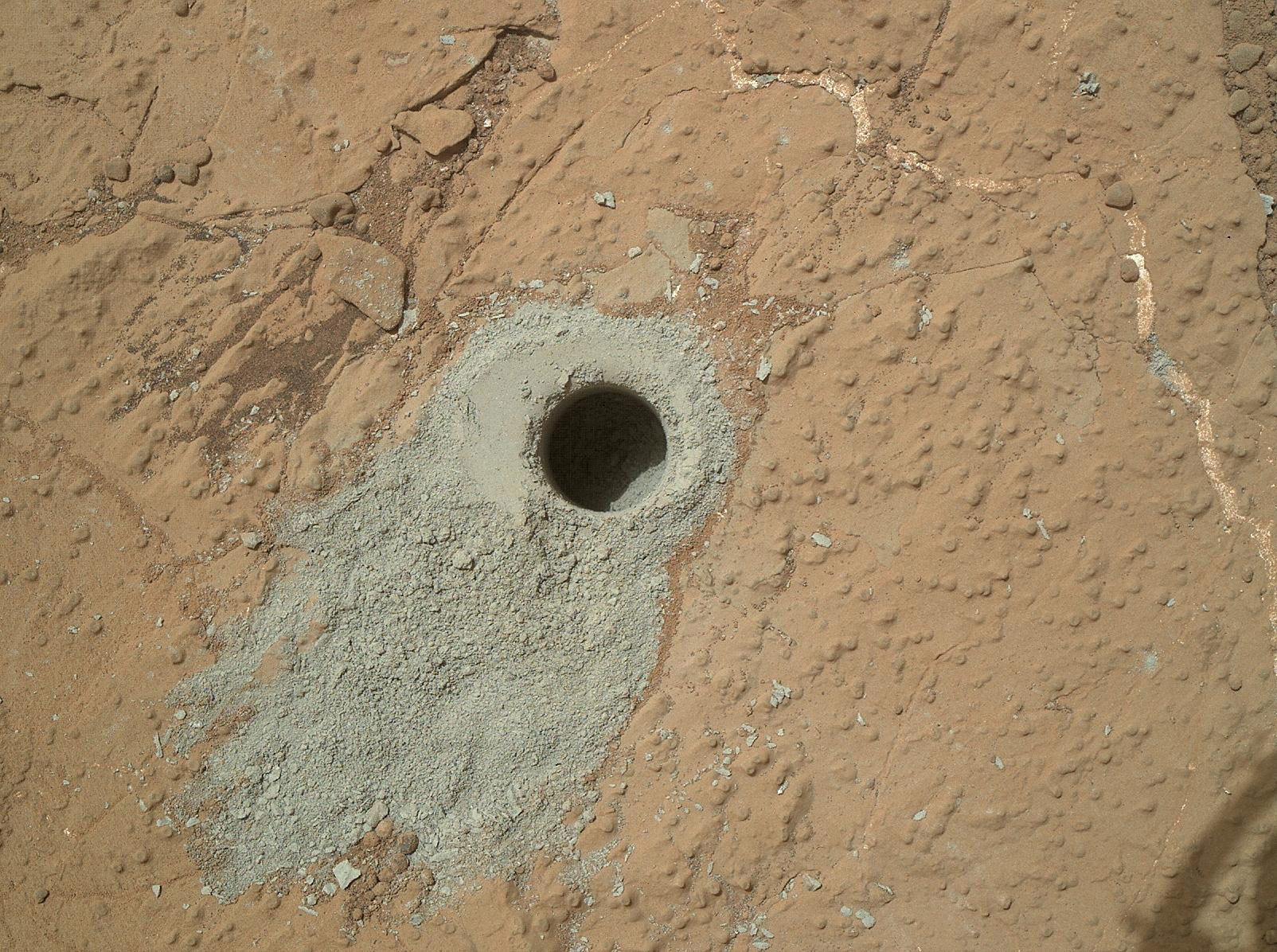
    NASA’s Mars rover Curiosity drilled into this rock target, “Cumberland,” during the 279th Martian day, or sol, of the rover’s work on Mars (May 19, 2013) and collected a powdered sample of material from the rock’s interior. Credit: NASA/JPL-Caltech/MSSS

    NASA’s Curiosity rover has completed the drilling of the second rock sample on Mars and should deliver portions of the sample in coming days to laboratory instruments inside the rover.

    NASA’s Mars rover Curiosity has used the drill on its robotic arm to collect a powdered sample from the interior of a rock called “Cumberland.”

    Plans call for delivering portions of the sample in coming days to laboratory instruments inside the rover. This is only the second time that a sample has been collected from inside a rock on Mars. The first was Curiosity’s drilling at a target called “John Klein” three months ago. Cumberland resembles John Klein and lies about nine feet (2.75 meters) farther west. Both are within a shallow depression called “Yellowknife Bay.”
    Curiosity Drills into Second Target on Mars
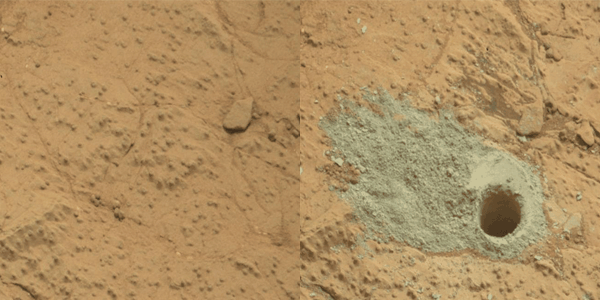
    This pair of images from the Mars Hand Lens Imager (MAHLI) on NASA’s Mars rover Curiosity shows the rock target “Cumberland” before and after Curiosity drilled into it to collect a sample for analysis. The diameter of the drilled hole is about 0.6 inch (1.6 centimeters). Credit: NASA/JPL-Caltech/MSSS

    The hole that Curiosity drilled into Cumberland on May 19 is about 0.6 inch (1.6 centimeters) in diameter and about 2.6 inches (6.6 centimeters) deep.

    The science team expects to use analysis of material from Cumberland to check findings from John Klein. Preliminary findings from analysis of John Klein rock powder by Curiosity’s onboard laboratory instruments indicate that the location long ago had environmental conditions favorable for microbial life. The favorable conditions included the key elemental ingredients for life, an energy gradient that could be exploited by microbes, and water that was not harshly acidic or briny.

    NASA’s Mars Science Laboratory Project is using Curiosity to assess the history of habitable environmental conditions inside Gale Crater. After a few more high-priority observations by the rover within and near Yellowknife Bay, the rover team plans to start Curiosity on a months-long trek to the base of a layered mound, Mount Sharp, at the middle of the crater. JPL, a division of the California Institute of Technology in Pasadena, manages the project for NASA’s Science Mission Directorate in Washington.

    Never miss a breakthrough: Join the SciTechDaily newsletter.
    Follow us on Google and Google News.

    Astronomy Curiosity Rover JPL Mars NASA Planetary Science
    Share. Facebook Twitter Pinterest LinkedIn Email Reddit

    Related Articles

    Mineralogy of Martian Soil Is Similar to Soils of Volcanic Origin in Hawaii

    Curiosity Rover Photographs Diverse Rocks

    Curiosity Prepares to Take Its First Scoop of Soil for Analysis

    Curiosity Finds Ancient Streambed on Mars

    NASA’s Curiosity Prepares for Use of Its Arm and Tools

    Curiosity Sends Back Radioed Words and New Telephoto View of Mars

    NASA’s Curiosity Readies for First Drive on Mars

    Color HiRISE Image of Curiosity Rover on Mars

    First 360-Degree Color Panorama From NASA’s Curiosity Mars Rover

    Leave A Reply Cancel Reply

    • Facebook
    • Twitter
    • Pinterest
    • YouTube

    Don't Miss a Discovery

    Subscribe for the Latest in Science & Tech!

    Trending News

    “I Couldn’t Do It Anymore” – Antarctic Guides Quit Their Dream Jobs After Witnessing Tourism’s Damage

    Scientists Say Eating Less Protein May Help You Live Longer

    Scientists Solve a Long-Standing Mystery About Bird and Dinosaur Eggs

    Belly Fat and Low Vitamin D May More Than Double the Risk of Early Death

    Lost in Space: Rare Cosmic Flare Exposes a Wandering Black Hole Far From Its Galaxy’s Center

    Dark Matter May Be Leaving a Signal in Earth’s Atmosphere

    Scientists Discover a 300-Million-Year-Old Geological Time Capsule Inside Fossilized Wood

    Oral Weight Loss Pill Helps Patients Lose up to 12% of Body Weight

    Follow SciTechDaily
    • Facebook
    • Twitter
    • YouTube
    • Pinterest
    • Newsletter
    • RSS
    SciTech News
    • Biology News
    • Chemistry News
    • Earth News
    • Health News
    • Physics News
    • Science News
    • Space News
    • Technology News
    Recent Posts
    • Industrial Chicken Farming Is Supercharging the Spread of a Dangerous Foodborne Bacterium
    • Honeybee Queens May Pass Toxic Chemicals to the Next Generation
    • This Common Amino Acid May Help the Body Fight Cancer and Viruses
    • Schizophrenia’s Brain Damage May Start in One Key Region
    • A Simple Treatment Could Save Extremely Premature Babies From Blindness
    Copyright © 1998 - 2026 SciTechDaily. All Rights Reserved.
    • Science News
    • About
    • Contact
    • Editorial Board
    • Privacy Policy
    • Terms of Use

    Type above and press Enter to search. Press Esc to cancel.