
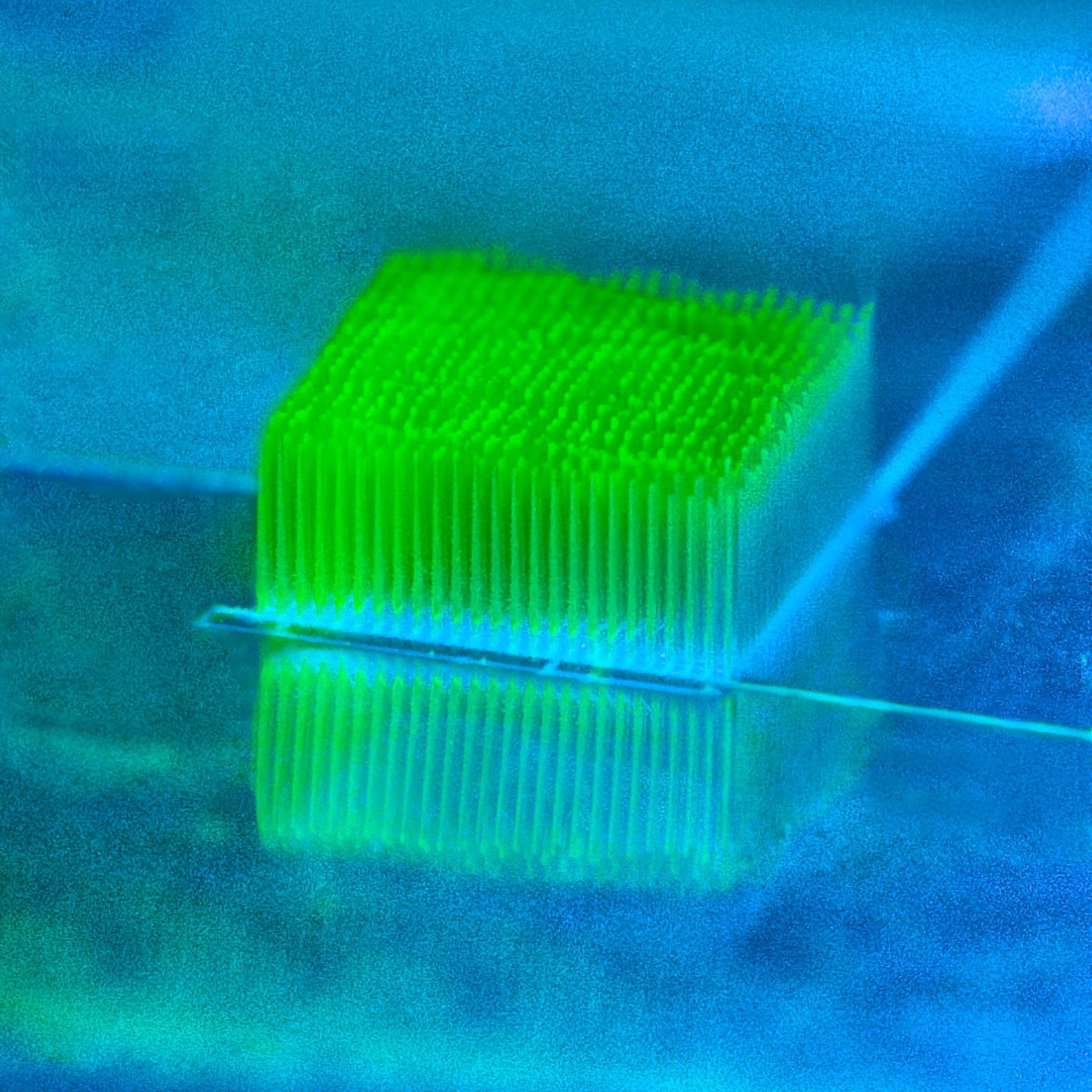
Researchers have made tiny ‘skyscrapers’ for communities of bacteria, helping them to generate electricity from just sunlight and water.
The researchers, from the University of Cambridge, used 3D printing to create grids of high-rise ‘nano-housing’ where sun-loving bacteria can grow quickly. The researchers were then able to extract the bacteria’s waste electrons, left over from photosynthesis, which could be used to power small electronics.
Other research teams have extracted energy from photosynthetic bacteria, but the Cambridge researchers have found that providing them with the right kind of home increases the amount of energy they can extract by over an order of magnitude. The approach is competitive against traditional methods of renewable bioenergy generation and has already reached solar conversion efficiencies that can outcompete many current methods of biofuel generation.
Their results, reported in the journal Nature Materials, open new avenues in bioenergy generation and suggest that ‘biohybrid’ sources of solar energy could be an important component in the zero-carbon energy mix.
Current renewable technologies, such as silicon-based solar cells and biofuels, are far superior to fossil fuels in terms of carbon emissions, but they also have limitations, such as a reliance on mining, challenges in recycling, and a reliance on farming and land use, which results in biodiversity loss.
“Our approach is a step towards making even more sustainable renewable energy devices for the future,” said Dr. Jenny Zhang from the Yusuf Hamied Department of Chemistry, who led the research.
Zhang and her colleagues from the Department of Biochemistry and the Department of Materials Science and Metallurgy are working to rethink bioenergy into something that is sustainable and scalable.
Photosynthetic bacteria, or cyanobacteria, are the most abundant life form on Earth. For several years, researchers have been attempting to ‘re-wire’ the photosynthesis mechanisms of cyanobacteria in order to extract energy from them.
“There’s been a bottleneck in terms of how much energy you can actually extract from photosynthetic systems, but no one understood where the bottleneck was,” said Zhang. “Most scientists assumed that the bottleneck was on the biological side, in the bacteria, but we’ve found that a substantial bottleneck is actually on the material side.”
In order to grow, cyanobacteria need lots of sunlight – like the surface of a lake in the summertime. And in order to extract the energy they produce through photosynthesis, the bacteria need to be attached to electrodes.
Custom Electrodes Boost Energy Extraction
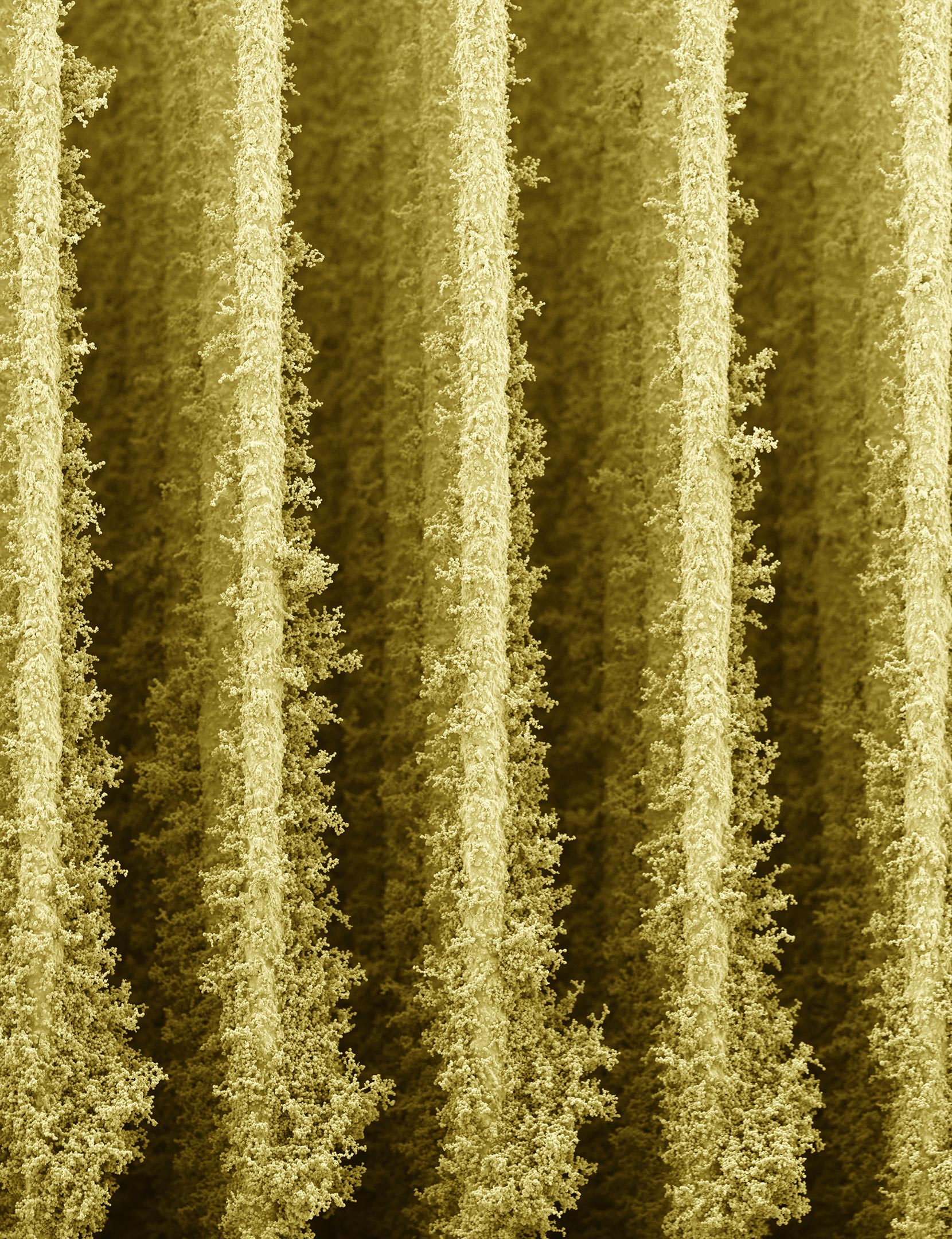
The Cambridge team 3D-printed custom electrodes out of metal oxide nanoparticles that are tailored to work with the cyanobacteria as they perform photosynthesis. The electrodes were printed as highly branched, densely packed pillar structures, like a tiny city.
Zhang’s team developed a printing technique that allows control over multiple length scales, making the structures highly customizable, which could benefit a wide range of fields.
“The electrodes have excellent light-handling properties, like a high-rise apartment with lots of windows,” said Zhang. “Cyanobacteria need something they can attach to and form a community with their neighbors. Our electrodes allow for a balance between lots of surface area and lots of light – like a glass skyscraper.”
Breakthrough in Biohybrid Solar Energy Generation
Once the self-assembling cyanobacteria were in their new ‘wired’ home, the researchers found that they were more efficient than other current bioenergy technologies, such as biofuels. The technique increased the amount of energy extracted by over an order of magnitude over other methods for producing bioenergy from photosynthesis.
“I was surprised we were able to achieve the numbers we did – similar numbers have been predicted for many years, but this is the first time that these numbers have been shown experimentally,” said Zhang. “Cyanobacteria are versatile chemical factories. Our approach allows us to tap into their energy conversion pathway at an early point, which helps us understand how they carry out energy conversion so we can use their natural pathways for renewable fuel or chemical generation.”
Reference: “3D-printed hierarchical pillar array electrodes for high performance semi-artificial photosynthesis” by Xiaolong Chen, Joshua M. Lawrence, Laura T. Wey, Lukas Schertel, Qingshen Jing, Silvia Vignolini, Christopher J. Howe, Sohini Kar-Narayan and Jenny Z. Zhang, 7 March 2022, Nature Materials.
DOI: 10.1038/s41563-022-01205-5
The research was supported in part by the Biotechnology and Biological Sciences Research Council, the Cambridge Trust, the Isaac Newton Trust and the European Research Council. Jenny Zhang is BBSRC David Phillips Fellow in the Department of Chemistry, and a Fellow of Corpus Christi College, Cambridge.
Never miss a breakthrough: Join the SciTechDaily newsletter.
Follow us on Google and Google News.
2 Comments
Don’t bacteria create CO2 during respiration and eventual decay? Is this any better than burning gas or coal?
g