
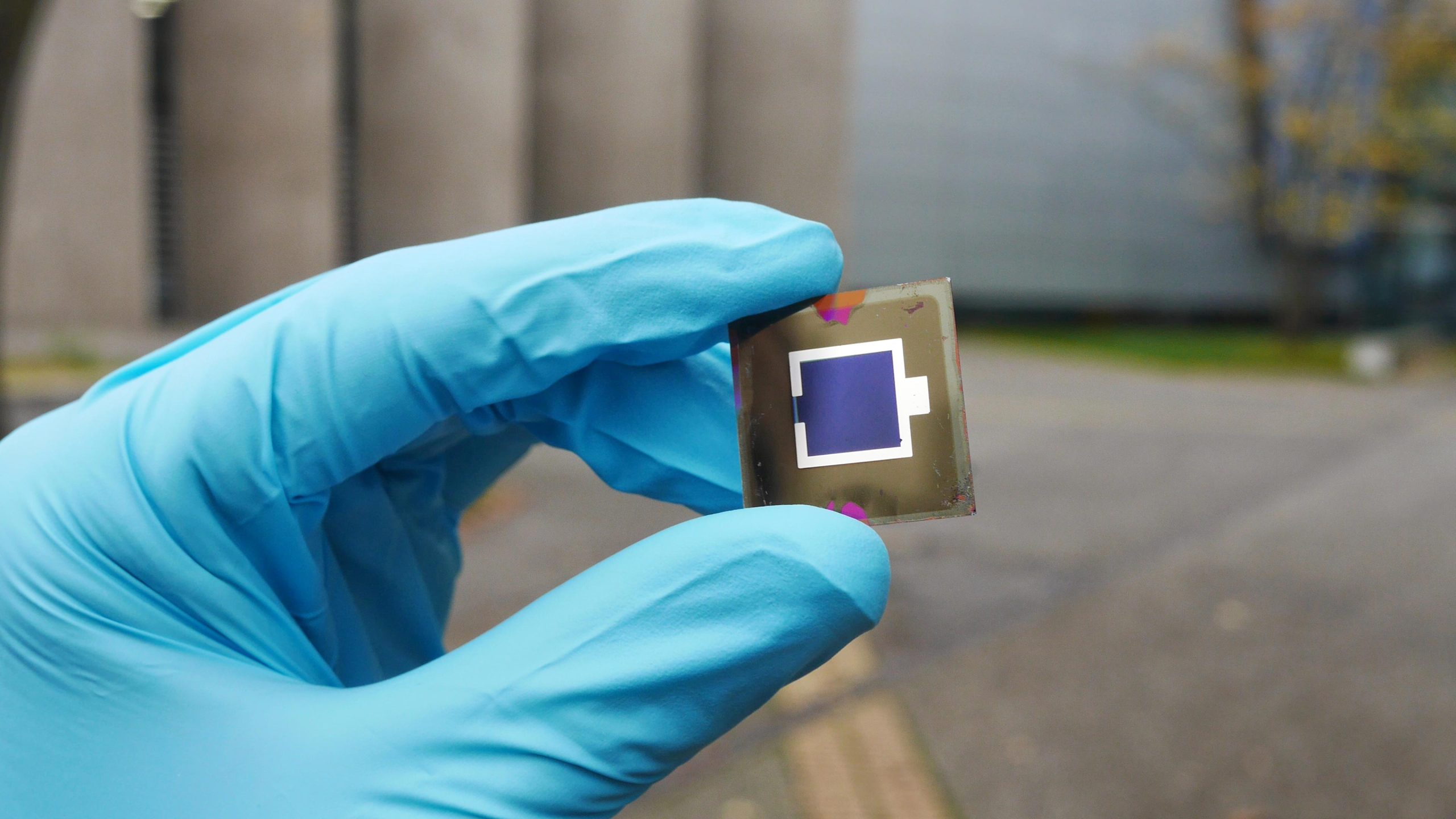
Three HZB teams led by Prof. Christiane Becker, Prof. Bernd Stannowski and Prof. Steve Albrecht have jointly managed to increase the efficiency of perovskite silicon tandem solar cells fabricated completely at HZB to a new record value of 29.80 %. The value has now been officially certified and is documented in the NREL-charts. This brings the 30 percent mark within reach.
Today’s solar modules are mainly made of silicon, and possibilities for further increases in efficiency have already been largely exploited. But since 2008, the material class of “metal halide perovskites” has moved into the focus of research: these semiconductor compounds convert sunlight into electrical energy very well and still offer a lot of room for improvement. In particular, they can be combined with silicon solar cells to tandem solar cells that use sunlight much more efficiently.
A Race for Records
At HZB, several groups have been working intensively since 2015 on both the perovskite semiconductors and silicon technologies and the combination of both into innovative tandem solar cells. In January 2020, HZB had achieved a record 29.15 % for a perovskite silicon tandem solar cell and published the work in the journal Science. Then, before Christmas 2020, the company Oxford PV was able to announce a certified efficiency of 29.52 %. Since then, the exciting race for new records has been on. “An efficiency of 30 % is like a psychological threshold for this fascinating new technology which could revolutionize the photovoltaic industry in the near future,” explains Steve Albrecht, who is working on perovskite thin films at the HySPRINT lab at HZB. Bernd Stannowski, group leader for silicon technology, adds: “I would particularly emphasize the good cooperation between the different groups and institutes at HZB. This is how we managed to develop these new tandem solar cells entirely at HZB and once again get the world record.”

Official Certification
The recent research and development focus was on the optical improvement of the silicon heterojunction bottom cell. A nanotextured front side and a dielectric back reflector were added. Now came the official confirmation by Fraunhofer ISE CalLab: “Our new perovskite silicon tandem solar cells were independently certified with a world record efficiency of 29.80 %,” says a delighted Christiane Becker, an expert on nanostructures in solar cells and their effects on the optical and electrical properties.
Nanotextured Silicon
For the new work, Dr. Philipp Tockhorn (Albrecht group) and doctoral student Johannes Sutter (Becker group) investigated how nanostructures at different interfaces affect the performance of a tandem solar cell, consisting of a perovskite solar cell on top of a silicon solar cell. First, they used a computer simulation to calculate the photocurrent density in the perovskite and silicon subcells for different geometries with and without nanotextures. Then they produced perovskite silicon tandem solar cells with different textures: “Even the nanotexturing on one side improves the light absorption and enables a higher photocurrent compared to a flat reference,” says Sutter. And his colleague Tockhorn adds: “Remarkably, the nanotextures also lead to a slight improvement in the electronic quality of the tandem solar cell and to better film formation of the perovskite layers.”
Dielectric Feflector
Improvements were also made to the back side of the tandem solar cell, which is designed to reflect infrared light back into the silicon absorber. “By using a dielectric reflector, we were able to use this part of the sunlight more efficiently, resulting in a higher photocurrent,” says Dr. Alexandros Cruz Bournazou (Stannowski group).
Outlook Is Bright
The results pave the way for further improvements. The simulations suggest that the performance could be increased even further by nanostructuring the absorber layers on both sides. The researchers are convinced that an efficiency of well over 30 % could be achievable soon. The race is on.
Reference: “Monolithic perovskite/silicon tandem solar cell with >29% efficiency by enhanced hole extraction” by Amran Al-Ashouri, Eike Köhnen, Bor Li, Artiom Magomedov, Hannes Hempel, Pietro Caprioglio, José A. Márquez, Anna Belen Morales Vilches, Ernestas Kasparavicius, Joel A. Smith, Nga Phung, Dorothee Menzel, Max Grischek, Lukas Kegelmann, Dieter Skroblin, Christian Gollwitzer, Tadas Malinauskas, Marko Jošt, Gašper Matic, Bernd Rech, Rutger Schlatmann, Marko Topic, Lars Korte, Antonio Abate, Bernd Stannowski, Dieter Neher, Martin Stolterfoht, Thomas Unold, Vytautas Getautis and Steve Albrecht, 11 December 2021, Science.
DOI: 10.1126/science.abd4016
Never miss a breakthrough: Join the SciTechDaily newsletter.
Follow us on Google and Google News.
7 Comments
Ok, the new standard will apparently be 30%. Wouldn’t this be a great article to mention what the existing standard is.
I’m waiting for a photovoltaic cell that’s 101% efficient.
Excellent!
NREL may not benchmark cells on noise reduction, shading tolerance and even amplifier gain, but if those ratings get popular, they might better. Panels that immediately answer ‘is this cool’ TBA.
Excellent work. Few concerns:-
1. By what date is Commercial production going to start?
2. What is the life & lifetime efficiency level Estimate?
3. What is the cost per watt?
4. What is the Fragility index when fitted in panel?
Here you go Sue:
https://www.engadget.com/2011-12-19-scientists-create-first-solar-cell-with-over-100-percent-quantum.html
Now if they’ll just ” murder” those cells with some matte black paint & roll ’em on 22’s they’ll get waaaay past 30%🤪