
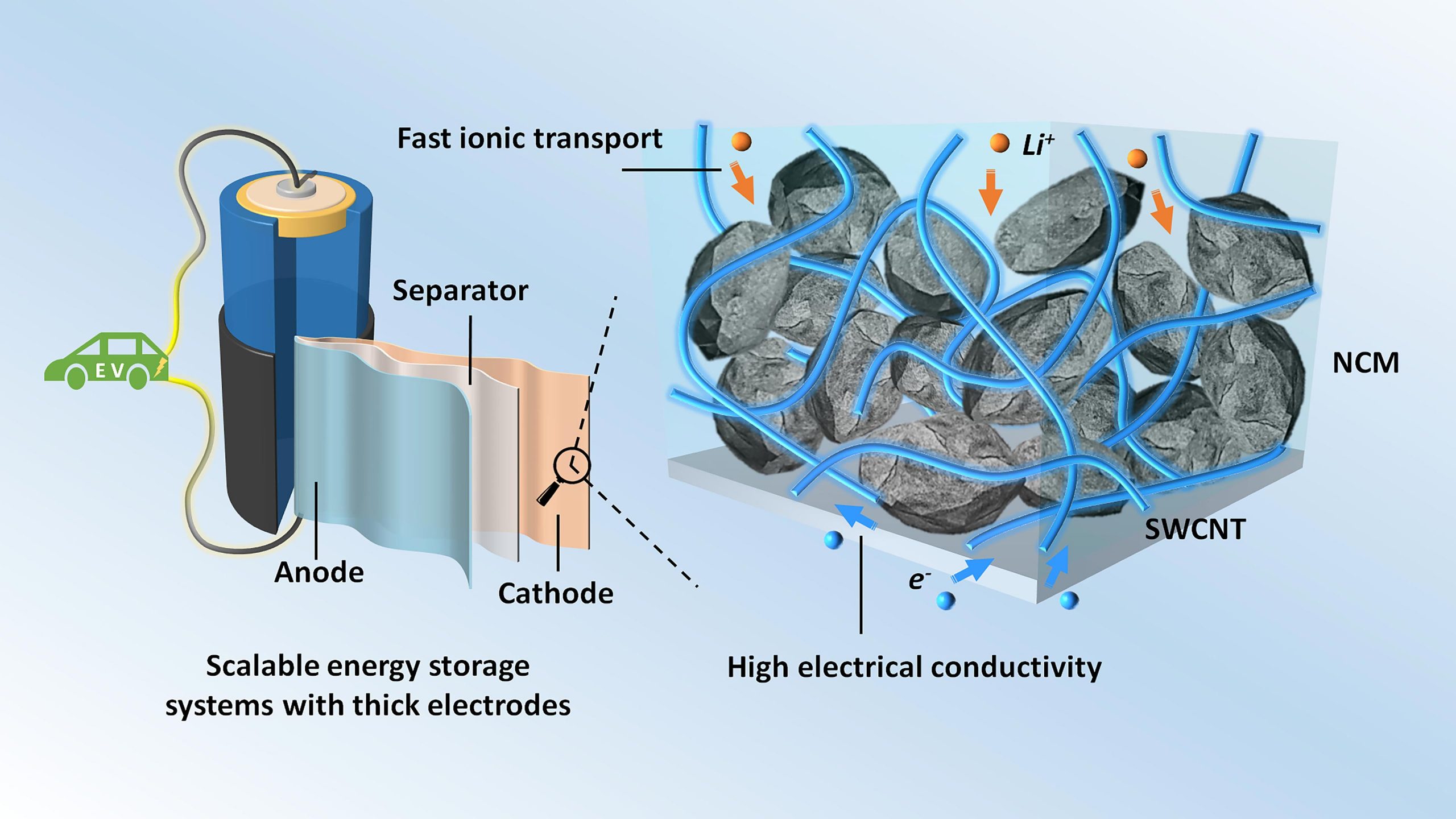
Conductive carbon fillers in lithium-ion batteries allow high power output with reversible energy storage.
Lithium-ion batteries are the major rechargeable power source for many portable devices as well as electric vehicles, but their use is limited, because they do not provide high power output while simultaneously allowing reversible energy storage. Research reported in Applied Physics Reviews, by AIP Publishing, aims to offer a solution by showing how the inclusion of conductive fillers improves battery performance.
The optimum battery design involves thick electrode structures. This enhances the energy density, but the design suffers from poor lithium-ion transport, a key step in the functioning of these electrodes. Various improvement techniques have been tried, including building vertically aligned channels or creating pores of the proper size to facilitate transport of the lithium ions.
Another approach involves the use of fillers made of carbon that conduct electricity. This study considered three types of fillers: single-walled carbon nanotubes (SWCNTs), graphene nanosheets, and a substance known as Super P, a type of carbon black particles produced during oxidation of petroleum precursors. Super P is the most commonly used conductive filler in lithium-ion batteries.
The fillers were added to a type of electrode material known as NCM that contains nickel, cobalt, and manganese. The investigators examined the resulting composites with scanning electron microscopy. The Super P and NCM particles were found to be arranged in a point-to-point contact mode.
The SWCNTs were, however, wrapped around the NCM particles, forming a conductive coating. In addition, networks of interconnected SWCNTs were observed in the spaces between NCM particles. The graphene nanosheets were also wrapped around the NCM electrode particles but not as uniformly as the SWCNTs were.
The SWCNTs were found to be the best conductive filler for NCM electrodes.
“The measured conductivity is consistent with percolation theory … When an electrically conductive filler is added to an insulating matrix, significant increases in conductivity will occur once the first conducting pathway through the composite is formed,” said Guihua Yu, one of the authors.
Since percolation requires a complete pathway through the filler, a sufficient amount of conductive filler is needed. Therefore, the investigators considered various amounts of filler and found that combining NCM electrodes with as little as 0.16% by weight of SWCNT produced good electrical conductivity. Higher amounts of Super P and graphene were required to achieve these same results.
The investigators used several spectroscopic techniques, including Raman and X-ray absorption spectroscopy, to study the resulting composites.
“This is a collaborative effort from the Center for Mesoscale Transport Properties, an Energy Frontier Research Center supported by the U.S. Department of Energy Basic Energy Sciences program. Our findings suggest that the integration of SWCNTs into the NCM electrode facilitates ion and charge transfer. This will lead to higher electrochemical utilization, especially at high rates of discharge,” Yu said.
Reference: “Unveiling the dimensionality effect of conductive fillers in thick battery electrodes for high-energy storage systems featured” by Zhengyu Ju, Xiao Zhang, Steven T. King, Calvin D. Quilty, Yue Zhu, Kenneth J. Takeuchi, Esther S. Takeuchi, David C. Bock, Lei Wang, Amy C. Marschilok and Guihua Yu, 10 November 2020, Applied Physics Reviews.
DOI: 10.1063/5.0024123
Never miss a breakthrough: Join the SciTechDaily newsletter.
Follow us on Google and Google News.