
What Is Atmospheric Radiation?
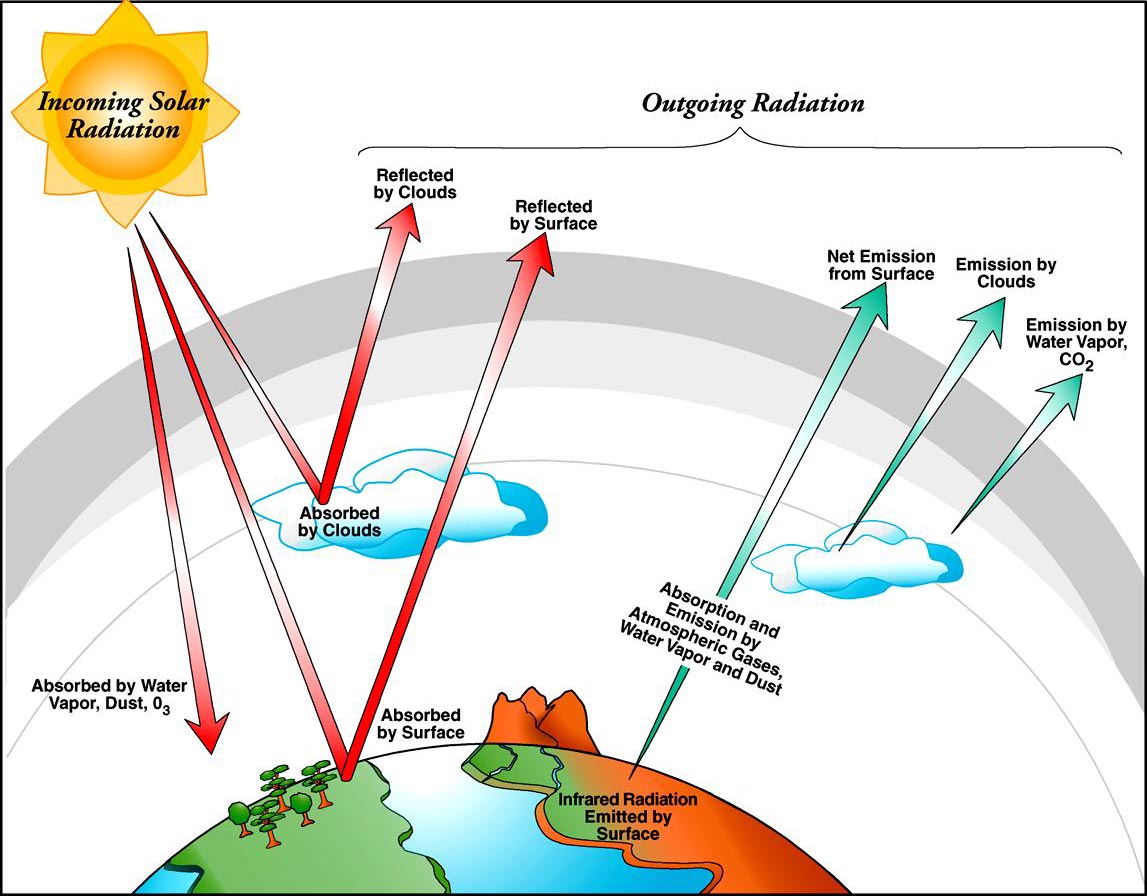
Atmospheric radiation is the flow of electromagnetic energy between the sun and the Earth’s surface as it is influenced by clouds, aerosols, and gases in the Earth’s atmosphere. It includes both solar radiation (sunlight) and long-wave (thermal) radiation. Several factors influence the amount of solar radiation reaching the Earth’s surface and the amount of radiation leaving the Earth’s atmosphere. These factors include atmospheric elements such as cloud droplets, humidity, temperature, atmospheric gases, aerosol particles, and even the characteristics of land and ocean surfaces. Atmospheric radiation is critically important to understand because it affects both weather (for example, heating of the land surface by sunlight drives the formation of convective clouds) and climate (for example, long term changes in the amount of radiation reflected or absorbed by aerosols, clouds, or gases may change temperature or precipitation patterns).
Atmospheric Radiation Facts
- The DOE ARM facility has been collecting atmospheric data for over 25 years, using three fixed and three mobile facilities.
- The DOE ARM user facility has made detailed measurements of atmospheric properties and radiation on every continent (including on the ice sheets of Antarctica), on ships at sea (including the middle of the Arctic Ocean), and at numerous sites across the United States.
- Complex interactions between drizzle, radiation, and turbulence are important to the evolution of stratocumulus clouds.
- Impacts of cloud droplets as well as aerosol particles on atmospheric radiation are significant and depend on the details of the particle sizes, physical shapes, and chemical characteristics.
DOE Office of Science: Contributions to Atmospheric Radiation Measurements
The DOE Office of Science’s Atmospheric Radiation Measurement (ARM) user facility operates six major observational sites around the world to study variability of the atmospheric energy budget. These sites have radars, lidars, and other specialized instruments that together measure atmospheric properties and the atmospheric radiation reaching and leaving the Earth’s surface. They measure more than 100 variables including air temperature and humidity profiles, aerosol physics and chemistry, solar and longwave radiation, cloud properties, carbon dioxide, ozone, soil moisture, precipitation, and even details of wind fluctuations. ARM also uses aircraft and tethered balloons to measure details not observable from the ground, such as the size, number, and composition of aerosol and cloud particles in the atmosphere. The ground-based instruments operate 24 hours a day, 7 days a week, to fully sample daily and annual cycles of atmospheric properties and radiation.
Founded in 1989, ARM was the first large-scale facility to use a broad suite of instruments to continually measure cloud and aerosol properties and their effects on Earth’s energy balance. The science generated by the analysis of ARM data has been game changing. It is now a model for programs around the world. Because ARM is today the most sophisticated facility for improving scientific understanding of the physical properties of the atmosphere, scientists around the world use ARM data to improve numerical models of weather and climate to improve the safety and livelihoods of people worldwide. This research effort contributes to the Department of Energy’s mission of addressing energy and environmental challenges.
Never miss a breakthrough: Join the SciTechDaily newsletter.
Follow us on Google and Google News.