
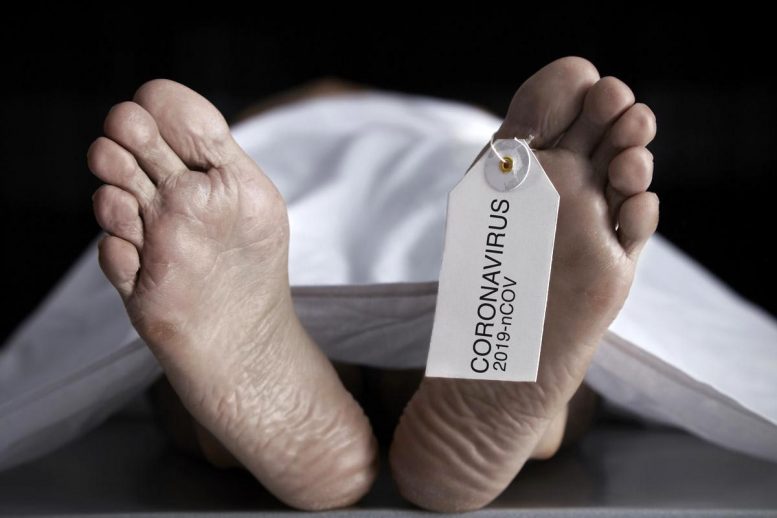
A Dartmouth study reveals COVID-19 death risk grows exponentially with age, especially impacting middle-aged and older adults.
COVID-19 has been spreading rapidly over the past several months, and the U.S. death toll has now reached 400,000. As evident from the age distribution of those fatalities, COVID-19 is dangerous not only for the elderly but for middle-aged adults, according to a Dartmouth-led study published in the European Journal of Epidemiology.
“For a person who is middle-aged, the risk of dying from COVID-19 is about 100 times greater than dying from an automobile accident,” explains lead author Andrew Levin, a professor of economics at Dartmouth College. “Generally speaking, very few children and young adults die of COVID-19. However, the risk is progressively greater for middle-aged and older adults. The odds that an infection becomes fatal is only 1:10,000 at age 25, whereas those odds are roughly 1:100 at age 60, 1:40 at age 70, and 1:10 at age 80.”
An Exponential Relationship Between Age and Risk
These findings represent the culmination of a systematic review of all available studies of COVID-19 prevalence in countries with advanced economies; this review encompassed more than 1,000 research papers and government documents disseminated prior to September 18, 2020. The research team identified 27 studies where the survey design was representative of the general population, covering 34 geographical locations in the U.S., Canada, Asia, and Europe. Using those prevalence data, the researchers investigated the age-specific ratio of COVID-19 fatalities to infections and found a very clear exponential relationship.
An initial version of this study was posted online in July 2020 as an NBER Working Paper and was regularly updated on the medRxiv preprint server prior to being published as an open-access article in the European Journal of Epidemiology. The findings remain highly relevant as the total number of COVID-19 deaths in the U.S. continues to climb. “Our findings are consistent with the CDC’s Weekly Updates by Select Demographic and Geographic Characteristics, which report on COVID-19 deaths by age group,” says Levin. “Nearly 40 percent of U.S. COVID-19 deaths have occurred among those ages 45 to 74 years, while almost 60 percent have occurred among those over 75 years old. By contrast, children and young adults (less than 45 years old) account for less than 3 percent of U.S. COVID-19 deaths.”
Levin also emphasized the urgent practical implications of his team’s research findings. “While COVID-19 vaccines are now being distributed, several more months are likely to pass before these vaccines have been fully disseminated to the public,” says Levin. “We need get through this period as safely as possible. Taking basic precautions–including wearing a mask, practicing social distancing, and washing your hands often–is critical to protecting yourself, family, friends, and community members from this very deadly disease.”
Reference: “Assessing the age specificity of infection fatality rates for COVID-19: systematic review, meta-analysis, and public policy implications” by Andrew T. Levin, William P. Hanage, Nana Owusu-Boaitey, Kensington B. Cochran, Seamus P. Walsh and Gideon Meyerowitz-Katz, 8 December 2020, European Journal of Epidemiology.
DOI: 10.1007/s10654-020-00698-1
The study was co-authored by William P. Hanage at the Harvard T.H. Chan School of Public Health, Nana Owusu-Boaitey at Case Western Reserve University School of Medicine, Gideon Meyerowitz-Katz at the University of Wollongong, and recent Dartmouth graduates Kensington B. Cochran ’20 and Seamus P. Walsh ’20.
Never miss a breakthrough: Join the SciTechDaily newsletter.
Follow us on Google and Google News.