
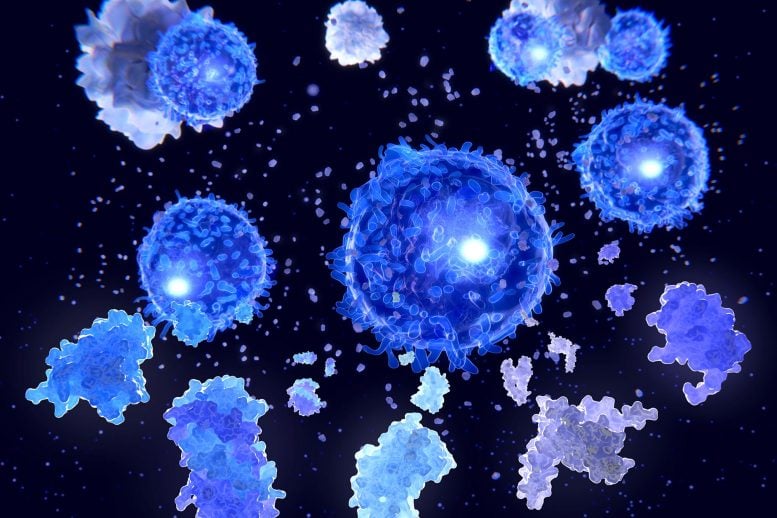
Inflammatory immune response can cause T cells to become depleted, affecting patient outcomes in coronavirus cases and leaving them prone to secondary infection.
Cytokine storms may affect the severity of COVID-19 cases by lowering T cell counts, according to a new study published in Frontiers in Immunology. Researchers studying coronavirus cases in China found that sick patients had a significantly low number of T cells, a type of white blood cell that plays a crucial role in immune response, and that T cell counts were negatively correlated with case severity.
Interestingly, they also found a high concentration of cytokines, a protein that normally helps fight off infection. Too many cytokines can trigger an excessive inflammatory response known as a cytokine storm, which causes the proteins to attack healthy cells. The study suggests that coronavirus does not attack T cells directly, but rather triggers the cytokine release, which then drives the depletion and exhaustion of T cells.
The findings offer clues on how to target treatment for COVID-19, which has become a worldwide pandemic and a widespread threat to human health in the past few months. “We should pay more attention to T cell counts and their function, rather than respiratory function of patients,” says author Dr. Yongwen Chen of Third Military Medical University in China, adding that “more urgent, early intervention may be required in patients with low T lymphocyte counts.”
Chen says he and his co-authors became interested in examining T cells when they noticed that many of the patients they treated for COVID-19 had abnormally low numbers of lymphocytes, a type of white blood cell that includes T cells. “Considering T cells’ central role of response against viral infections, especially in the early stage when antibodies are not boosted yet, we took the T cells as our focal point,” says Chen.
Authors examined 522 patients with coronavirus along with 40 healthy controls. All patients studied were admitted to two hospitals in Wuhan, China between December 2019 and January 2020, and ages ranged between 5 days and 97 years old. Of the 499 patients who had their lymphocytes recorded, 76% had significantly low total T cell counts. ICU patients had significantly lower T cell counts compared with non-ICU cases, and patients over the age of 60 had the lowest number of T cells.
Importantly, the T cells that did survive were exhausted and could not function at full capacity. Not only does this have implications for COVID-19 patient outcomes, but T cell exhaustion leaves patients more vulnerable to secondary infection and calls for scrupulous care.
Chen says that future research should focus on finding finer subpopulations of T cells in order to discover their vulnerability and effect in disease, along with identifying drugs that recover T cell numbers and boost function.
Authors say that Tocilizumab is an existing drug that may be effective, but that it needs to be investigated in the context of coronavirus. Antiviral treatments, such as Remdesivir, may also prevent the progression of T cell exhaustion, but all future treatments will require further study.
In the meantime, this new research deepens our understanding of how the novel coronavirus affects the body and it indicates ways to lessen its impact.
Reference: “Reduction and Functional Exhaustion of T Cells in Patients With Coronavirus Disease 2019 (COVID-19)” by Bo Diao, Chenhui Wang, Yingjun Tan, Xiewan Chen, Ying Liu, Lifen Ning, Li Chen, Min Li, Yueping Liu, Gang Wang, Zilin Yuan, Zeqing Feng, Yi Zhang, Yuzhang Wu and Yongwen Chen, 1 May 2020, Frontiers in Immunology.
DOI: 10.3389/fimmu.2020.00827
Never miss a breakthrough: Join the SciTechDaily newsletter.
Follow us on Google and Google News.