
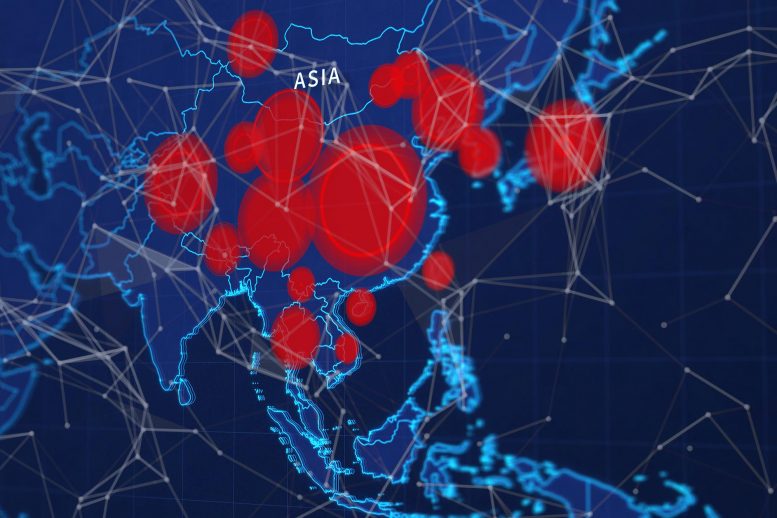
Yale University researchers and colleagues in Hong Kong and China have developed an approach for rapidly tracking population flows that could help policymakers worldwide more effectively assess the risk of disease spread and allocate limited resources as they combat the COVID-19 pandemic.
The approach, described in a study published early online on April 29 in the journal Nature, differs from existing epidemiological models by exploiting real-time data about population flows, such as phone use data and other “big data” sources that can accurately quantify the movement of people.
“This work shows that it is possible to very accurately forecast the timing, intensity, and geographic distribution of the COVID-19 outbreak based on population movement alone,” said Yale’s Nicholas A. Christakis, Sterling Professor of Social and Natural Science and a co-author of the study. “Moreover, by tracking population flows in real time, our model can provide policymakers and epidemiologists a powerful tool to limit an epidemic’s impact and save lives.”
In developing the model, the researchers used nationwide mobile-phone geo-location data to track about 11.5 million occasions of people transiting through Wuhan, a prefecture city in China’s Hubei Province, between January 1 and January 24, 2020 — a period covering the run-up to the Chinese Lunar New Year and the annual chunyun mass migration in China. People moved through Wuhan to 296 prefectures in 31 provinces and regions throughout the country. The researchers linked the population-flow data, which was provided by a major national wireless telecommunications carrier, to COVID-19 infection counts, provided by the Chinese Center for Disease Control and Prevention (Chinese CDC), by location and time at the prefecture level.
Their analysis demonstrates the effectiveness of the quarantine imposed on Wuhan on January 23. By the end of the day on January 24, movement out of the city had almost completely ceased, according to their findings.
The researchers found that the distribution of people leaving Wuhan accurately predicted the relative frequency of subsequent COVID-19 infections across China through February 19, 2020. Researchers also developed a “risk source” model that leveraged population flow data to accurately forecast confirmed cases and identify places at risk of high transmission rates during the outbreak’s early stages.
Their analysis also corroborates the data released by the Chinese CDC through February 19 (for the prefectures outside of Wuhan itself) because it shows that a totally independent source of information — the telecom carrier — is very well correlated with official COVID-19 case counts.
“If there are more confirmed cases than expected ones, there is a higher risk of community spread. If there are fewer expected cases than reported, it means that the city’s preventive measures are particularly effective or it can indicate that further investigation by the central authorities is needed to eliminate possible risks from inaccurate measurement,” said Jayson Jia, associate professor of marketing in the Faculty of Business and Economics at the University of Hong Kong, and lead author of the study.
“What is innovative about our approach is that we use misprediction to assess the level of community risk. Our model accurately tells us how many cases we should expect given travel data. We contrast this against the confirmed cases using the logic that what cannot be explained by imported cases and primary transmissions should be community spread,” Jia added.
The new model can be applied using any dataset that accurately captures people’s movements, such as train ticketing or car tolling data, researchers noted, meaning that policymakers worldwide could use it to inform efforts to contain the virus’ spread if data regarding population movements is available.
“People spread contagious diseases when they move,” said Christakis, director of the Yale Institute for Network Science. “By accurately capturing population movements over time, we can predict how a contagion will spread geographically and use data-analytic techniques to help control it before a devastating epidemic erupts or re-erupts.”
Reference: “Population flow drives spatio-temporal distribution of COVID-19 in China” by Jayson S. Jia, Xin Lu, Yun Yuan, Ge Xu, Jianmin Jia and Nicholas A. Christakis, 29 April 2020, Nature.
DOI: 10.1038/s41586-020-2284-y
The study’s other co-authors Xin Lu, the National University of Defense Technology in Changsha, China, and the Karolinska Institutet in Stockholm, Sweden; Yun Yuan, Southwest Jiaotong University; Ge Xu, Hunan University of Technology and Business; and Jianmin Jia, Chinese University of Hong Kong, Shenzhen, and the paper’s corresponding author.
Never miss a breakthrough: Join the SciTechDaily newsletter.
Follow us on Google and Google News.