
Close Menu
    Facebook X (Twitter) Instagram
    SciTechDaily
    • Biology
    • Chemistry
    • Earth
    • Health
    • Physics
    • Science
    • Space
    • Technology
    Facebook X (Twitter) Pinterest YouTube RSS
    SciTechDaily
    Home»Physics»Physicists Guide a Single Ion Through a Bose-Einstein Condensate
    Physics

    Physicists Guide a Single Ion Through a Bose-Einstein Condensate

    By University of StuttgartJanuary 31, 2021No Comments3 Mins Read
    Facebook Twitter Pinterest Telegram LinkedIn WhatsApp Email Reddit
    Share
    Facebook Twitter LinkedIn Pinterest Telegram Email Reddit
    Guide Single Ion Through Bose Einstein Condensate
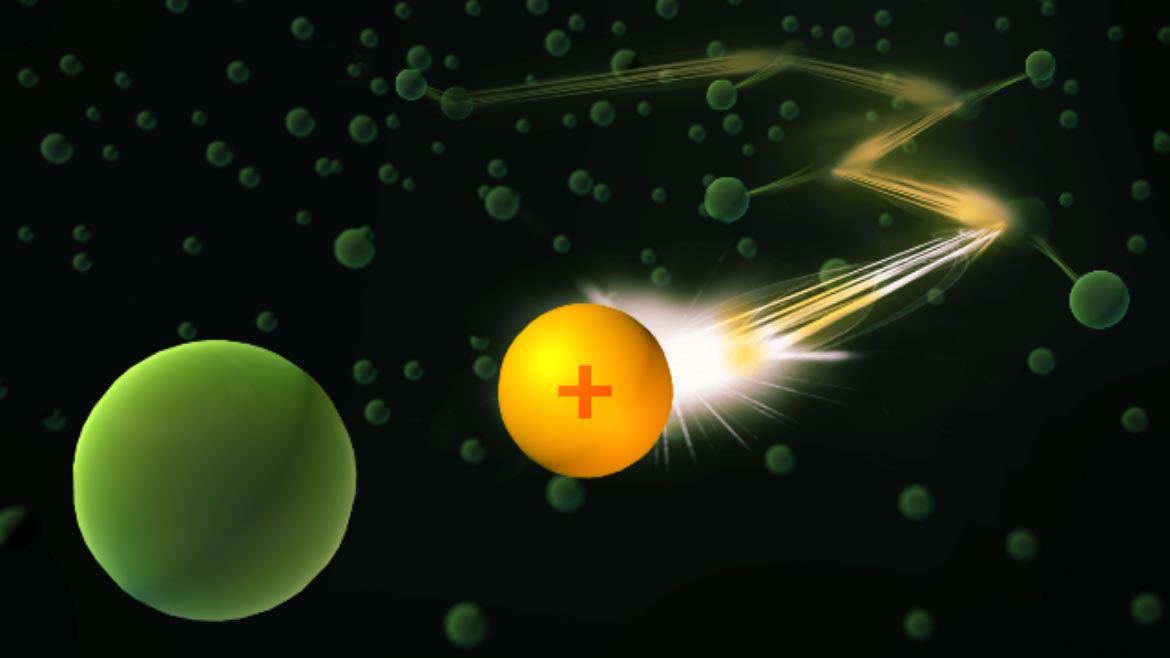
    The trajectory of a positively charged ion (yellow) through the BEC (green) can only be visualized artistically. The ion microscope, which is already being developed at the institute promises to make this path directly visible in the future with a resolution of below 200 nanometers. Credit: Celina Brandes

    Stuttgart physicists have measured the movement of a single ion through a Bose-Einstein condensate, offering new insights into quantum transport and interactions in ultracold matter.

    Transport processes are ubiquitous in nature but still raise many questions. The research team around Florian Meinert from the 5th Institute of Physics at the University of Stuttgart has now developed a new method that allows them to observe a single charged particle on its path through a dense cloud of ultracold atoms. The results were published in the prestigious journal Physical Review Letters and are subject in a Viewpoint of the accompanying popular science journal Physics.

    Meinert‘s team uses a so-called Bose Einstein condensate (BEC) for their experiments. This exotic state of matter consists of a dense cloud of ultracold atoms.  By means of sophisticated laser excitation, the researchers create a single Rydberg atom within the gas.

    In this giant atom, the electron is a thousand times further away from the nucleus than in the ground state and thus only very weakly bound to the core. With a specially designed sequence of electric field pulses, the researchers snatch the electron away from the atom. The formerly neutral atom turns into a positively charged ion that remains nearly at rest despite the process of detaching the electron.

    In a next step, the researchers use precise electric fields to pull the ion in a controlled way through the dense cloud of atoms in the BEC. The ion picks up speed in the electric field, collides on its way with other atoms, slows down and is accelerated again by the electric field. The interplay between acceleration and deceleration by collisions leads to a constant motion of the ion through the BEC.

    First Measurement of Ion Mobility in a BEC

    “This new approach allows us to measure the mobility of a single ion in a Bose Einstein condensate for the very first time,” said Thomas Dieterle, PhD student on the experiment. The researchers’ next goal is to observe collisions between a single ion and atoms at even lower temperatures, where quantum mechanics instead of classical mechanics dictates the processes.

    “In the future, our newly created model system — the transport of a single ion — will allow for a better understanding of more complex transport processes that are relevant in many-body systems, e.g. in certain solids or in superconductors,” said Meinert. These measurements are also an important step on the way to investigate exotic quasi-particles, so-called polarons, which can arise through interaction between atoms and ions.

    The neighboring lab at the institute already works on an ion microscope that will allow to directly observe collisions between atoms and ions. While an electron microscope uses negatively charged particles to create an image, this is what happens in an ion microscope with positively charged ions. Electrostatic lenses deflect ions similar to light rays in a classical optical microscope.

    Reference: “Transport of a Single Cold Ion Immersed in a Bose-Einstein Condensate” by T. Dieterle, M. Berngruber, C. Hölzl, R. Löw, K. Jachymski, T. Pfau and F. Meinert, 19 January 2021, Physical Review Letters.
    DOI: 10.1103/PhysRevLett.126.033401

    Never miss a breakthrough: Join the SciTechDaily newsletter.
    Follow us on Google and Google News.

    Bose-Einstein Condensates Particle Physics
    Share. Facebook Twitter Pinterest LinkedIn Email Reddit

    Related Articles

    ICARUS Experiment Claims Neutrinos Aren’t Faster Than Light

    New Type of Neutrino Oscillation Discovered at Daya Bay

    More Data of Elusive Higgs Boson from Defunct US Tevatron Collider

    Dynamics of a System of Ultracold Potassium Atoms

    Evidence of Elusive Majorana Fermions Raises Possibilities for Quantum Computing

    Possible Mistakes Found in Faster Than Light Neutrino Measurement

    Quantum Entanglement of 8 Photons Successfully Accomplished by Physicists

    Higgs Boson Signals Gain Strength at Large Hadron Collider

    Quantum Physicists Take a Step Forward in Understanding Quantum Inseparability

    Leave A Reply Cancel Reply

    • Facebook
    • Twitter
    • Pinterest
    • YouTube

    Don't Miss a Discovery

    Subscribe for the Latest in Science & Tech!

    Trending News

    This Copper Drug Clears Alzheimer’s Brain Toxins and Boosts Memory

    Adults Over 65 Lost Massive Amounts of Weight With Ozempic

    How Flocking Birds “Defy” One of Physics’ Most Fundamental Laws

    Physicists Create a New Kind of Schrödinger’s Cat State From Exotic Quantum Building Blocks

    Your Diet Could Be Missing the Key Ingredient for Heart Protection

    Researchers Warn Widely Prescribed Blood Pressure Drugs Could Be Harming Diabetic Kidneys

    James Webb Spots Something Strange Between Day and Night on an Alien Planet

    How Ancient People Moved a 6-Ton Stone 700 Kilometers to Stonehenge

    Follow SciTechDaily
    • Facebook
    • Twitter
    • YouTube
    • Pinterest
    • Newsletter
    • RSS
    SciTech News
    • Biology News
    • Chemistry News
    • Earth News
    • Health News
    • Physics News
    • Science News
    • Space News
    • Technology News
    Recent Posts
    • Scientists Uncover Cause of Inflammatory Bowel Disease Solving Decades-Old Mystery
    • The Surprising Reason Swimming Could Be Better for Your Heart Than Running
    • Could Vitamin C Be the Secret to Keeping Your Brain Younger?
    • The Surprising Fix for Robot Traffic Jams
    • Near Absolute Zero, This Transistor Starts Acting Like a Brain Cell
    Copyright © 1998 - 2026 SciTechDaily. All Rights Reserved.
    • Science News
    • About
    • Contact
    • Editorial Board
    • Privacy Policy
    • Terms of Use

    Type above and press Enter to search. Press Esc to cancel.