
Close Menu
    Facebook X (Twitter) Instagram
    SciTechDaily
    • Biology
    • Chemistry
    • Earth
    • Health
    • Physics
    • Science
    • Space
    • Technology
    Facebook X (Twitter) Pinterest YouTube RSS
    SciTechDaily
    Home»Health»COVID Variant P.1 Is More Transmissible and More Lethal
    Health

    COVID Variant P.1 Is More Transmissible and More Lethal

    By American Association for the Advancement of ScienceApril 28, 2021No Comments3 Mins Read
    Facebook Twitter Pinterest Telegram LinkedIn WhatsApp Email Reddit
    Share
    Facebook Twitter LinkedIn Pinterest Telegram Email Reddit
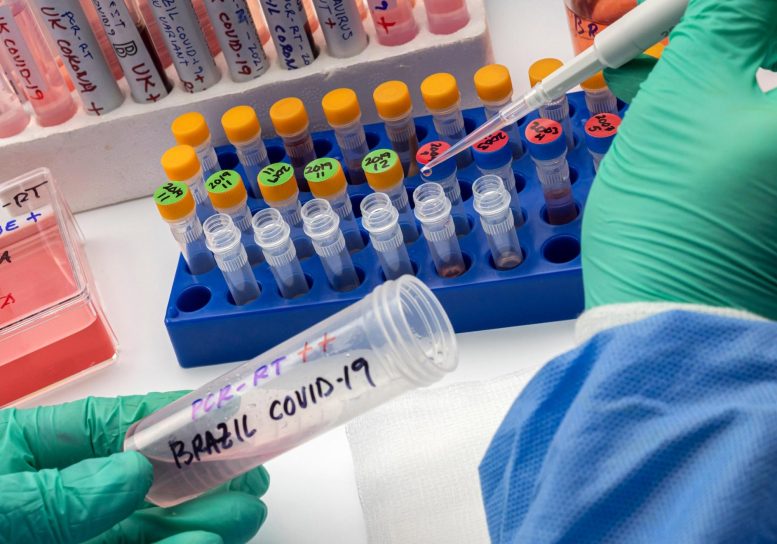
    Brazil COVID Variant
    The P.1 COVID variant appears to be more transmissible and has an increased likelihood of evading protective immunity from previous infections with non-P.1 lineages.

    A new report tracks the evolution of a variant lineage of SARS-CoV-2 associated with rapid transmission in Manaus, Brazil, that evolved in November 2020. The study’s authors suggest this variant, “P.1,” may be more transmissible and more likely to evade protective immunity elicited by previous infection with non-P.1 lineages.

    Manaus, Brazil, reached unprecedented levels of SARS-CoV-2 transmission in mid-2020. And after a momentary respite, COVID-19 cases surged with fatal consequences.

    Using molecular clock analysis, Nuno Faria et al. tracked the evolution of a new, more aggressive lineage called P.1, which possesses 17 mutations, including three (K417T, E484K and N501Y) in the spike protein. Following a period of accelerated evolution, this variant emerged in November 2020.

    It is more transmissible and more lethal than its predecessor and more likely to evade immunity, the authors say. Enhanced global genomic surveillance of such variants of concern, which may exhibit increased transmissibility and/or immune evasion, is critical to accelerate pandemic responsiveness, the authors say.

    Reference: “Genomics and epidemiology of the P.1 SARS-CoV-2 lineage in Manaus, Brazil” by Nuno R. Faria, Thomas A. Mellan, Charles Whittaker, Ingra M. Claro, Darlan da S. Candido, Swapnil Mishra, Myuki A. E. Crispim, Flavia C. S. Sales, Iwona Hawryluk, John T. McCrone, Ruben J. G. Hulswit, Lucas A. M. Franco, Mariana S. Ramundo, Jaqueline G. de Jesus, Pamela S. Andrade, Thais M. Coletti, Giulia M. Ferreira, Camila A. M. Silva, Erika R. Manuli, Rafael H. M. Pereira, Pedro S. Peixoto, Moritz U. G. Kraemer, Nelson Gaburo Jr, Cecilia da C. Camilo, Henrique Hoeltgebaum, William M. Souza, Esmenia C. Rocha, Leandro M. de Souza, Mariana C. de Pinho, Leonardo J. T Araujo, Frederico S. V. Malta, Aline B. de Lima, Joice do P. Silva, Danielle A. G. Zauli, Alessandro C. de S. Ferreira, Ricardo P Schnekenberg, Daniel J. Laydon, Patrick G. T. Walker, Hannah M. Schlüter, Ana L. P. dos Santos, Maria S. Vidal, Valentina S. Del Caro, Rosinaldo M. F. Filho, Helem M. dos Santos, Renato S. Aguiar, José L. Proença-Modena, Bruce Nelson, James A. Hay, Mélodie Monod, Xenia Miscouridou, Helen Coupland, Raphael Sonabend, Michaela Vollmer, Axel Gandy, Carlos A. Prete Jr., Vitor H. Nascimento, Marc A. Suchard, Thomas A. Bowden, Sergei L. K. Pond, Chieh-Hsi Wu, Oliver Ratmann, Neil M. Ferguson, Christopher Dye, Nick J. Loman, Philippe Lemey, Andrew Rambaut, Nelson A. Fraiji, Maria do P. S. S. Carvalho, Oliver G. Pybus, Seth Flaxman, Samir Bhatt and Ester C. Sabino, 14 April 2021, Science.
    DOI: 10.1126/science.abh2644

    Never miss a breakthrough: Join the SciTechDaily newsletter.
    Follow us on Google and Google News.

    American Association for the Advancement of Science COVID-19 Infectious Diseases Public Health Virology
    Share. Facebook Twitter Pinterest LinkedIn Email Reddit

    Related Articles

    New Study Shows Third Dose of Pfizer-BioNTech COVID Vaccine May Protect Against Omicron

    COVID-19: An Analysis of Coronavirus Mutations in More Than 1,000 People

    New Genetic Identification of COVID-19 Susceptibility Will Aid Treatment

    FDA Approved Drug May Help Calm Cytokine Storm in COVID-19

    Antibody Neutralizes SARS and COVID-19 Coronaviruses – On Accelerated Path Toward Clinical Trials

    Experts Dire Warning: 250,000,000 People in Africa Will Catch Coronavirus and Up to 190,000 Will Likely Die

    Team of Biochemists and Virologists Discover Potential Targets for COVID-19 Therapy

    How COVID-19 Kills: New Study Explains the Mechanisms of the New Coronavirus

    Vitamin D Linked to Low Coronavirus Death Rate

    Leave A Reply Cancel Reply

    • Facebook
    • Twitter
    • Pinterest
    • YouTube

    Don't Miss a Discovery

    Subscribe for the Latest in Science & Tech!

    Trending News

    Scientists Say Love Follows Mathematical Patterns

    “Zombie Cells” Reveal a Hidden Weakness That Could Help Fight Aging

    Alien Signals May Be Hiding in a Radio Band SETI Has Barely Explored

    Earth’s Hidden Thermostat Has Regulated Climate for 60 Million Years

    This 518-Million-Year-Old Creature Reveals How Spiders Got Their Bite

    Scientists Built a Programmable Chip That Can Slow Light on Command

    The Backyard “Silly Sprinkler” That Cracked One of Physics’ Biggest Puzzles

    This Common Sleep Habit Could Be Making You Gain Weight

    Follow SciTechDaily
    • Facebook
    • Twitter
    • YouTube
    • Pinterest
    • Newsletter
    • RSS
    SciTech News
    • Biology News
    • Chemistry News
    • Earth News
    • Health News
    • Physics News
    • Science News
    • Space News
    • Technology News
    Recent Posts
    • This Star Is Racing Around the Milky Way’s Black Hole at 8% the Speed of Light
    • Where on Earth Was This Fossil 200 Million Years Ago?
    • A 25,000-Year-Old Ritual Tradition Was Hidden Beneath This Cave Floor
    • A Hidden Source of Metal-Mining Emissions Could Be 10x Larger Than Estimated
    • Plant Compounds in Berries, Tea, and Cocoa May Support Healthy Brain Aging
    Copyright © 1998 - 2026 SciTechDaily. All Rights Reserved.
    • Science News
    • About
    • Contact
    • Editorial Board
    • Privacy Policy
    • Terms of Use

    Type above and press Enter to search. Press Esc to cancel.