
Close Menu
    Facebook X (Twitter) Instagram
    SciTechDaily
    • Biology
    • Chemistry
    • Earth
    • Health
    • Physics
    • Science
    • Space
    • Technology
    Facebook X (Twitter) Pinterest YouTube RSS
    SciTechDaily
    Home»Technology»Ultrathin Flat Lens Focuses Light Without Optical Distortions
    Technology

    Ultrathin Flat Lens Focuses Light Without Optical Distortions

    By Caroline Perry, Harvard University, SEASAugust 24, 2012No Comments4 Mins Read
    Facebook Twitter Pinterest Telegram LinkedIn WhatsApp Email Reddit
    Share
    Facebook Twitter LinkedIn Pinterest Telegram Email Reddit
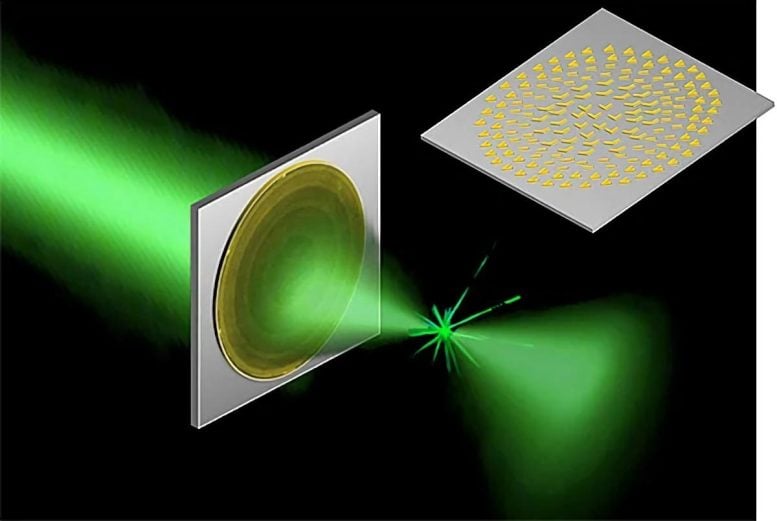
    Ultrathin Wafer Focuses Telecom Wavelengths Without Distortion
    A new ultrathin, flat lens focuses light without imparting the optical distortions of conventional lenses. Credit: Artist’s rendition courtesy of Francesco Aieta

    By plating a very thin wafer of silicon with a nanometer-thin layer of gold, applied physicists have created an ultrathin, flat lens that focuses light without imparting the distortions of conventional lenses.

    Applied physicists at the Harvard School of Engineering and Applied Sciences (SEAS) have created an ultrathin, flat lens that focuses light without imparting the distortions of conventional lenses.

    At a mere 60 nanometers thick, the flat lens is essentially two-dimensional, yet its focusing power approaches the ultimate physical limit set by the laws of diffraction.

    Operating at telecom wavelengths (i.e., the range commonly used in fiber-optic communications), the new device is completely scalable, from near-infrared to terahertz wavelengths, and simple to manufacture. The results have been published online in the journal Nano Letters.
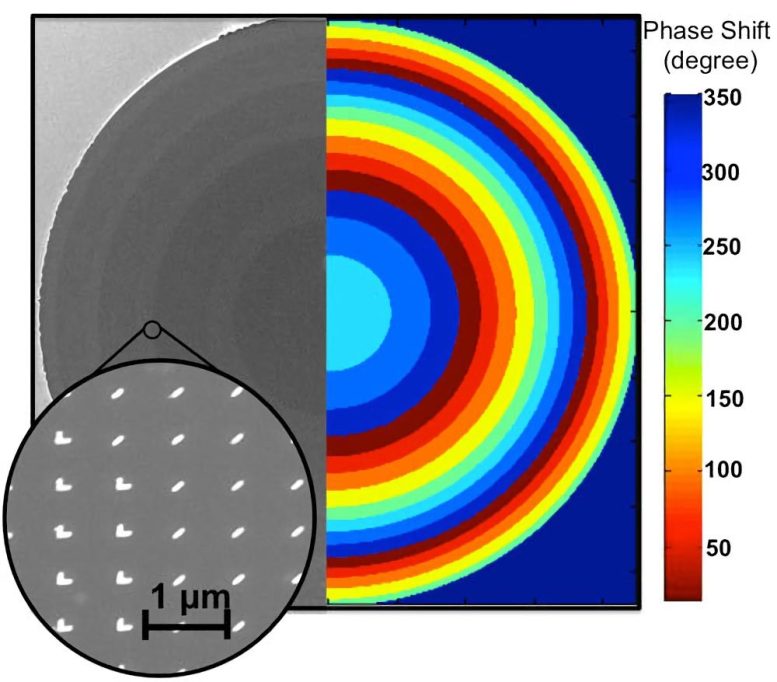
    Flat Lense Micrograph
    Left: A micrograph of the flat lens (diameter approximately 1 mm) made of silicon. The surface is coated with concentric rings of gold optical nanoantennas (inset) which impart different delays to the light traversing the lens. Right: The colored rings show the magnitude of the phase delay corresponding to each ring. Credit: Image courtesy of Francesco Aieta

    “Our flat lens opens up a new type of technology,” says principal investigator Federico Capasso, Robert L. Wallace Professor of Applied Physics and Vinton Hayes Senior Research Fellow in Electrical Engineering at SEAS. “We’re presenting a new way of making lenses. Instead of creating phase delays as light propagates through the thickness of the material, you can create an instantaneous phase shift right at the surface of the lens. It’s extremely exciting.”

    Capasso and his collaborators at SEAS create the flat lens by plating a very thin wafer of silicon with a nanometer-thin layer of gold. Next, they strip away parts of the gold layer to leave behind an array of V-shaped structures, evenly spaced in rows across the surface. When Capasso’s group shines a laser onto the flat lens, these structures act as nanoantennas that capture the incoming light and hold onto it briefly before releasing it again. Those delays, which are precisely tuned across the surface of the lens, change the direction of the light in the same way that a thick glass lens would, with an important distinction.
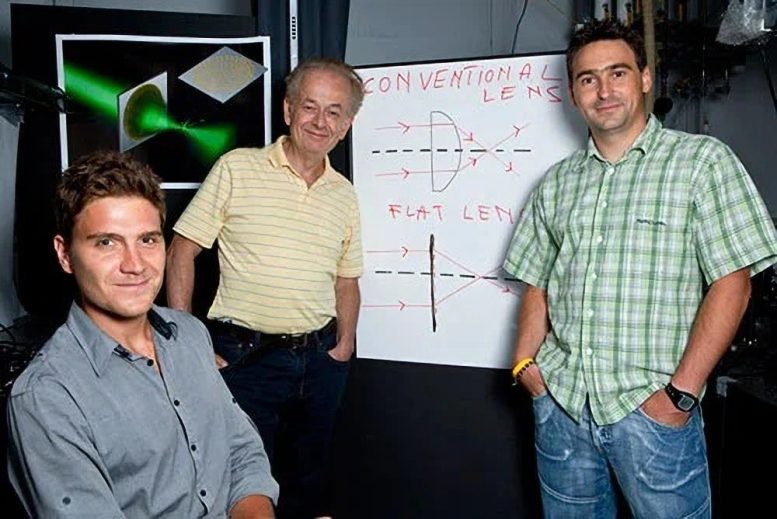
    Francesco Aieta, Federico Capasso, and Patrice Genevet
    Left to right: Francesco Aieta, Federico Capasso, and Patrice Genevet. Credit: Photo by Eliza Grinnell, SEAS Communications.

    The flat lens eliminates optical aberrations such as the “fish-eye” effect that results from conventional wide-angle lenses. Astigmatism and coma aberrations also do not occur with the flat lens, so the resulting image or signal is completely accurate and does not require any complex corrective techniques.

    The array of nanoantennas, dubbed a “metasurface,” can be tuned for specific wavelengths of light by simply changing the size, angle, and spacing of the antennas.

    “In the future, we can potentially replace all the bulk components in the majority of optical systems with just flat surfaces,” says lead author Francesco Aieta, a visiting graduate student from the Università Politecnica delle Marche in Italy. “It certainly captures the imagination.”

    Reference: “Aberration-Free Ultrathin Flat Lenses and Axicons at Telecom Wavelengths Based on Plasmonic Metasurfaces” by Francesco Aieta, Patrice Genevet, Mikhail A. Kats, Nanfang Yu, Romain Blanchard, Zeno Gaburro and Federico Capasso, 15 August 2012, Nano Letters.
    DOI: 10.1021/nl302516v

    Aieta’s and Capasso’s coauthors at SEAS included postdoctoral research associates Patrice Genevet and Nanfang Yu (Ph.D. ’09), graduate students Mikhail A. Kats and Romain Blanchard, and visiting scholar Zeno Gaburro.

    The work was supported by the National Science Foundation (NSF), the NSF-funded Harvard Nanoscale Science and Engineering Center, and the Center for Nanoscale Systems at Harvard (a member of the NSF-supported National Nanotechnology Infrastructure Network). The researchers also individually received support from the Robert A. Welch Foundation, the European Communities Seventh Framework Programme, and an NSF Graduate Research Fellowship.

    Never miss a breakthrough: Join the SciTechDaily newsletter.
    Follow us on Google and Google News.

    Harvard University Lenses Nanotechnology Yale School of Engineering & Applied Science
    Share. Facebook Twitter Pinterest LinkedIn Email Reddit

    Related Articles

    New Nanofiber Dressings Dramatically Accelerate Healing and Tissue Regeneration

    Single Metalens Opens New Possibilities in Virtual and Augmented Reality

    Vanadium-Sapphire Device Absorbs 99.75% of Infrared Light

    Cancer-Fighting DNA Nanorobots Could Target Specific Cells for Repair

    Nanomaterials Actively Self-Regulate in Response to Environmental Change

    Solid-Oxide Fuel Cell That Converts Hydrogen Into Electricity Also Capable of Battery-Like Storage

    Using Chitosan to Remove Arsenic From Water Supplies

    SLIPS Prevents Ice From Sticking on Metal Surfaces

    Researchers Develop DNA Nanorobot to Seek Specific Cell Targets

    Leave A Reply Cancel Reply

    • Facebook
    • Twitter
    • Pinterest
    • YouTube

    Don't Miss a Discovery

    Subscribe for the Latest in Science & Tech!

    Trending News

    This Copper Drug Clears Alzheimer’s Brain Toxins and Boosts Memory

    Adults Over 65 Lost Massive Amounts of Weight With Ozempic

    How Flocking Birds “Defy” One of Physics’ Most Fundamental Laws

    Physicists Create a New Kind of Schrödinger’s Cat State From Exotic Quantum Building Blocks

    Your Diet Could Be Missing the Key Ingredient for Heart Protection

    Researchers Warn Widely Prescribed Blood Pressure Drugs Could Be Harming Diabetic Kidneys

    James Webb Spots Something Strange Between Day and Night on an Alien Planet

    How Ancient People Moved a 6-Ton Stone 700 Kilometers to Stonehenge

    Follow SciTechDaily
    • Facebook
    • Twitter
    • YouTube
    • Pinterest
    • Newsletter
    • RSS
    SciTech News
    • Biology News
    • Chemistry News
    • Earth News
    • Health News
    • Physics News
    • Science News
    • Space News
    • Technology News
    Recent Posts
    • Scientists Uncover Cause of Inflammatory Bowel Disease Solving Decades-Old Mystery
    • The Surprising Reason Swimming Could Be Better for Your Heart Than Running
    • Could Vitamin C Be the Secret to Keeping Your Brain Younger?
    • The Surprising Fix for Robot Traffic Jams
    • Near Absolute Zero, This Transistor Starts Acting Like a Brain Cell
    Copyright © 1998 - 2026 SciTechDaily. All Rights Reserved.
    • Science News
    • About
    • Contact
    • Editorial Board
    • Privacy Policy
    • Terms of Use

    Type above and press Enter to search. Press Esc to cancel.