
Close Menu
    Facebook X (Twitter) Instagram
    SciTechDaily
    • Biology
    • Chemistry
    • Earth
    • Health
    • Physics
    • Science
    • Space
    • Technology
    Facebook X (Twitter) Pinterest YouTube RSS
    SciTechDaily
    Home»Technology»Cancer-Fighting DNA Nanorobots Could Target Specific Cells for Repair
    Technology

    Cancer-Fighting DNA Nanorobots Could Target Specific Cells for Repair

    By SciTechDailySeptember 24, 20121 Comment3 Mins Read
    Facebook Twitter Pinterest Telegram LinkedIn WhatsApp Email Reddit
    Share
    Facebook Twitter LinkedIn Pinterest Telegram Email Reddit
    drug-delivering nanorobot
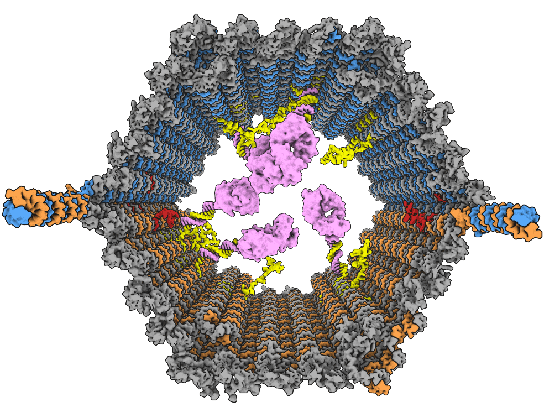
    Wyss Institute scientists have developed a drug-delivering nanorobot that looks like an open-ended barrel (above). The exterior surface of the device is programmed to recognize a target on a cell surface; the drug payload (purple) is secured with anchor strands (yellow) to the interior. Double-stranded DNA latches (blue, red, and orange) ensure that the robot unlocks only in the presence of a molecular key expressed by the target cells. That opens the device (below right), enabling the payload to attack only the designated cells. Images courtesy of Shawn M. Douglas / Wyss Institute for Biologically Inspired Engineering

    Nanites and nano-scale robots have been found mostly in the realm of science fiction, but scientists at Harvard’s Wyss Institute for Biological Inspired Engineering are working on making them a reality. The goal is to track down and destroy a patient’s cancer cells, without having adverse effects on patients.

    The scientists published their findings in the journal Science. Shawn Douglas, a research fellow at the Wyss Institute, describes a method for creating cellular robots, roughly the size of a virus, out of strands of protein and DNA. He’s dubbed the devices “DNA nanorobots,” and they are short, hexagonal tubes made of interwoven DNA that open along their length like a clamshell. At one end, there is a DNA hinge and at the other, there is a pair of twisted DNA fragments that act like latches to hold the device shut.
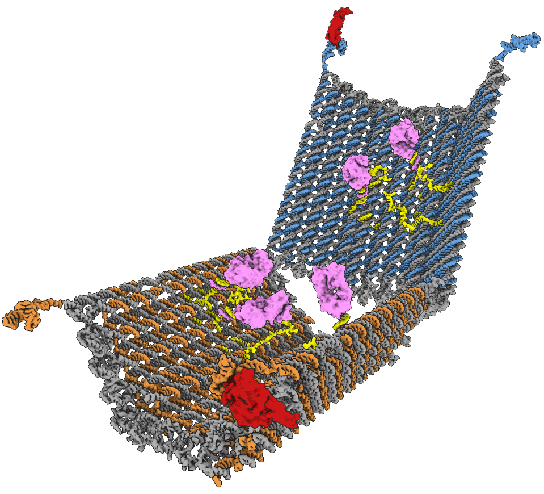
    Wyss Institute scientists have developed a drug-delivering nanorobot

    The inside can hold molecules of any substances, effectively turning it into a delivery device, transporting medication to specific cells inside the human body. The goal is to make tools that can target malfunctioning cells and fix them.

    DNA is an ideal material for building devices at the nano-scale level. There are many developed tools in place to understand, manipulate and manufacture it. Using DNA synthesizers, it’s even possible to create custom lengths of molecules.

    Scientists are using a process called DNA origami to assemble these tools. It was developed in 2006 at Caltech by a researcher named Paul Rothemund. First, a long strand of DNA is used as a backbone to scaffold the structure. The strand is mixed with short sequences of custom-built DNA that are designed to bind to specific sections of the scaffold, bending and twisting it into pre-determined shapes.

    Douglas uses the DNA of the virus M13, harmless to humans, as a scaffold but any long DNA molecule will work. Each of the nanorobots measures 45 nanometers long by 35 nanometers in width, meaning that it can directly interact with the surface of individual cells.

    The DNA nanorobots also track down specific cell types, thanks to their molecular latches. Aptimers, two twisted strands of DNA, can be designed to react to a specific chemical marker or ligand, on a particular cell type, like those in a cancerous tumor. Currently, Douglas is designing DNA aptimers that unravel in the presence of platelet-derived growth factor (PDGF), a protein that regulates cell growth and division. It’s over-expressed on the outer membrane of cancerous cells. This can be used as a target for the DNA nanorobots.

    It’s hoped that by targeting specific cells in this fashion, the nanorobots will be able to treat diseases like cancer without the need for chemotherapy.

    Reference: “A Logic-Gated Nanorobot for Targeted Transport of Molecular Payloads” by Shawn M. Douglas, Ido Bachelet and George M. Church, 17 February 2012, Science.
    DOI: 10.1126/science.1214081

    Never miss a breakthrough: Join the SciTechDaily newsletter.
    Follow us on Google and Google News.

    DNA Harvard University Nanotechnology Popular Robotics Wyss Institute
    Share. Facebook Twitter Pinterest LinkedIn Email Reddit

    Related Articles

    MagicDNA: Tiny, Complex DNA Robots Designed in Minutes Instead of Days

    Jumping Spiders Inspire Incredible Compact Depth Sensor

    Engineers Develop Multifunctional Flexible Robots Using MORPH System

    Single-Stranded DNA and RNA Origami That Can Autonomously Fold Into Defined Structures

    Programmable Biofilm-Based Materials That Self-Assemble

    Robotic RoboBees Achieve First Controlled Flight

    DARPA & Harvard’s Soft, Self-Camouflaging Robot

    Nanomaterials Actively Self-Regulate in Response to Environmental Change

    Researchers Develop DNA Nanorobot to Seek Specific Cell Targets

    1 Comment

    1. Shane Scott Thompson on April 8, 2015 7:26 pm

      Well infact to improve the idea say that it was possible to make a nanite that instead of getting an injection every time you get sick have a nanite grind down a disease or illness to its basic elements to heal the body instead of harm this way it can use the atoms from the cell to heal others with the resources it gets from the illness

      Reply
    Leave A Reply Cancel Reply

    • Facebook
    • Twitter
    • Pinterest
    • YouTube

    Don't Miss a Discovery

    Subscribe for the Latest in Science & Tech!

    Trending News

    Don’t Miss: A Brilliant Venus and Glowing Harvest Moon Light Up the Sky

    New Twist on the Einstein Problem Reveals Unexpected Physics

    JWST Captures Stunning Evidence of How Supermassive Black Holes Feed

    Early Exercise May Permanently Change How Much Energy the Body Uses To Move

    New Molecule Wipes Out Aggressive Lymphoma Tumors in Mice in Just 11 Days

    The Human Family Tree May Need a Major Rewrite

    Scientists Find a Surprising Cancer-Fighting Effect in Dark Sweet Cherries

    New AI Detects Hidden Warning Signs of Solar Eruptions Hours Before They Emerge

    Follow SciTechDaily
    • Facebook
    • Twitter
    • YouTube
    • Pinterest
    • Newsletter
    • RSS
    SciTech News
    • Biology News
    • Chemistry News
    • Earth News
    • Health News
    • Physics News
    • Science News
    • Space News
    • Technology News
    Recent Posts
    • Africa’s Giant Herbivores Were Disappearing Millions of Years Before Humans Could Hunt Them
    • This Utah Mountain Is Hiding Enough Ice To Fill 600 Olympic Pools
    • Vagus Nerve Stimulation Could Unlock the Brain’s Hidden Learning Potential
    • Your Mother’s Age May Leave a Biological Mark That Lasts for Generations
    • Women Who Ate More Antioxidants Had Strikingly Lower Rates of Cervical Cancer
    Copyright © 1998 - 2026 SciTechDaily. All Rights Reserved.
    • Science News
    • About
    • Contact
    • Editorial Board
    • Privacy Policy
    • Terms of Use

    Type above and press Enter to search. Press Esc to cancel.