
Close Menu
    Facebook X (Twitter) Instagram
    SciTechDaily
    • Biology
    • Chemistry
    • Earth
    • Health
    • Physics
    • Science
    • Space
    • Technology
    Facebook X (Twitter) Pinterest YouTube RSS
    SciTechDaily
    Home»Space»“Core Reaction” – Moon Rock Formation Discovery Solves Major Puzzle in Lunar Geology
    Space

    “Core Reaction” – Moon Rock Formation Discovery Solves Major Puzzle in Lunar Geology

    By University of BristolJanuary 25, 2024No Comments4 Mins Read
    Facebook Twitter Pinterest Telegram LinkedIn WhatsApp Email Reddit
    Share
    Facebook Twitter LinkedIn Pinterest Telegram Email Reddit
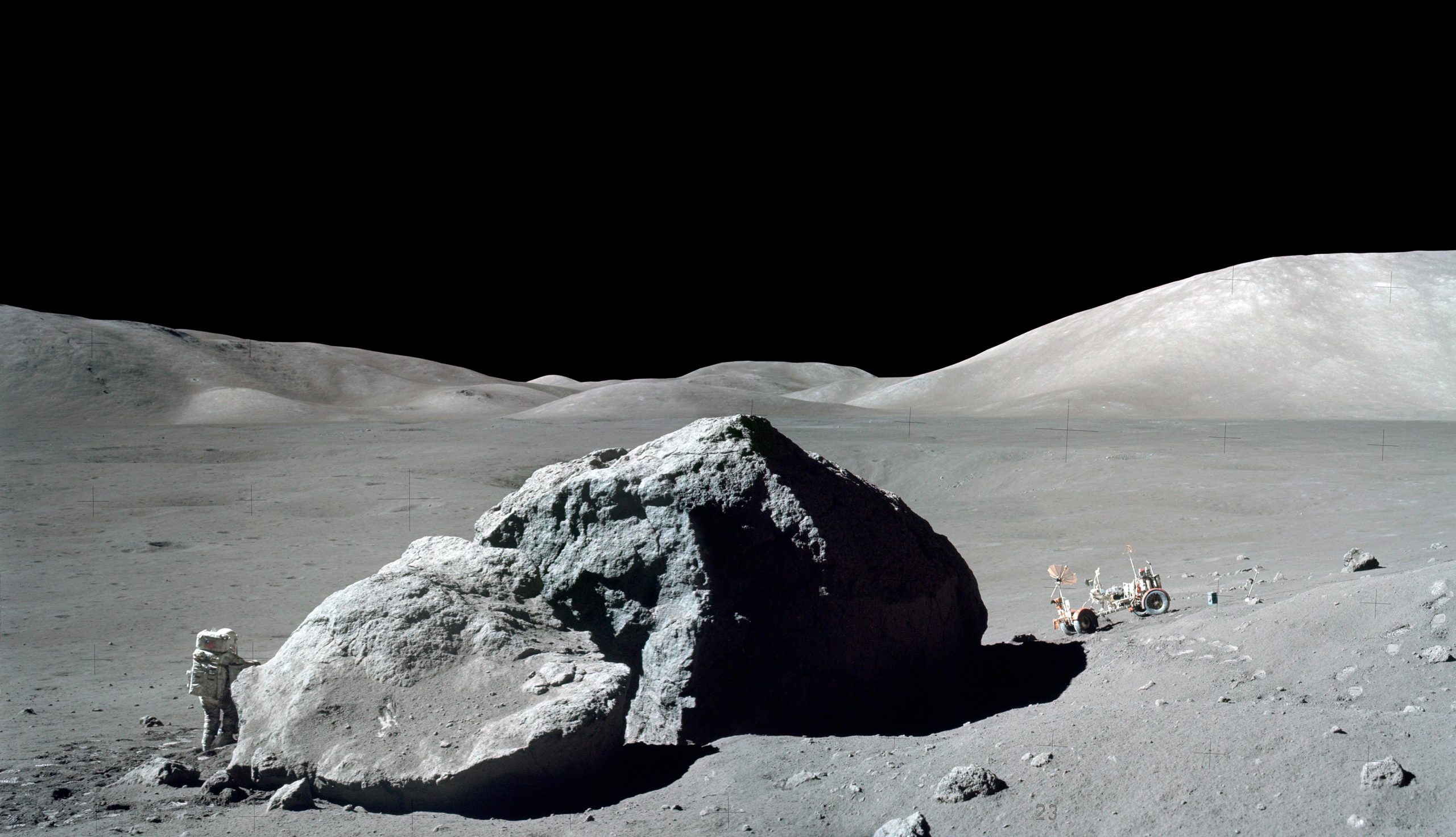
    NASA Apollo 17 Astronaut Next to Huge Lunar Boulder
    Image shows astronaut-geologist Harrison H. Schmitt standing next to a huge lunar boulder during NASA’s Apollo 17 mission in 1972. The scientists in this research used rock samples from this Apollo mission. Credit: NASA/Gene Cernan

    New research has uncovered the process behind the formation of unique magmatic rocks on the Moon, shedding light on their distinct composition and how they came to be on the lunar surface.

    New research has cracked a vital process in the creation of a unique rock type from the Moon. The discovery explains its signature composition and very presence on the lunar surface at all, unraveling a mystery that has long eluded scientists.

    The study, published on January 15 in Nature Geoscience, reveals a key step in the genesis of these distinctive magmas. A combination of high temperature laboratory experiments using molten rocks, together with sophisticated isotopic analyses of lunar samples, identify a critical reaction that controls their composition.
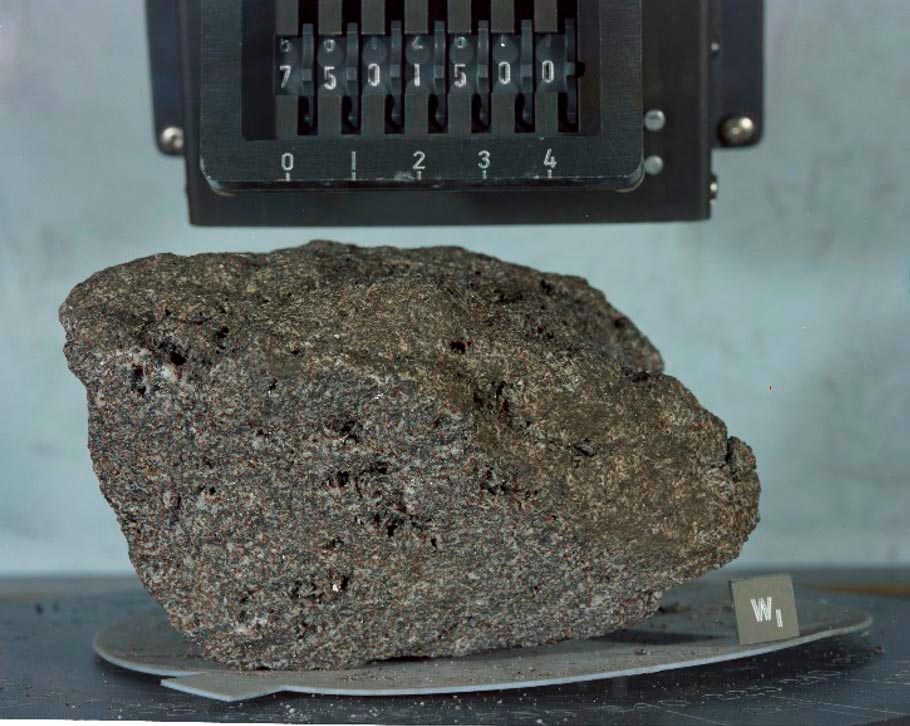
    High-Ti Basalt Moon Rock
    Image shows Moon rock, known as high-Ti basalt, sample from Apollo 17 mission like those analyzed in this study. Credit: NASA

    The Core Reaction

    This reaction took place in the deep lunar interior some three and a half billion years ago, involving exchange of the element iron (Fe) in the magma with the element magnesium (Mg) in the surrounding rocks, modifying the chemical and physical properties of the melt.

    Co-lead author Tim Elliott, Professor of Earth Sciences at the University of Bristol, said: “The origin of volcanic lunar rocks is a fascinating tale involving an ‘avalanche’ of an unstable, planetary-scale crystal pile created by the cooling of a primordial magma ocean.

    “Central to constraining this epic history is the presence of a magma type unique to the Moon, but explaining how such magmas could even have got to the surface, to be sampled by Space missions, has been a troublesome problem. It is great to have resolved this dilemma.”
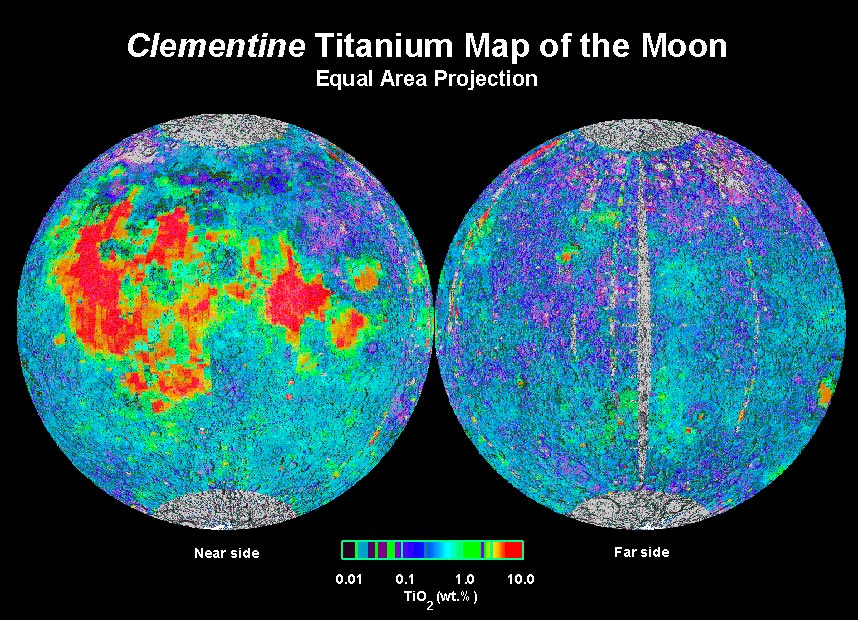
    Moon Surface Titanium Abundances
    Image shows a map of the Titanium abundances of the Moon’s surface, obtained from NASA’s Clementine spacecraft. The red parts indicate extremely high concentrations compared to terrestrial rocks. Credit: Lunar and Planetary Institute

    Understanding High-Ti Basalts

    Surprisingly high concentrations of the element titanium (Ti) in parts of the lunar surface have been known since the NASA Apollo missions, back in the 1960s and 1970s, which successfully returned solidified, ancient lava samples from the Moon’s crust. More recent mapping by orbiting satellite shows these magmas, known as ‘high-Ti basalts’, to be widespread on the Moon.

    “Until now models have been unable to recreate magma compositions that match essential chemical and physical characteristics of the high-Ti basalts. It has proven particularly hard to explain their low density, which allowed them to be erupted some three and a half billion years ago,” added co-lead author Dr. Martijn Klaver, Research Fellow at the University of Münster Institute of Mineralogy.
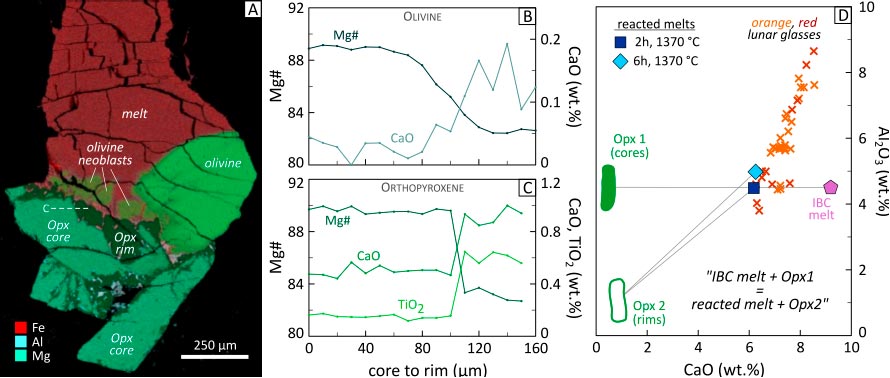
    Melt Reacts With Surrounding Crystals
    An electron-microscope image of an experiment from this study. Melt (brown color) reacts with surrounding crystals (green colors), resulting in a less Fe-rich melt. Credit: University of Bristol/University of Münster

    The international team of scientists, led by the Universities of Bristol in the UK and Münster in Germany managed to mimic the high-Ti basalts in the process in the lab using high-temperature experiments. Measurements of the high-Ti basalts also revealed a distinctive isotopic composition that provides a fingerprint of the reactions reproduced by the experiments.

    Both results clearly demonstrate how the melt-solid reaction is integral in understanding the formation of these unique magmas.

    Reference: “Titanium-rich basaltic melts on the Moon modulated by reactive flow processes” by Martijn Klaver, Stephan Klemme, Xiao-Ning Liu, Remco C. Hin, Christopher D. Coath, Mahesh Anand, C. Johan Lissenberg, Jasper Berndt and Tim Elliott, 15 January 2024, Nature Geoscience.
    DOI: 10.1038/s41561-023-01362-5

    Never miss a breakthrough: Join the SciTechDaily newsletter.
    Follow us on Google and Google News.

    Geoscience Moon Popular University of Bristol
    Share. Facebook Twitter Pinterest LinkedIn Email Reddit

    Related Articles

    Chinese Scientists Discover Water Reservoir on the Moon

    Bombardment History Revealed: The Moon Sustained Twice As Many Impacts As Can Be Seen on Its Surface

    Chinese Lunar Rover Discovers “Mind-Blowing” Translucent Glass Globules on the Moon

    Mysterious Iron Nanoparticles: Planetary Scientists Find Evidence of Solar-Driven Change on the Moon

    Presence of Water in the Primary Crust Indicates That the Early Moon Was Wet

    Data Suggests the Possible Ice on the Moon at Shackleton Crater

    Saturn’s Moon Phoebe Has Planet-Like Qualities

    NASA LRO Spacecraft Reveals Geological Activity on the Moon’s Surface

    GRAIL Probes Now Orbiting The Moon

    Leave A Reply Cancel Reply

    • Facebook
    • Twitter
    • Pinterest
    • YouTube

    Don't Miss a Discovery

    Subscribe for the Latest in Science & Tech!

    Trending News

    Even Occasional Binge Drinking May Triple Liver Damage Risk

    Liftoff! NASA’s Artemis II Launch Sends Astronauts Around the Moon for First Time in 50 Years

    Scientists Discover New Way To Eliminate “Zombie Cells” Driving Aging

    This New Quantum Theory Could Change Everything We Know About the Big Bang

    This One Vitamin May Help Protect Your Brain From Dementia Years Later

    Stopping Weight-Loss Drugs Like Ozempic Can Quickly Erase Heart Benefits

    A 500-Million-Year-Old Surprise Is Forcing Scientists to Rethink Spider Evolution

    Coffee and Blood Pressure: What You Need To Know Before Your Next Cup

    Follow SciTechDaily
    • Facebook
    • Twitter
    • YouTube
    • Pinterest
    • Newsletter
    • RSS
    SciTech News
    • Biology News
    • Chemistry News
    • Earth News
    • Health News
    • Physics News
    • Science News
    • Space News
    • Technology News
    Recent Posts
    • Even “Failed” Diets May Deliver Long-Term Health Gains, Study Finds
    • Childhood Junk Food May Rewire the Brain for Life
    • NIH Scientists Discover Powerful New Opioid That Relieves Pain Without Dangerous Side Effects
    • Breakthrough Study Reveals Why Damaged Nerves Struggle To Heal
    • 20-Year Study Reveals Cholera’s Surprising Weakness
    Copyright © 1998 - 2026 SciTechDaily. All Rights Reserved.
    • Science News
    • About
    • Contact
    • Editorial Board
    • Privacy Policy
    • Terms of Use

    Type above and press Enter to search. Press Esc to cancel.