
Close Menu
    Facebook X (Twitter) Instagram
    SciTechDaily
    • Biology
    • Chemistry
    • Earth
    • Health
    • Physics
    • Science
    • Space
    • Technology
    Facebook X (Twitter) Pinterest YouTube RSS
    SciTechDaily
    Home»Space»Chandra Identifies X-Ray Emission from the Nuclear Region of Arp 220
    Space

    Chandra Identifies X-Ray Emission from the Nuclear Region of Arp 220

    By Jonathan McDowell, et al., Harvard-Smithsonian Center For AstrophysicsFebruary 12, 2018No Comments3 Mins Read
    Facebook Twitter Pinterest Telegram LinkedIn WhatsApp Email Reddit
    Share
    Facebook Twitter LinkedIn Pinterest Telegram Email Reddit
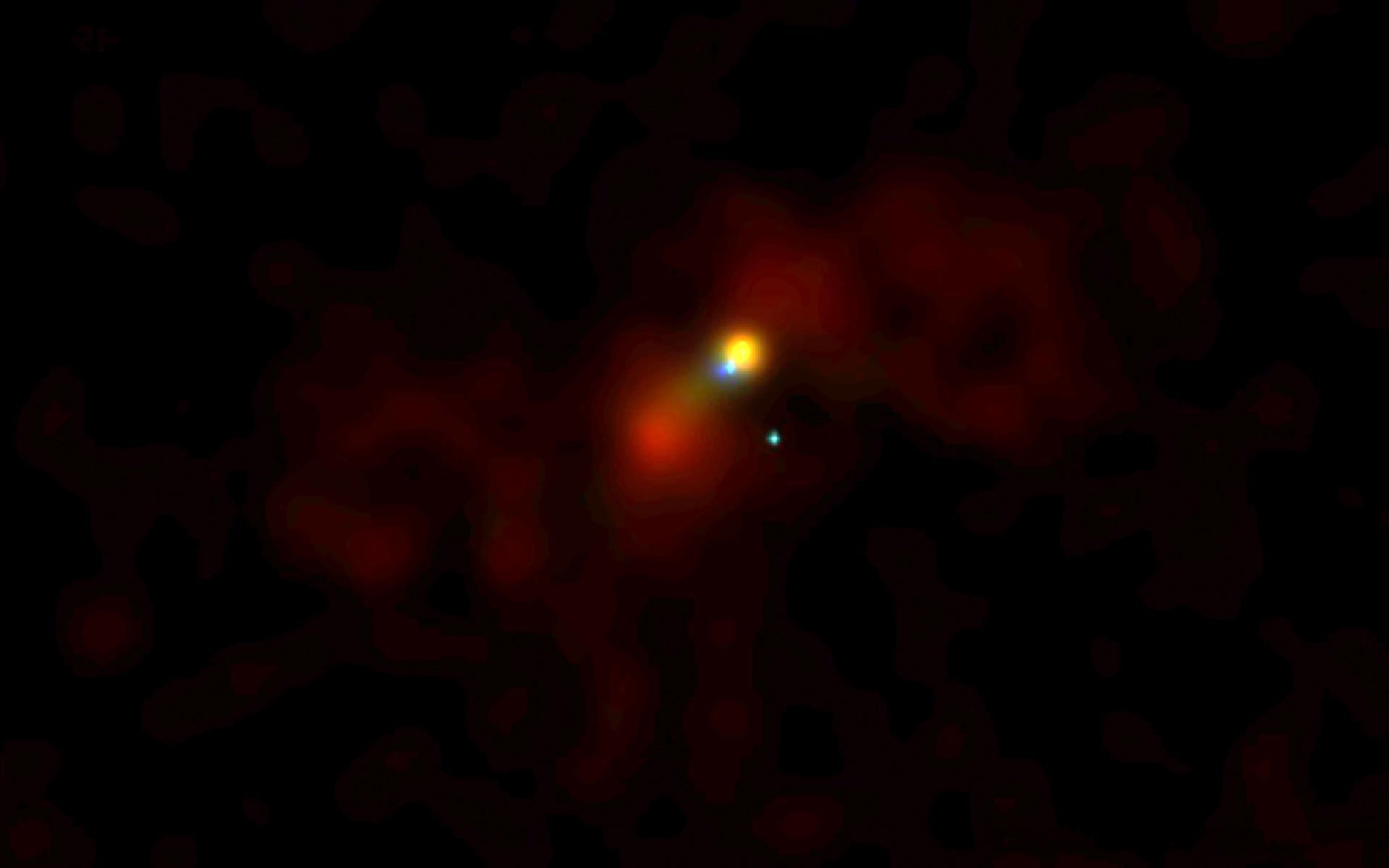
    X-Ray Emission from the Nuclear Region of Arp 220
    A Chandra X-ray image of the ultraluminous merging galaxy Arp 220. Astronomers studying the X-ray emission have concluded that accretion onto the supermassive black hole nuclei contributes only a modest amount, compared with star formation, to the galaxy’s luminosity. NASA/SAO/CXC/J.McDowell

    The galaxy Arp 220 is ultraluminous (defined as having more than about 300 times the luminosity of our own galaxy) and, at a distance of only about 260 million light-years, is the closest ultraluminous galaxy to our Milky Way. Even more dramatic galaxies can have luminosities as much as ten times brighter, and astronomers are still piecing together the reasons for these huge energy outputs. The two primary suspects for the energetics are bursts of star formation that produce many hot young stars, or the accretion of material onto the supermassive black hole at a galaxy’s nucleus – an active galactic nucleus (AGN). As the closest example, Arp 220 is one of the best places to probe these different scenarios; however, observations are difficult because whatever is powering the activity in Arp 220 is heavily shrouded in dust and the nuclear region is invisible at optical wavelengths.

    The starburst explanation should produce many hot young stars with abundant ultraviolet light and supernovae resulting from the deaths of the most massive and short-lived stars. The AGN explanation will produce hotter gas with more X-ray emission and characteristic spectral features. So far signs of both processes have been detected. Astronomers generally have concluded that stars are being made at a rate of about ten thousand solar masses per year, dominating the luminosity, and that the AGN contributes only modestly to the output, less than 25%.

    Adding to the appeal and mystery of Arp 220, however, is the fact that it is a merger of two galaxies and its two constituent galactic nuclei are approaching coalescence, currently being only about one thousand light-years apart. This makes the relatively small AGN output puzzling: Simulations of galaxy mergers suggest that as the nuclei get close together their accretion soars and their luminosity dominates the emission, even exceeding 80% of the total. Moreover, observations of supermassive black hole nuclei in general find that they are systematically larger in larger galaxies, something that would be expected if, as galaxies grow in a merger, their black holes also grow from accreting matter and radiate as they do so.

    CfA astronomers Alessandro Paggi, Giuseppina Fabbiano, Guido Risaliti, Margarita Karovska, Martin Elvis, W. Peter Maksym, and Jonathan McDowell and two colleagues obtained new data using the Chandra X-ray Observatory which, combined with archival Chandra data, allowed them to identify in X-rays two locations of extremely hot atomic iron and potassium emission that coincide with the two nuclei. The lines can be produced either in supernovae (a consequence of star formation) or by an AGN. The scientists analyze these and related data to conclude that supernovae are most likely the primary source of the emission, and that, in agreement with earlier results, the AGN contribution is only modest. They also estimate the masses of the two black holes as being relatively modest, only about ten thousand solar masses each. One implication of this paper is that the merger has not yet progressed to the stage in which active accretion onto the black hole lights up the galaxy.

    Reference: “X-Ray Emission from the Nuclear Region of Arp 220” by Alessandro Paggi, Giuseppina Fabbiano, Guido Risaliti, Junfeng Wang, Margarita Karovska, Martin Elvis, W. Peter Maksym, Jonathan McDowell and Jay Gallagher, 23 May 2017, The Astronomical Journal.
    doi: 10.3847/1538-4357/aa713b

    Never miss a breakthrough: Join the SciTechDaily newsletter.
    Follow us on Google and Google News.

    Astronomy Astrophysics Black Hole Chandra X-ray Observatory Cosmology Harvard-Smithsonian Center for Astrophysics
    Share. Facebook Twitter Pinterest LinkedIn Email Reddit

    Related Articles

    Invisible Storm Lights Up Galaxy Cluster With Record-Breaking Radio Glow

    Astronomers Discover a Cosmic Particle Accelerator in Abell 3411 and 3412

    NASA’s Chandra Views a Stellar Circle of Life, Cygnus X-3

    New Phoenix Cluster Observations Provide A Fresh Perspective

    Astronomers Identify the Smallest Supermassive Black Hole to Date

    Chandra Reveals Evidence of Multiple Eruptions From a Black Hole

    A Significant Step Towards Explaining the Cosmic Origins of the Seeds of Galaxies

    Astronomers Search for Trigger of Nearby Supernova

    NASA Data Suggests Black Holes Abundant Among the Earliest Stars

    Leave A Reply Cancel Reply

    • Facebook
    • Twitter
    • Pinterest
    • YouTube

    Don't Miss a Discovery

    Subscribe for the Latest in Science & Tech!

    Trending News

    The Universe Is Expanding Too Fast and Scientists Can’t Explain Why

    “Like Liquid Metal”: Scientists Create Strange Shape-Shifting Material

    Early Warning Signals of Esophageal Cancer May Be Hiding in Plain Sight

    Common Blood Pressure Drug Shows Surprising Power Against Deadly Antibiotic-Resistant Superbug

    Scientists Uncover Dangerous Connection Between Serotonin and Heart Valve Disease

    Scientists Discover a “Protector” Protein That Could Help Reverse Hair Loss

    Bone-Strengthening Discovery Could Reverse Osteoporosis

    Scientists Uncover Hidden Trigger Behind Stem Cell Aging

    Follow SciTechDaily
    • Facebook
    • Twitter
    • YouTube
    • Pinterest
    • Newsletter
    • RSS
    SciTech News
    • Biology News
    • Chemistry News
    • Earth News
    • Health News
    • Physics News
    • Science News
    • Space News
    • Technology News
    Recent Posts
    • A Common Diabetes Drug May Hold the Key to Stopping HIV From Coming Back
    • Ancient “Syphilis-Like” Disease in Vietnam Challenges Key Scientific Assumptions
    • Drinking Alcohol To Cope in Your 20s Could Damage Your Brain for Life
    • Scientists Crack Alfalfa’s Chromosome Mystery After Decades of Debate
    • Ancient Ant-Plant Alliance Collapses As Predatory Wasps Move In
    Copyright © 1998 - 2026 SciTechDaily. All Rights Reserved.
    • Science News
    • About
    • Contact
    • Editorial Board
    • Privacy Policy
    • Terms of Use

    Type above and press Enter to search. Press Esc to cancel.