
Close Menu
    Facebook X (Twitter) Instagram
    SciTechDaily
    • Biology
    • Chemistry
    • Earth
    • Health
    • Physics
    • Science
    • Space
    • Technology
    Facebook X (Twitter) Pinterest YouTube RSS
    SciTechDaily
    Home»Space»Hubble Views Glowing Gas and Dark Dust in Spiral Galaxy NGC 4634
    Space

    Hubble Views Glowing Gas and Dark Dust in Spiral Galaxy NGC 4634

    By NASASeptember 24, 2012No Comments2 Mins Read
    Facebook Twitter Pinterest Telegram LinkedIn WhatsApp Email Reddit
    Share
    Facebook Twitter LinkedIn Pinterest Telegram Email Reddit
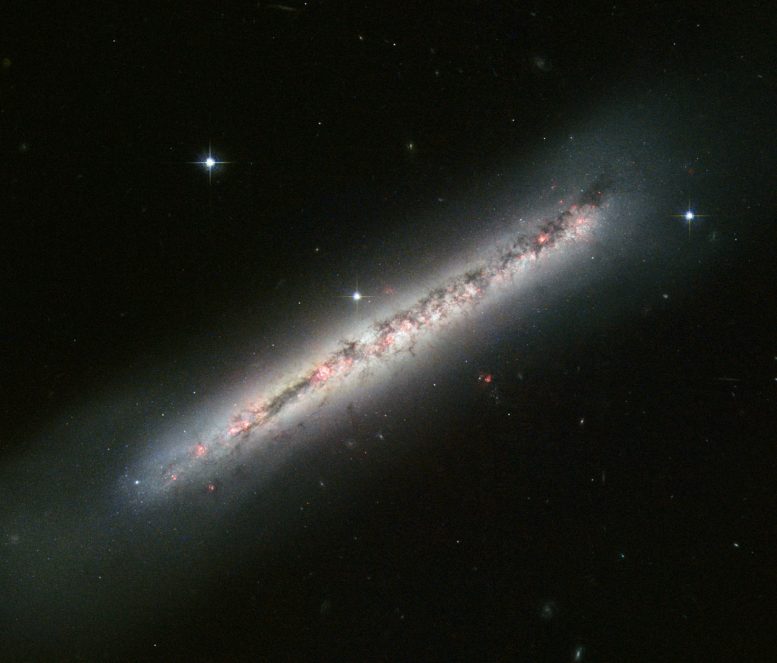
    sharp image of NGC 4634
    The spiral galaxy NGC 4634 is located about 70 million light-years away in the constellation of Coma Berenices. Credit: ESA/Hubble & NASA

    Located roughly 70 million light-years from Earth in the constellation of Coma Berenices, spiral galaxy NGC 4634 is seen in great detail in this new photo from the Hubble Space Telescope.

    The NASA/ESA Hubble Space Telescope has produced a sharp image of NGC 4634, a spiral galaxy seen exactly side-on. Its disk is slightly warped by ongoing interactions with a nearby galaxy, and it is crisscrossed by clearly defined dust lanes and bright nebulae.

    NGC 4634, which lies around 70 million light-years from Earth in the constellation of Coma Berenices, is one of a pair of interacting galaxies. Its neighbor, NGC 4633, lies just outside the upper right corner of the frame, and is visible in wide-field views of the galaxy. While it may be out of sight, it is not out of mind: its subtle effects on NGC 4634 are easy to see to a well-trained eye.

    Gravitational interactions pull the neat spiral forms of galaxies out of shape as they get closer to each other, and the disruption to gas clouds triggers vigorous episodes of star formation. While this galaxy’s spiral pattern is not directly visible thanks to our side-on perspective, its disk is slightly warped, and there is clear evidence of star formation.

    Along the full length of the galaxy, and scattered around parts of its halo, are bright pink nebulae. Similar to the Orion Nebula in the Milky Way, these are clouds of gas that are gradually coalescing into stars. The powerful radiation from the stars excites the gas and makes it light up, much like a fluorescent sign. The large number of these star formation regions is a telltale sign of gravitational interaction.

    The dark filamentary structures that are scattered along the length of the galaxy are caused by cold interstellar dust blocking some of the starlight.

    Hubble’s image is a combination of exposures in visible light produced by Hubble’s Advanced Camera for Surveys and the Wide Field and Planetary Camera 2.

    Never miss a breakthrough: Join the SciTechDaily newsletter.
    Follow us on Google and Google News.

    European Space Agency Hubble Space Telescope NASA Popular
    Share. Facebook Twitter Pinterest LinkedIn Email Reddit

    Related Articles

    Hubble’s Newest Discovery Isn’t a Star, It’s a Window Into the Dark Universe

    Hubble Celebrates 34th Anniversary With a Spectacular View of the Little Dumbbell Nebula

    Spectacular Image of Heart of Phantom Galaxy Showcases Webb’s Power

    Celebrating Hubble’s 32nd Birthday: A Magnificent View of an Unusual Collection of Five Galaxies

    Hubble Uncovers Bizarre, Evolutionary Missing Link From the Dawn of the Universe

    Spiral Snapshot Hides an Astronomical Monstrosity

    Galaxy Zoo: Hubble Captures a Tumultuous Galactic Trio

    Hubble Space Telescope Captures Galactic Conjunction

    ESA’s Hershel Space Telescope Captures Incredible Views of Eagle Nebula

    Leave A Reply Cancel Reply

    • Facebook
    • Twitter
    • Pinterest
    • YouTube

    Don't Miss a Discovery

    Subscribe for the Latest in Science & Tech!

    Trending News

    Collapsing Plasma May Hold the Key to Cosmic Magnetism

    This Breakthrough Solar Panel Generates Power From Both Sunlight and Raindrops

    Scientists Uncover New Metabolic Effects Beyond Weight Loss of Mounjaro

    Scientists Discover Cancer Tumors Are “Addicted” to This Common Antioxidant

    1,800 Miles Down: Scientists Uncover Mysterious Movements at the Edge of Earth’s Core

    Scientists Discover Hidden “Good Fats” in Green Rice That Could Transform Nutrition

    Your Child’s Clothes Could Contain Toxic Lead, Study Finds

    Researchers Break a 150-Year-Old Math Law With a Surprising Donut Discovery

    Follow SciTechDaily
    • Facebook
    • Twitter
    • YouTube
    • Pinterest
    • Newsletter
    • RSS
    SciTech News
    • Biology News
    • Chemistry News
    • Earth News
    • Health News
    • Physics News
    • Science News
    • Space News
    • Technology News
    Recent Posts
    • Natural Oils vs. Antibiotics: The Swine Study That Could Change Farming
    • The Biggest Volcanic Event in Earth’s History Transformed an Entire Oceanic Plate
    • Scientists Warn: Humanity Has Pushed the Planet Past Its Limits
    • Stronger Flu Shot Linked to Nearly 55% Lower Alzheimer’s Risk, Study Finds
    • Researchers Say That Eating Mango With Avocado Offers Surprising Heart Benefits
    Copyright © 1998 - 2026 SciTechDaily. All Rights Reserved.
    • Science News
    • About
    • Contact
    • Editorial Board
    • Privacy Policy
    • Terms of Use

    Type above and press Enter to search. Press Esc to cancel.