
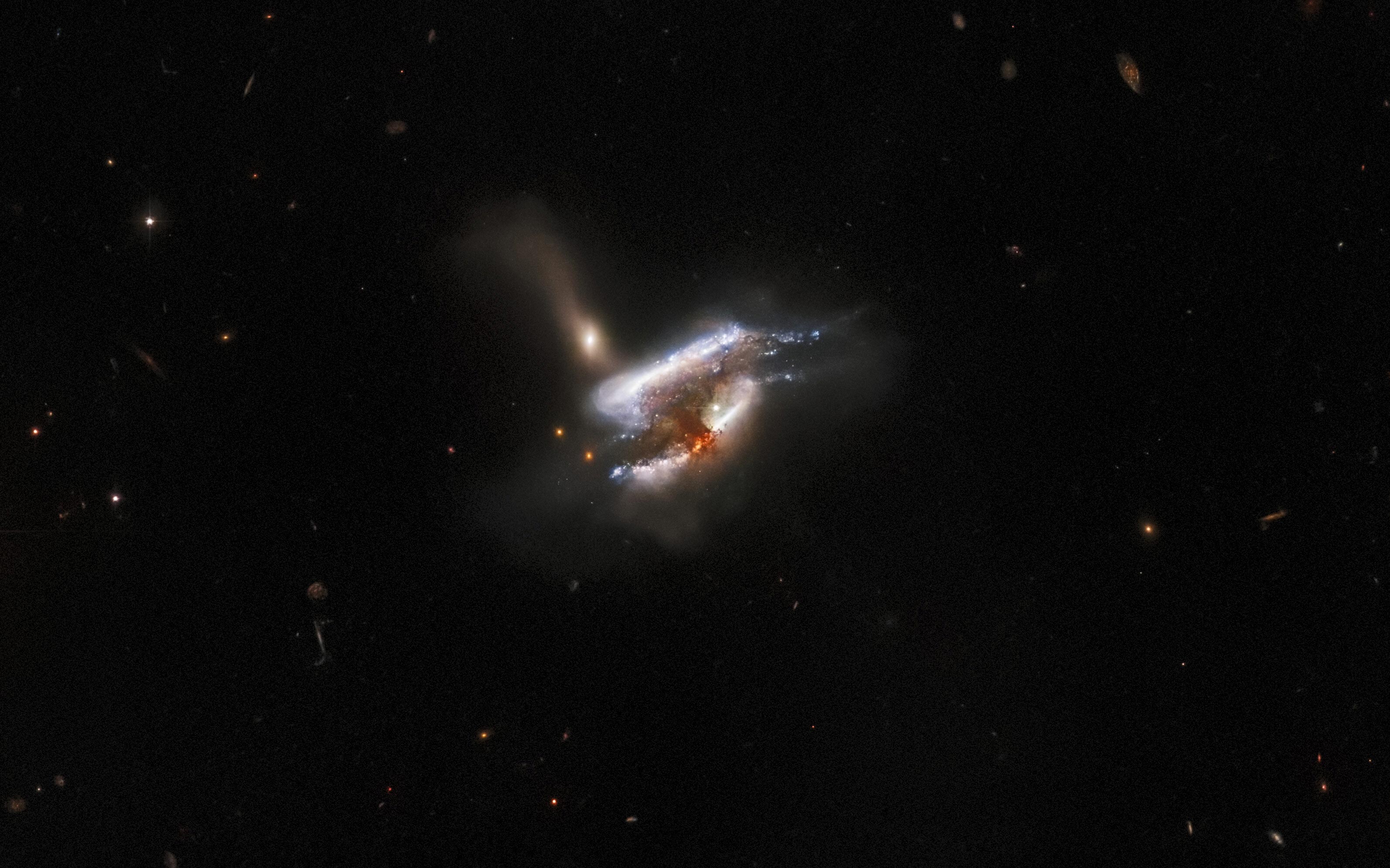
Hubble captured a triple galaxy merger in IC 2431, a galaxy 681 million light-years away.
The mass of dust and bright swirls of stars in this image are the distant galaxy merger IC 2431, which lies 681 million light-years from Earth in the constellation Cancer. The NASA/ESA Hubble Space Telescope has captured what appears to be a triple galaxy merger in progress, as well as a tumultuous mixture of star formation and tidal distortions caused by the gravitational interactions of this galactic trio. The center of this image is obscured by a thick cloud of dust — though light from a background galaxy can be seen piercing its outer extremities.
This image is from a series of Hubble observations investigating weird and wonderful galaxies found by the Galaxy Zoo citizen science project. Using Hubble’s powerful Advanced Camera for Surveys (ACS), astronomers took a closer look at some of the more unusual galaxies that volunteers had identified.
The original Galaxy Zoo project was the largest galaxy census ever carried out, and relied on crowdsourcing time from more than 100,000 volunteers to classify 900,000 unexamined galaxies. The project achieved what would have been years of work for a professional astronomer in only 175 days, and has led to a steady stream of similar astronomical citizen science projects.
Later Galaxy Zoo projects have included the largest ever studies of galaxy mergers and tidal dwarf galaxies, as well as the discovery of entirely new types of compact star-forming galaxies.
Never miss a breakthrough: Join the SciTechDaily newsletter.
Follow us on Google and Google News.
6 Comments
Babu G. Ranganathan*
(B.A. Bible/Biology)
HUGE PROBLEMS WITH BIG BANG THEORY
Big Bang scientists extrapolate a hypothetical scenario from a few facts. Yes, some galaxies are expanding, moving further away (Red shift), but this is not the case with the entire universe. There are galaxies in the universe running perpendicular to the rest of the galaxies, and there are galaxies even running towards us (Blue shift). All this is contrary to Big Bang. Also, if Big Bang really occurred, there should be a uniform distribution of gasses.
The uniform distribution of gasses throughout the universe would have made sure that the gasses didn’t have enough gravitational attraction to form into planets and stars. The hypothesis of dark matter providing enough gravitational force has been increasingly discredited.
Big Bang scientists have never proved the existence of dark matter. They only assume that it exists. The latest technologies to detect dark matter have come up empty. Big Bang scientists must hope that dark matter exists so that it would provide enough gravitational force for planets, stars, and galaxies to form.
Big Bang scientists believe that dark matter can be the only gravitational explanation for how galaxies behave. However, other scientists have successfully shown an alternative explanation to dark matter known as MOND, which stands for Modified Newtonian Dynamics. In other words, it is not necessary to believe that 80% of the universe must be made up of dark matter in order to explain certain behavior and movement of galaxies.
“The (galactic) structures discovered during the past few years, however, are so massive that even if CDM (Cold Dark Matter) did exist, it could not account for their formation” (Dr. Duane T. Gish, “The Big Bang Theory Collapses.” Furthermore, an explosion cannot explain the precise orbits and courses of thousands of billions of stars in billions of galaxies. Gravity may explain how that order is maintained, but mere gravity alone cannot explain the origin of that order!
The disorder in the universe can be explained because of chance and random processes, but the order can be explained only because of intelligence and design.
Some evolutionary astronomers believe that trillions of stars crashed into each other leaving surviving stars to find precise orderly orbits in space. Not only is this irrational, but if there was such a mass collision of stars then there would be a super mass residue of gas clouds in space to support this hypothesis. The present level of residue of gas clouds in space doesn’t support the magnitude of star deaths required for such a hypothesis. And, as already stated, the origin of stars cannot be explained by the Big Bang because of the reasons mentioned above. It’s one thing to say that stars may decay and die into random gas clouds, but it is totally different to say that gas clouds form into stars.
Read the Internet article, ‘SMOKING GUN’ PROOF OF BIG BANG ALREADY IN DOUBT by creationist and scientist Dr. Jake Hebert. Most people don’t realize how much disagreement there is among evolutionary scientists concerning their own theories. The media doesn’t report those details, at least not to any substantial extent.
Visit my newest Internet site: THE SCIENCE SUPPORTING CREATION
Author of popular Internet article, TRADITIONAL DOCTRINE OF HELL EVOLVED FROM GREEK ROOTS
*I have given successful lectures (with question and answer period afterwards) defending creation before evolutionist science faculty and students at various colleges and universities. I’ve been privileged to be recognized in the 24th edition of Marquis “Who’s Who in The East” for my writings on religion and science.
Or it could be explained by a fundamental misunderstanding of how gravity works. Interactions that exist that we’ve not yet quantified that work as the dark matter/energy signature they cant find. Take universal simulations on supercomputers. We cant create anything resembling the observable universe until we remove dark matter and time as variables. Once those are gone, the simulations then work out to a remarkable degree of accuracy to what we actually see.
And none of it requires intelligent design. Just gravity and endless, incalculable time. And even then we are still working from a finite point in time. Consider for a moment that the universe is infinite, the CMB is simply the distance at which light no longer carries enough energy to be detectable as anything else, and the infinite universe has simply always existed. 13.7 billion years ago, 22 billion years ago, 6×10^22 years ago it was still there. Not saying im correct, just something to think about.
Are those galaxies having sex?
Perhaps it is possible that galaxies are eventually consumed by black holes,broken down to energies we have not yet conceived and then eventually by another bang formed into galaxies not in what we consider normal movements?
I just like learning more about the galaxy and space
I am with Michael. Learning more 😌. Babu understands knowledge, truly 🤓 smart.books n all;mystery of looking up at night seeing galaxies n 🌟 stars. Funny earth is small compared to others known objects. Enjoying the reading of not guessing ,knowledge. Open minds,closed mouths,check easy learning. Work to be done …😇😷🥳👽👽👽👽👽👽👽👽👽👽👽👽😽👾👾🤖