
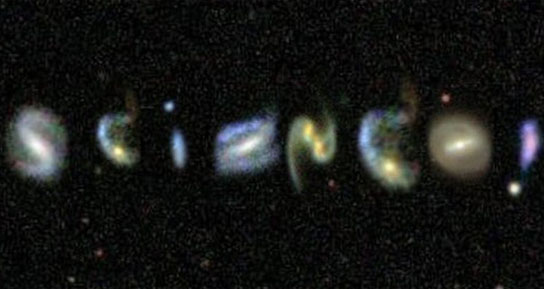
While helping to classifying galaxies seen in hundreds of thousands of telescope images as spiral or elliptical, Galaxy Zoo project volunteers came across galaxies that resemble letters of the alphabet.
The international team behind Galaxy Zoo, including astronomers from Oxford University, is inviting people to be involved in more discoveries as they launch a new incarnation of the site at http://galaxyzoo.org.
From today, the site includes more than 250,000 new images of galaxies, most of which have never been seen by humans. By classifying them, volunteers will add to our understanding of the processes which shaped our universe.
“We’d like to thank all those that have taken part in Galaxy Zoo in the past five years. Humans are better than computers at pattern recognition tasks like this, and we couldn’t have got so far without everyone’s help,” says Galaxy Zoo principal investigator Dr. Chris Lintott from the University of Oxford. “Now we’ve got a new challenge and we’d like to encourage volunteers old and new to get involved. You don’t have to be an expert – in fact, we’ve found not being an expert tends to make you better at this task. There are too many images for us to inspect ourselves, but by asking hundreds of thousands of people to help us we can find out what’s lurking in the data.”
More than 250,000 people have taken part in the Galaxy Zoo project since its launch in 2007, sorting through over 1 million images. Their findings have ranged from the scientifically exciting to the weird and wonderful.
Among the spiral and elliptical galaxies that the volunteers have characterized and classified, they have found an entire alphabet of galaxies. Galaxy Zoo team member Dr. Steven Bamford of the University of Nottingham has created a website at www.mygalaxies.co.uk where anyone can write their name in the stars.
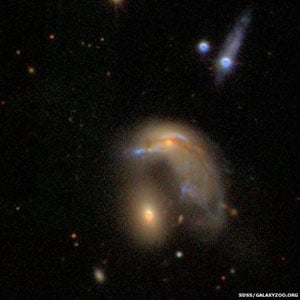
The team is also keen to add more animals to the volunteers’ celestial zoo, having found a convincing penguin-shaped galaxy.
Along with the quirky appeal of such findings, the researchers suggest such unusual formations may also tell us something about what happens when galaxies collide.
The new images on the Galaxy Zoo site come from the Sloan Digital Sky Survey, a ground-based telescope in New Mexico, and from large surveys with NASA’s Hubble Space Telescope.
Astronomer and Galaxy Zoo team member Kevin Schawinski from ETH Zurich in Switzerland says: “The two sources of data work together perfectly: the new images from Sloan give us our most detailed view of the local universe, while the CANDELS survey from the Hubble telescope allows us to look deeper into the universe’s past than ever before.”
The team is hoping that the hard work of volunteers on the new site will allow data from the two telescopes to be compared, offering insights into how nearby galaxies as we see them today may have arisen from how the universe looked in the past.
Dr. Karen Masters from the University of Portsmouth, another team member, explains: “In astronomy, we’re lucky enough to get to see both the past and the present of the universe. By comparing the two, we can try to understand the forces which have shaped the formation of the galaxies in it, including our own Milky Way.”
Never miss a breakthrough: Join the SciTechDaily newsletter.
Follow us on Google and Google News.