
Close Menu
    Facebook X (Twitter) Instagram
    SciTechDaily
    • Biology
    • Chemistry
    • Earth
    • Health
    • Physics
    • Science
    • Space
    • Technology
    Facebook X (Twitter) Pinterest YouTube RSS
    SciTechDaily
    Home»Space»Peering Into the Abyss: The Cutting-Edge Science of Black Hole Illumination
    Space

    Peering Into the Abyss: The Cutting-Edge Science of Black Hole Illumination

    By The Hebrew University of JerusalemJanuary 18, 20241 Comment4 Mins Read
    Facebook Twitter Pinterest Telegram LinkedIn WhatsApp Email Reddit
    Share
    Facebook Twitter LinkedIn Pinterest Telegram Email Reddit
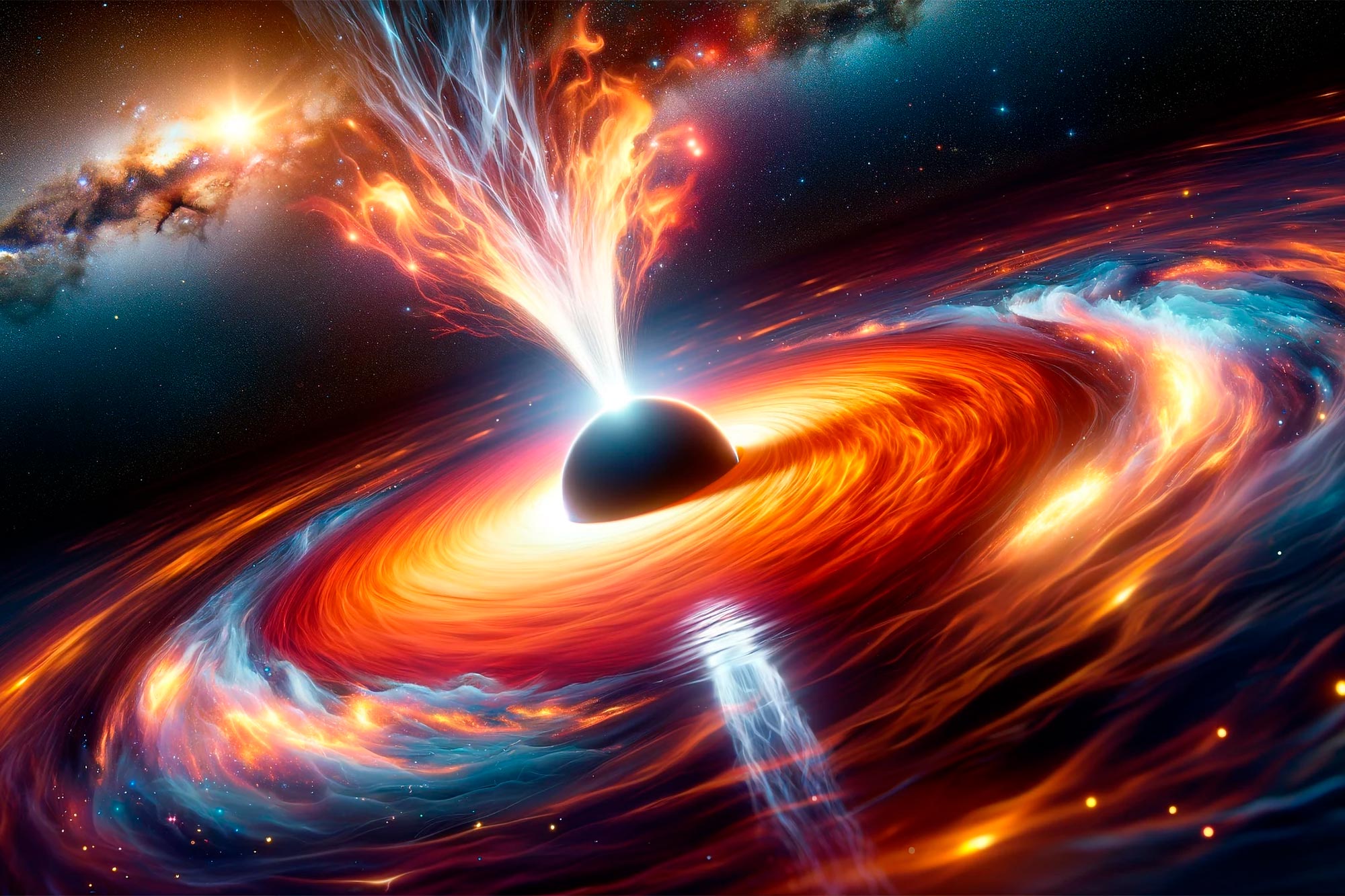
    Supermassive Black Hole Jet Art
    By using groundbreaking simulations, the study explores Tidal Disruption Events (TDEs), where stars are torn apart by black holes. This research has revealed a new type of shockwave in TDEs, altering our comprehension of their energy dissipation. These findings not only resolve a key theoretical debate but also pave the way for more accurate measurements of black hole properties and for testing Einstein’s theories in extreme gravitational environments. Credit: SciTechDaily.com

    New discoveries in Tidal Disruption Events enhance our understanding of supermassive black holes and their properties.

    A new study by Hebrew University is a significant breakthrough in understanding Tidal Disruption Events (TDEs) involving supermassive black holes. The new simulations, for the first time ever, accurately replicate the entire sequence of a TDE from stellar disruption to the peak luminosity of the resulting flare. This study has unveiled a previously unknown type of shockwave within TDEs, settling a longstanding debate about the energy source of the brightest phases in these events. It confirms that shock dissipation powers the brightest weeks of a TDE flare, opening doors for future studies to utilize TDE observations as a means to measure essential properties of black holes and potentially test Einstein’s predictions in extreme gravitational environments.

    The mysteries of supermassive black holes have long captivated astronomers, offering a glimpse into the deepest corners of our universe. Now, a new study led by Dr. Elad Steinberg and Dr. Nicholas C. Stone at the Racah Institute of Physics, The Hebrew University, sheds new light on these enigmatic cosmic entities.

    Supermassive black holes, ranging from millions to billions of times the mass of our Sun, have remained elusive despite their pivotal role in shaping galaxies. Their extreme gravitational pull warps spacetime, creating an environment that defies conventional understanding and presents a challenge for observational astronomers.
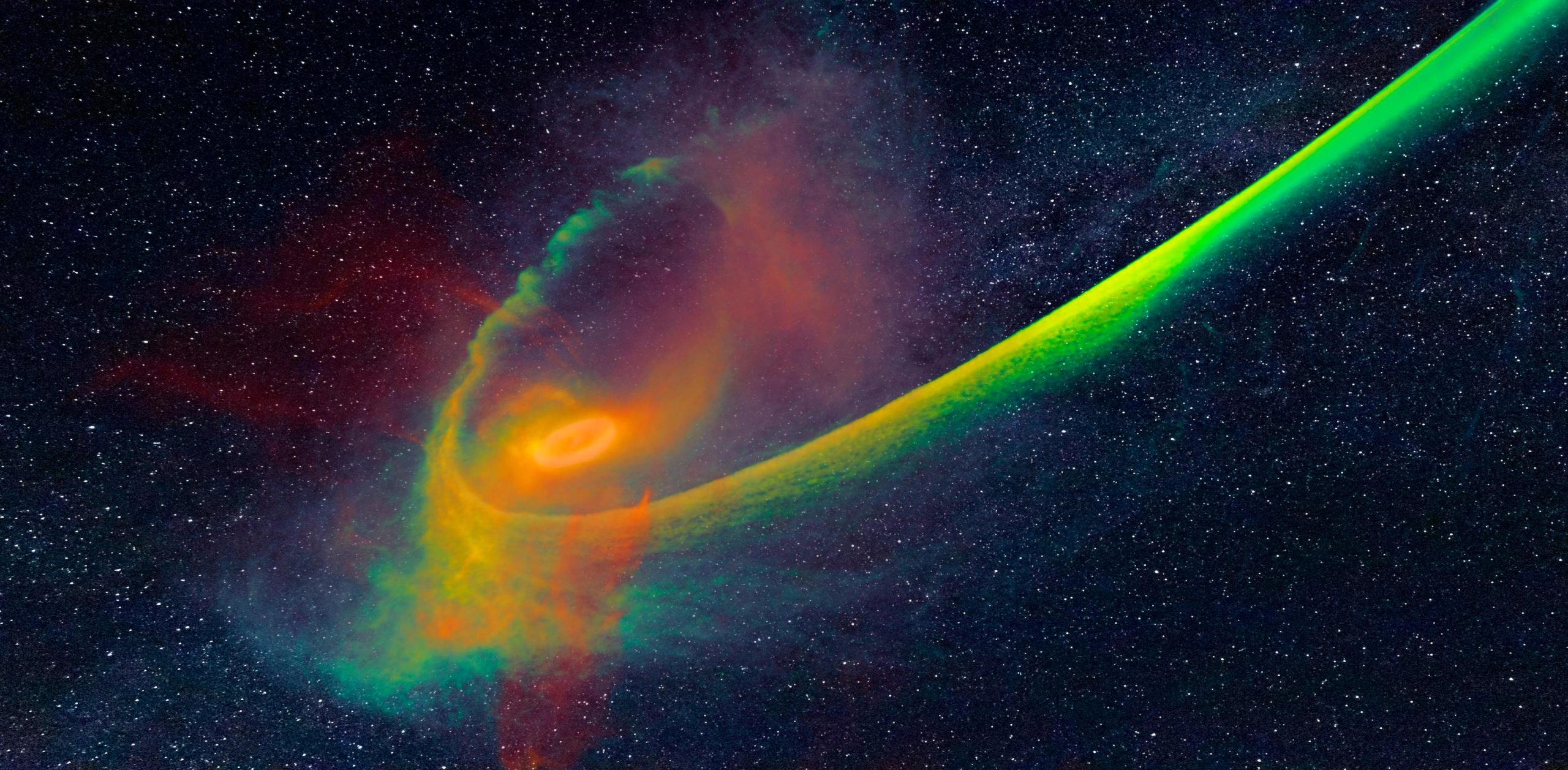
    Black Hole Devouring a Star
    A star in the midst of being disrupted by a supermassive black hole. As the star wanders past the supermassive black hole, the tidal field of the black hole rips apart the star. Half of the star is flung away to infinity and the other half falls back to the black hole. The picture shows the result of the simulation carried out by Steinberg and Stone, showing the density of the infalling half (green-blue color) as well as the heat that is generated by the shocks (white-red). Credit: Elad Steinberg

    Enter Tidal Disruption Events (TDEs), a dramatic phenomenon that occurs when ill-fated stars venture too close to a black hole’s event horizon, and are torn apart into thin streams of plasma. As this plasma returns toward the black hole, a series of shockwaves heat it up, leading to an extraordinary display of luminosity—a flare that surpasses the collective brightness of an entire galaxy for weeks or even months.

    The study conducted by Steinberg and Stone represents a significant leap forward in understanding these cosmic events. For the first time, their simulations have recreated a realistic TDE, capturing the complete sequence from the initial star disruption to the peak of the ensuing luminous flare, all made possible by pioneering radiation-hydrodynamics simulation software developed by Steinberg at The Hebrew University.

    This research has uncovered a previously unexplored type of shockwave within TDEs, revealing that these events dissipate their energy at a faster rate than previously understood. By clarifying this aspect, the study resolves a long-standing theoretical debate, confirming that the brightest phases of a TDE flare are powered by shock dissipation—a revelation that sets the stage for comprehensive exploration by observational astronomers.

    These findings pave the way for translating TDE observations into precise measurements of crucial black hole properties, including mass and spin. Moreover, these cosmic occurrences could serve as a litmus test for validating Einstein’s predictions in extreme gravitational environments.

    Steinberg and Stone’s study not only unravels the intricate dynamics of TDEs but also opens a new chapter in our quest to comprehend the fundamental workings of supermassive black holes. Their simulations mark a crucial step towards harnessing these celestial events as invaluable tools for deciphering the cosmic mysteries lurking at the heart of galaxies.

    Reference: “Stream–disk shocks as the origins of peak light in tidal disruption events” by Elad Steinberg, and Nicholas C. Stone, 17 January 2024, Nature.
    DOI: 10.1038/s41586-023-06875-y

    Never miss a breakthrough: Join the SciTechDaily newsletter.
    Follow us on Google and Google News.

    Astrophysics Black Hole The Hebrew University of Jerusalem
    Share. Facebook Twitter Pinterest LinkedIn Email Reddit

    Related Articles

    “Truly Extraordinary” – Supermassive Black Hole Found in the Last Place Scientists Expected

    Intermediate-Mass Black Hole Candidates Discovered at the Center of the Milky Way

    Study Challenges Prevailing Ideas About How Supermassive Black Holes Grow

    Gamma-Ray Beams Suggest Milky Way’s Central Black Hole Had Active Past

    Astronomers Observed Evolved Star Being Devoured

    The “Ordinary” Black Hole of Centaurus A

    Relationship Between Black Hole Growth and Star Formation in Seyfert Galaxies

    Scientists Convene to Take a Picture of the Supermassive Black Hole at the Center of the Milky Way

    Black Hole Fires Cosmic Bullets of Ionized Gases

    1 Comment

    1. Fixed gravity for you. on January 20, 2024 6:24 am

      No one knows why, but no one in charge of mob media can get enough of that wonderful “black hole” hasbara!

      Reply
    Leave A Reply Cancel Reply

    • Facebook
    • Twitter
    • Pinterest
    • YouTube

    Don't Miss a Discovery

    Subscribe for the Latest in Science & Tech!

    Trending News

    The Universe Is Expanding Too Fast and Scientists Can’t Explain Why

    “Like Liquid Metal”: Scientists Create Strange Shape-Shifting Material

    Early Warning Signals of Esophageal Cancer May Be Hiding in Plain Sight

    Common Blood Pressure Drug Shows Surprising Power Against Deadly Antibiotic-Resistant Superbug

    Scientists Uncover Dangerous Connection Between Serotonin and Heart Valve Disease

    Scientists Discover a “Protector” Protein That Could Help Reverse Hair Loss

    Bone-Strengthening Discovery Could Reverse Osteoporosis

    Scientists Uncover Hidden Trigger Behind Stem Cell Aging

    Follow SciTechDaily
    • Facebook
    • Twitter
    • YouTube
    • Pinterest
    • Newsletter
    • RSS
    SciTech News
    • Biology News
    • Chemistry News
    • Earth News
    • Health News
    • Physics News
    • Science News
    • Space News
    • Technology News
    Recent Posts
    • Scientists Create “Liquid Gears” That Spin Without Touching
    • The Simple Habit That Could Help Prevent Cancer
    • Forgotten Medicinal Plant Shows Promise in Fighting Dangerous Superbugs
    • Millions Take These IBS Drugs, But a New Study Finds Serious Risks
    • 5 Common Myths About Learning a New Language, Debunked
    Copyright © 1998 - 2026 SciTechDaily. All Rights Reserved.
    • Science News
    • About
    • Contact
    • Editorial Board
    • Privacy Policy
    • Terms of Use

    Type above and press Enter to search. Press Esc to cancel.