
Close Menu
    Facebook X (Twitter) Instagram
    SciTechDaily
    • Biology
    • Chemistry
    • Earth
    • Health
    • Physics
    • Science
    • Space
    • Technology
    Facebook X (Twitter) Pinterest YouTube RSS
    SciTechDaily
    Home»Biology»Drug (Cocaine, Methamphetamine, or Nicotine) Withdrawal Morphs Brain Communication Networks in Mice
    Biology

    Drug (Cocaine, Methamphetamine, or Nicotine) Withdrawal Morphs Brain Communication Networks in Mice

    By Society for NeuroscienceSeptember 27, 2021No Comments2 Mins Read
    Facebook Twitter Pinterest Telegram LinkedIn WhatsApp Email Reddit
    Share
    Facebook Twitter LinkedIn Pinterest Telegram Email Reddit
    Drug Withdrawal Morphs Brain Communication Networks in Mice
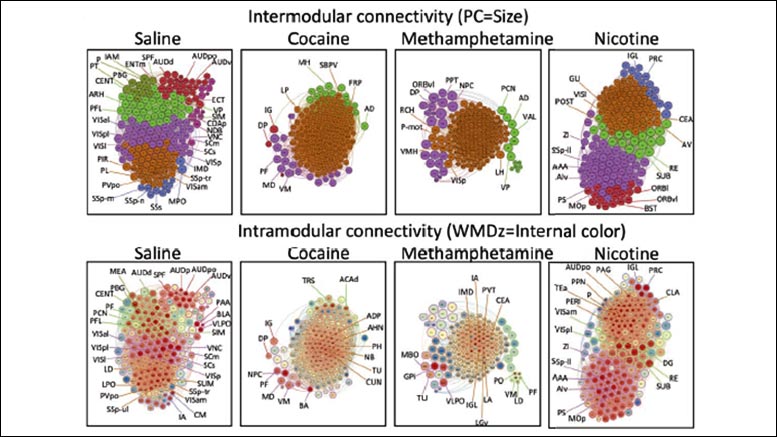
    Intramodular and intermodular network features of each treatment. Credit: Kimbrough et al., eNeuro

    Withdrawal from three different drugs shuffles brain networks in similar fashion.

    Zeroing in on specific brain regions when studying drug and alcohol abuse simplifies research but may leave out important insights. In fact, the landscape of the entire brain reorganizes during withdrawal, potentially hindering communication between regions, according to new research in mice published in eNeuro. 

    Kimbrough et al. administered psychostimulant drugs to mice (cocaine, methamphetamine, or nicotine) for one week then measured their neuronal activity during withdrawal. For all three drugs, the withdrawal brain state displayed increased functional connectivity — a measure of synchronized activity and communication between brain regions —compared to the control brain state. Withdrawal, however, shuffled which brain regions activated at the same time.

    The control brains displayed normal modularity, where small groups of brain regions activate together. The brains undergoing withdrawal, on the other hand, possessed large groups of coactivated brain regions, representing decreased modularity. This also occurs during traumatic brain injury and Alzheimer’s disease and implies impaired neural communication.

    These results indicate changes in brain modularity may be a universal effect of different types of addictive drugs.

    Reference: “Characterization of the Brain Functional Architecture of Psychostimulant Withdrawal Using Single-Cell Whole Brain Imaging” by Adam Kimbrough, Marsida Kallupi, Lauren C. Smith, Sierra Simpson, Andres Collazo and Olivier George, 27 September 2021, eNeuro.
    DOI: 10.1523/ENEURO.0208-19.2021

    Never miss a breakthrough: Join the SciTechDaily newsletter.
    Follow us on Google and Google News.

    Addiction Brain Neuroscience Society for Neuroscience
    Share. Facebook Twitter Pinterest LinkedIn Email Reddit

    Related Articles

    Gene Changes Linked to Severe Repetitive Behaviors Seen in Autism, Schizophrenia, and Drug Addiction

    Deep Inside the Brain: Neuroscientists Discover the Missing Piece of the Brain’s Multitasking Network

    Scientists Uncover Brain Mechanism That May Explain Why Sleep Helps You Learn

    Adult-Born Neurons Grow More Than Their Counterparts From Infancy – May Even Have Unique Functions

    Feeling Disconnected? Loneliness Alters Your Brain’s Social Network

    A Child’s Unique Brain Activity Reveals Their Memory Ability

    Unlocking the Neuroscience of How Experiencing Traumatic Stress Leads to Aggression

    Researchers Discover How Stress Restructures the Brain

    Functional Magnetic Resonance Imaging Shows How the Brain Repurposes Unused Regions

    Leave A Reply Cancel Reply

    • Facebook
    • Twitter
    • Pinterest
    • YouTube

    Don't Miss a Discovery

    Subscribe for the Latest in Science & Tech!

    Trending News

    Scientists Discover Cheap, Natural Remedy for High Blood Pressure

    Earth’s Upper Atmosphere Is Cooling Fast and Scientists Finally Know Why

    32,000 Olympic Pools of Magma Nearly Erupted Beneath Atlantic Island

    Exercise Changes the Heart in a Way Researchers Never Expected

    Too Much Sleep May Age Your Body Faster, New Study Warns

    Scientists Uncover Promising New Strategy To Stop Parkinson’s in Its Tracks

    Experts Reveal the Surprising Cancer Link Behind a Common Vitamin

    This Strange “Golden Orb” Found 2 Miles Deep Stumped Scientists for Years

    Follow SciTechDaily
    • Facebook
    • Twitter
    • YouTube
    • Pinterest
    • Newsletter
    • RSS
    SciTech News
    • Biology News
    • Chemistry News
    • Earth News
    • Health News
    • Physics News
    • Science News
    • Space News
    • Technology News
    Recent Posts
    • The Type of Alcohol You Drink Could Affect How Long You Live
    • 19-Year Study Reveals the Surprising Truth About Sitting and Dementia
    • This Common Vitamin May Help Stop Prediabetes From Turning Into Diabetes
    • Canada’s Billion-Year-Old Rocks Could Hold the Future of Clean Energy
    • Climate Change Is Quietly Choking Rivers Across the Planet
    Copyright © 1998 - 2026 SciTechDaily. All Rights Reserved.
    • Science News
    • About
    • Contact
    • Editorial Board
    • Privacy Policy
    • Terms of Use

    Type above and press Enter to search. Press Esc to cancel.