
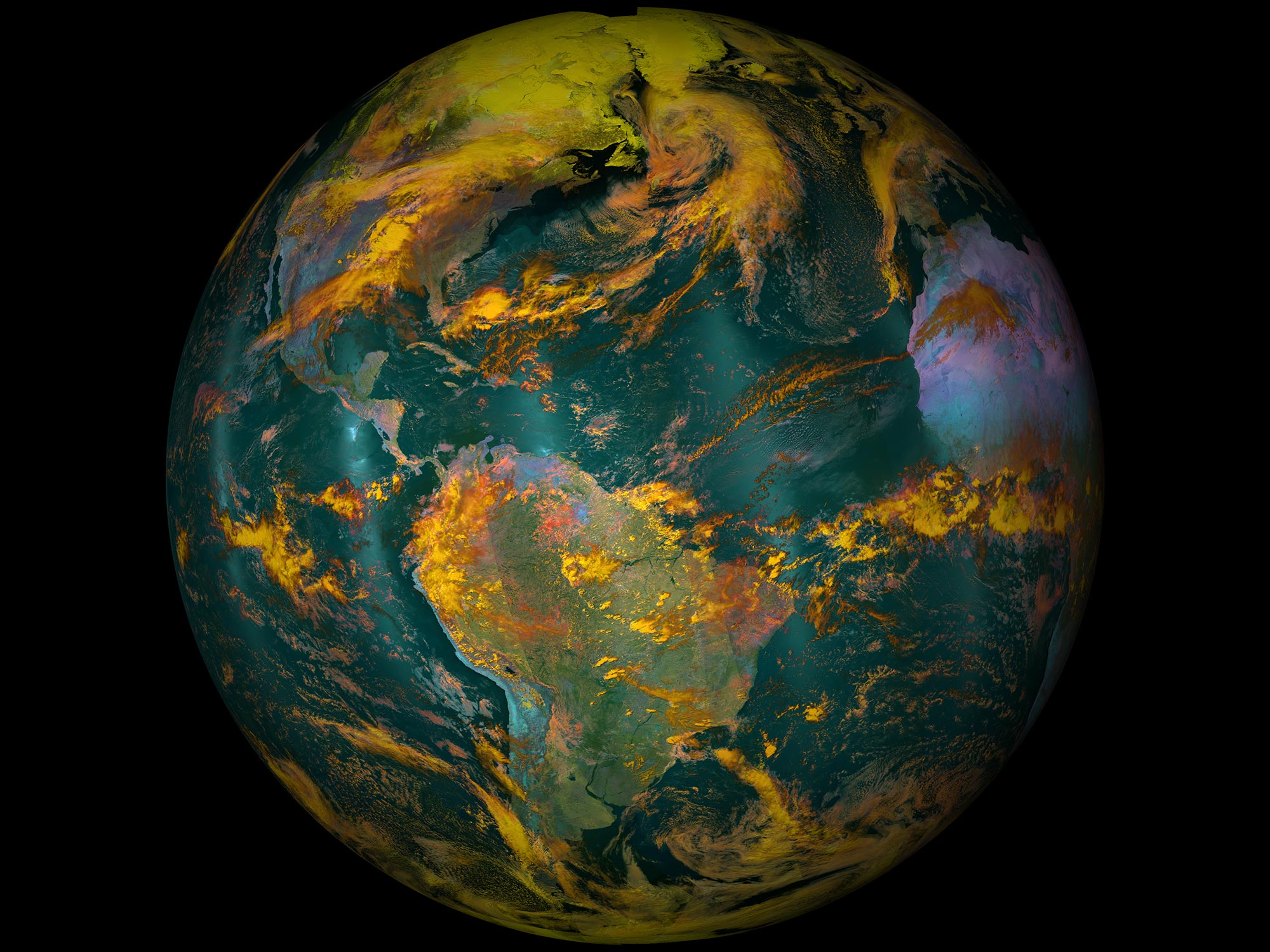
2021 Global Change Outlook from the MIT Joint Program on the Science and Policy of Global Change shows how more aggressive policies can sharply reduce climate risk.
The massive impact of the COVID-19 pandemic on lives and economies underscores that our collective survival and well-being hinges on our willingness to confront environmental threats that have global consequences. Key to protecting lives and making communities more resilient to such threats will be an emphasis on proactive, science-based decision-making at all levels of society. And among the most serious risks that science can help illuminate and alleviate are those resulting from human-induced climate change.
To minimize those risks, the Paris Agreement aims to commit nearly 200 nations to implement greenhouse gas emissions-reduction policies consistent with keeping the increase in the global average temperature since preindustrial times to well below 2 degrees Celsius (3.6 degrees Fahrenheit) — and pursue efforts to further limit that increase to 1.5 C (2.7 C). Recognizing that the first set of submitted near-term Paris pledges, known as Nationally Determined Contributions (NDCs), are inadequate by themselves to put the globe on track to meet those long-term targets and thus avoid the worst consequences of climate change, the accord calls for participating nations to strengthen their NDCs over time. To that end, the United States and a few other nations announced more stringent emissions-reduction goals for 2030 at the virtual climate summit convened by President Joe Biden in April.
To support decision-makers now engaged in or impacted by this ongoing, international effort to stabilize the climate, the MIT Joint Program on the Science and Policy of Global Change has released its 2021 Global Change Outlook. Based on a rigorous, integrated analysis of population and economic growth, technological change, NDCs, COVID-19 impacts, and other factors, the report presents the Joint Program’s latest projections for the future of the Earth’s energy, food, water and climate systems, as well as prospects for achieving the Paris Agreement’s short and long-term climate goals.
Projections are provided for a baseline “Paris Forever” scenario, in which current (as of March 2021) NDCs are maintained in perpetuity; a Paris 2 C scenario that caps global warming at 2 C by 2100; and two scenarios — “Accelerated Actions” (which includes the newly announced U.S. goal for 2030) and Paris 1.5 C — which limit warming to 1.5 C by 2100. Uncertainty is quantified using 400-member ensembles of projections for each scenario. This year’s outlook introduces a visualization tool that enables a higher-resolution exploration of the first three scenarios.
Energy
More aggressive emissions-reduction policies would accelerate a shift away from fossil fuels and toward renewable energy sources between now and 2050.
Under the Paris Forever scenario, the share of fossil fuels in the world’s energy mix drops during this period from about 80 percent to 70 percent, wind and solar expand nearly six-fold and natural gas by 50 percent, and electric vehicles (EVs) account for 38 percent of the light-duty vehicle (LDV) fleet. In the Paris 2 C scenario, the fossil fuel share drops to about 50 percent, wind and solar energy grow almost nine times and natural gas use expands by 25 percent, and EVs account for 50 percent of the global LDV fleet. The Accelerated Actions scenario squeezes out fossil fuels further and makes two-thirds of global LDVs electric.
“Electricity generation from renewable sources becomes a dominant source of power by 2050 in all scenarios, providing 70-80 percent of global power generation by mid-century in the climate stabilization scenarios,” says Joint Program Deputy Director Sergey Paltsev, a lead author of the report. “Climate policies essentially eliminate coal-based generation, while natural gas still keeps a sizeable share because of the need to support variable renewables. Resolving long-term energy storage issues are critical to full decarbonization.”
Food and Water
Under the Paris Forever scenario, agriculture and food production will keep growing. This will increase pressure for land-use change, water use, and use of energy-intensive inputs, which will also lead to higher greenhouse gas (GHG) emissions. The Paris 2 C scenario shows low impacts on agriculture and food production trends by mid-century. Although economic growth tends to shift demand toward more protein-rich food sources, higher carbon costs associated with livestock production drive demand downward, decreasing its prices, and such impacts are transmitted to the food sector.
The Paris Forever scenario indicates that more than half of the world’s population will undergo stresses on its water supply by 2050, and that three of every 10 people will live in water basins where compounding societal and environmental pressures on water resources will be experienced. The majority of expected increases in population under heightened water stress by mid-century cannot be avoided or reduced by climate mitigation efforts alone. Worldwide increases in population, economic growth, and associated water demands are largely a challenge of sustainability — one that can only be alleviated through widespread transformations of water systems’ storage capacity, conveyance, and water-use efficiencies.
Climate and Paris Goals
The outlook shows a wide gap between current (as of March 2021) GHG emissions-reduction commitments and those needed to put the world on track to meet the Paris Agreement’s long-term climate goals.
“Our projected global climate responses under the Paris Forever scenario indicate with near-certainty that the world will surpass critical GHG concentration thresholds and climate targets in the coming decades,” says Joint Program Deputy Director C. Adam Schlosser, a lead author of the report.
Under Paris Forever, the world is likely to exceed 2 C global climate warming by 2065, 2.8 C (5 F) by 2100, and 4.1 C (7.4 F) by 2150. While many countries have made good progress toward their NDCs and declared more ambitious GHG emissions mitigation goals, financing to assist the least-developed countries in sustainable development is not forthcoming at the levels needed.
The report’s projections indicate that the long-term climate targets of the Paris Agreement remain achievable, but come with different levels of risk. The Paris 2 C scenario shows negligible likelihood of even the “coolest” trajectories remaining below 1.5 C at the end of the century. The Paris 1.5 C scenario, however, can virtually assure the world of remaining below 2 C of global warming.
An important consequence of climate change is altered precipitation levels. Between now and 2050 under Paris Forever, global precipitation will likely increase by about 1.5 centimeters (0.6 inches) per year — approximately an additional 7,400 cubic kilometers (or nearly 2 quadrillion gallons) each year. By 2100, the total change in precipitation will most likely rise to about 4 cm/year (or 21,200 km3/yr) — nearly triple that of the mid-century change. Paris 2 C halves global precipitation increases, and Paris 1.5 C reduces them to almost a third of the Paris Forever increases. These aggressive mitigation scenarios convey considerable reductions in flood risk and associated adaptation costs.
Reducing Climate Risk
For the first time, the outlook explores two well-known sets of risks posed by climate change. Research highlighted in this report indicates that elevated climate-related physical risks will continue to evolve by mid-century, along with heightened transition risks that arise from shifts in the political, technological, social, and economic landscapes that are likely to occur during the transition to a low-carbon economy.
“Our outlook shows that we could dramatically reduce overall climate risk through more ambitious and accelerated policy measures and investments aligned with meeting the Paris Agreement’s long-term 1.5 C or 2 C climate targets,” says MIT Joint Program Director Ronald Prinn. “Decision-makers in government, industry, and financial institutions can play a key role in moving us further along this path.”
Reference: 2021 Global Change Outlook
Never miss a breakthrough: Join the SciTechDaily newsletter.
Follow us on Google and Google News.
1 Comment
More science, less politics. Puh-leeeeze.