
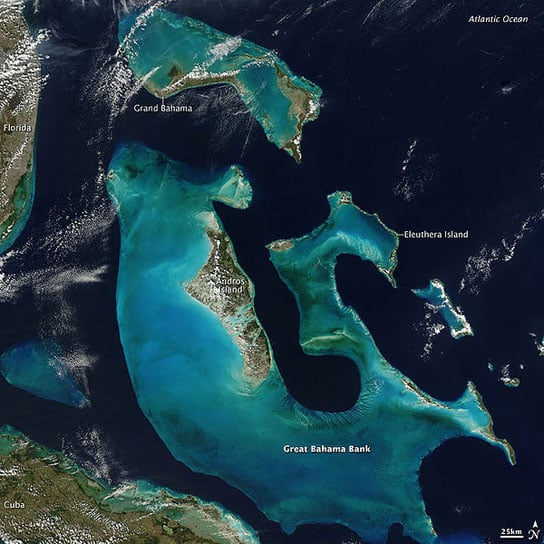
Scientists agree that the ocean levels are increasing as the global temperature warms, but how high they will go is the question. By studying where the shorelines stood on coral reefs and cliffs in the Bahamas and Bermuda 400,000 years ago, new research suggests that past estimates of sea-level rise may have been inflated.
The seas are creeping higher as the planet warms. But how high could they go?
Projections for the year 2100 range from inches to several feet, or even more.
The sub-tropical islands of Bermuda and the Bahamas are two seemingly unlikely places scientists have gone looking for answers.
The cliffs and ancient reefs on Bermuda and the Bahamas have lured fossil hunters for decades. The land of the Bahamas, for example, has a foundation of fossil coral; the stone is derived from the disintegration of age-old coral reefs and seashells.
These areas are now attracting scientists investigating global sea level rise.
By pinpointing where the shorelines stood on cliffs and coral reefs in the Bahamas and Bermuda during an extremely warm period 400,000 years ago, researchers hope to narrow the range of global sea-level projections for the future.
After correcting for what they say was sinking of these islands at that time, scientists estimate that the seas rose 20 feet to 43 feet higher than today–up to a third less than previous estimates, though still a drastic change.
The study infers that the Greenland and West Antarctica ice sheets collapsed during the ancient warm period, but that ice loss from the vast East Antarctic Ice Sheet was negligible.
The results are reported in this week’s issue of the journal Nature.
“Our research provides a simple explanation for high beach deposits [such as fossils in the Bahamas],” said the paper’s lead author Maureen Raymo, a scientist at Columbia University’s Lamont-Doherty Earth Observatory.
The average global sea level rose eight inches (20 centimeters) since the 1880s, and is currently rising an inch (2.5 centimeters) per decade, driven by thermal expansion of seawater and melting of glaciers and ice sheets, including the still mostly intact ice in Greenland and West Antarctica.
In its most recent report, the Intergovernmental Panel on Climate Change estimated that the seas could rise up to two feet by 2100.
That number could go higher depending on the amount of ice melt and the quantity of greenhouse gas emissions.
The United Nations estimates a five-foot (1.5-meter) sea-level rise would be enough to swamp 17 million people in low-lying Bangladesh alone.
The new study factors in the loading and unloading of ice from North America during the ice ages preceding the long-ago sea-level rise.
As the ice sheets grew, their weight pushed down the land beneath them while causing land at the edges–Bermuda and the Bahamas–to bulge upward, says Raymo.
When the ice pulled back, the continent rebounded, and the islands sank.
“We’re re-thinking many of our estimates of past sea-level rise now that we’re more aware of the effects of unloading of ice,” said Bil Haq, program director in the National Science Foundation’s (NSF) Division of Ocean Sciences, which funded the research. “We now have a meaningful way of calculating the rebound.
“This study is a good example of collaboration between paleoceanography and geophysics to resolve an important issue: the question of future sea-level rise.”
Today, both Greenland and West Antarctica are losing mass in a warming world, but signals from East Antarctica are less clear.
Raymo said the research helps show that “catastrophic collapse” of the East Antarctic ice is probably not a threat today.
“However, we do need to worry about Greenland and West Antarctica.”
Reference: “Collapse of polar ice sheets during the stage 11 interglacial” by Maureen E. Raymo and Jerry X. Mitrovica, 14 March 2012, Nature.
DOI: 10.1038/nature10891
Never miss a breakthrough: Join the SciTechDaily newsletter.
Follow us on Google and Google News.
4 Comments
“That number could go higher depending on the amount of ice melt and the quantity of greenhouse gas emissions.”
The only way that a calculation can be made is by assuming a given volume of ice melt, and the temperature change (thermosteric expansion) of the water. (Even so, there is still uncertainty about the actual volume of the ocean basins and whether an increase in the water volume will depress the basins, increasing the basin volume.) The role of greenhouse gas emissions (GHGE) is speculation, based on models that presume to predict future temperatures based on GHGE. One might similarly speculate on the role of under-ice volcanic activity in West Antarctica, as influencing ice melt.
“The role of greenhouse gas emissions (GHGE) is speculation, based on models that presume to predict future temperatures based on GHGE.” -Clyde
Reviews of old global warming studies (e.g. Hausfather,et al 2020, Geophysical Research Letters) have shown that even the early models were quite skilled at predicting the warming that has occurred since then. Even Hansen’s 1988 model overshot not because of a fundamental problem in physics but due to an overestimate of future methane emissions and not anticipating the Montreal Protocol’s effect on CFC levels. We moved passed the “speculation” phase decades ago.
“One might similarly speculate on the role of under-ice volcanic activity in West Antarctica, as influencing ice melt.” -Clyde
The absence of a hole in the ice from a rare Tonga-scale eruption suggests that volcanic activity consists of smaller and therefore more frequent events, typified by Mt. Erebus, erupting during its 1841 discovery and repeatedly thereafter, and bearing a persistent lava lake. Such activity, especially averaged over the entire western Antarctic, would suggest a relatively consistent energy input over time. One might even note that the rifting causing much of the current volcanic activity started long before the current ice sheet, and yet somehow ice was able to build up over the top of it. Volcanic activity suddenly increasing in a 50 year window of the ice sheet’s 34 million year history exactly when humans started releasing large amounts of CO2 is improbable, though not impossible.
“The only way that a calculation can be made is by assuming a given volume of ice melt, and the temperature change (thermosteric expansion) of the water. (Even so, there is still uncertainty about the actual volume of the ocean basins….” -Clyde
Ocean basin volume is not as uncertain as you make it out to be, but more importantly, is largely irrelevant, as the ocean basins are already full of water. New water volume will have to occur at the surface and intruding into the exquisitely mapped land near the shore.
“whether an increase in the water volume will depress the basins, increasing the basin volume.” -Clyde
Since it will be spread thinly and relatively evenly over the entire surface of all the oceans, the effect will be negligible (but on a similarly large time scale) compared situations where a smaller area receives (or is relieved of) a much larger weight, such as the isostatic rebound of the Earth’s surface after the melting of a 2 mile high ice sheet covering only the northern third of North America/Eurasia after the last glacial.