
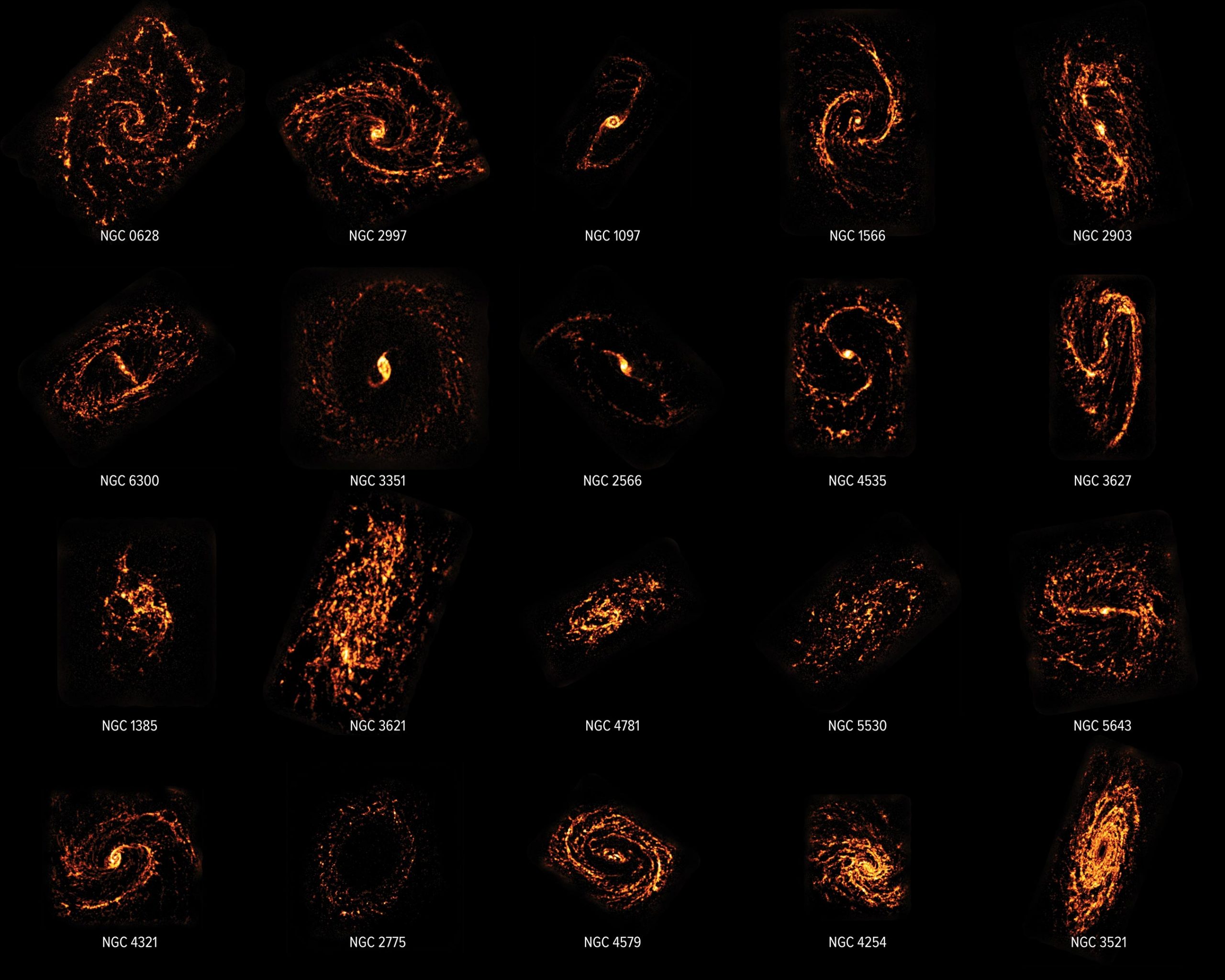
Study of Nearby Galaxies Gives New Insights Into Star Formation
Astronomers have taken a big step forward in understanding the dark and violent places where stars are born.
Over the past five years, an international team of researchers has conducted the first systematic survey of “stellar nurseries” across our part of the universe, charting the more than 100,000 of these nurseries across more than 90 nearby galaxies and providing new insights into the origins of stars.
“Every star in the sky, including our own sun, was born in one of these stellar nurseries,” said Adam Leroy, associate professor of astronomy at The Ohio State University and one of the leaders of the project.
“These nurseries are responsible for building galaxies and making planets, and they’re just an essential part in the story of how we got here. But this is really the first time we have gotten a complete view of these stellar nurseries across the whole nearby universe.”
The project is called PHANGS-ALMA, and the research was possible thanks to the ALMA telescope array high in the Andes mountains in Chile.
ALMA, the most powerful radio telescope in the world, is an international facility with heavy U.S. involvement led by the National Science Foundation and National Radio Astronomy Observatory.
The power of this facility allowed the team to survey the stellar nurseries across a diverse set of 90 galaxies, while previous studies had mostly focused only on an individual galaxy or a part of one galaxy.
Seeing the Universe in Gas and Dust
“When optical telescopes take pictures, they capture the light from stars. When ALMA takes a picture, it sees the glow from the gas and dust that will form stars,” said Jiayi Sun, an Ohio State PhD student who is completing a dissertation based on the survey this month.
“The new thing with PHANGS-ALMA is that we can use ALMA to take pictures of many galaxies, and these pictures are as sharp and detailed as those taken by optical telescopes. This just hasn’t been possible before.”
The survey has expanded the amount of data on stellar nurseries by more than tenfold, Leroy said. That has given astronomers a much more accurate perspective of what these nurseries are like across our corner of the universe.
Based on these measurements, they have found that stellar nurseries are surprisingly diverse across galaxies, live only a relatively short time in astronomical terms, and are not very efficient at making stars.
The diversity of these stellar nurseries came as something of a surprise.
Environment Shapes Star Formation Efficiency
“For a long time, conventional wisdom among astronomers was that all stellar nurseries looked more or less the same,” Sun said.
“But with this survey we can see that this is really not the case. While there are some similarities, the nature and appearance of these nurseries change within and among galaxies, just like cities or trees may vary in important ways as you go from place to place across the world.”
For example, nurseries in larger galaxies, and those in the center of galaxies, tend to be denser and more massive, and much more turbulent, he said. Star formation is much more violent in these clouds, findings suggest.
“So the properties of these nurseries and even their ability to make stars seem to depend on the galaxies they live in,” Sun said.
Stars Disrupt the Clouds That Birthed Them
Results from the survey also showed that these stellar nurseries live for only 10 to 30 million years, which is a relatively short time in astronomical terms. And the team used the same measurements to gauge how efficiently these stellar nurseries turned their gas and dust into stars – and it turned out they weren’t that efficient.
“This survey is allowing us to build a much more complete picture of the life cycle of these regions, and we’re finding they are short-lived and inefficient,” Leroy said.
“It’s not random chance destroying these nurseries, but the new stars that they make. They are very ungrateful children.”
The radiation and heat that come out of these young stars begin to disperse and dissolve the clouds, eventually destroying them before they can convert most of their mass.
After more than five years of observations, the survey was recently completed and summarized by the PHANGS-ALMA team in two recent papers accepted to the Astrophysical Journal Supplement Series.
The publication of these two new papers marks a milestone, and the data collected by the project team is now publicly available. The researchers have already used PHANGS-ALMA to produce more than 20 scientific publications. Ten papers detailing the outcomes of the PHANGS survey were recently presented at the 238th meeting of the American Astronomical Society.
“We have an incredible dataset here that will continue to be useful,” Leroy said. “This is really a new view of galaxies and we expect to be learning from it for years to come.”
For more on this research, read Map of the Nearby Universe Created by Cosmic Cartographers Reveals the Diversity of Star-Forming Galaxies.
Reference: “PHANGS-ALMA: Arcsecond CO(2-1) Imaging of Nearby Star-Forming Galaxies” by Adam K. Leroy, Eva Schinnerer, Annie Hughes, Erik Rosolowsky, Jérôme Pety, Andreas Schruba, Antonio Usero, Guillermo A. Blanc, Mélanie Chevance, Eric Emsellem, Christopher M. Faesi, Cinthya N. Herrera, Daizhong Liu, Sharon E. Meidt, Miguel Querejeta, Toshiki Saito, Karin M. Sandstrom, Jiayi Sun, Thomas G. Williams, Gagandeep S. Anand, Ashley T. Barnes, Erica A. Behrens, Francesco Belfiore, Samantha M. Benincasa, Ivana Bešlić, Frank Bigiel, Alberto D. Bolatto, Jakob S. den Brok, Yixian Cao, Rupali Chandar, Jérémy Chastenet, I-Da Chiang, Enrico Congiu, Daniel A. Dale, Sinan Deger, Cosima Eibensteiner, Oleg V. Egorov, Axel García-Rodríguez, Simon C. O. Glover, Kathryn Grasha, Jonathan D. Henshaw, I-Ting Ho, Amanda A. Kepley, Jaeyeon Kim, Ralf S. Klessen, Kathryn Kreckel, Eric W. Koch, J. M. Diederik Kruijssen, Kirsten L. Larson, Janice C. Lee, Laura A. Lopez, Josh Machado, Ness Mayker, Rebecca McElroy, Eric J. Murphy, Eve C. Ostriker, Hsi-An Pan, Ismael Pessa, Johannes Puschnig, Alessandro Razza, Patricia Sánchez-Blázquez, Francesco Santoro, Amy Sardone, Fabian Scheuermann, Kazimierz Sliwa, Mattia C. Sormani, Sophia K. Stuber, David A. Thilker, Jordan A. Turner, Dyas Utomo, Elizabeth J. Watkins, Bradley Whitmore, 24 November 2021, The Astrophysical Journal Supplement Series.
DOI: 10.3847/1538-4365/ac17f3
arXiv: 2104.07739
Never miss a breakthrough: Join the SciTechDaily newsletter.
Follow us on Google and Google News.