
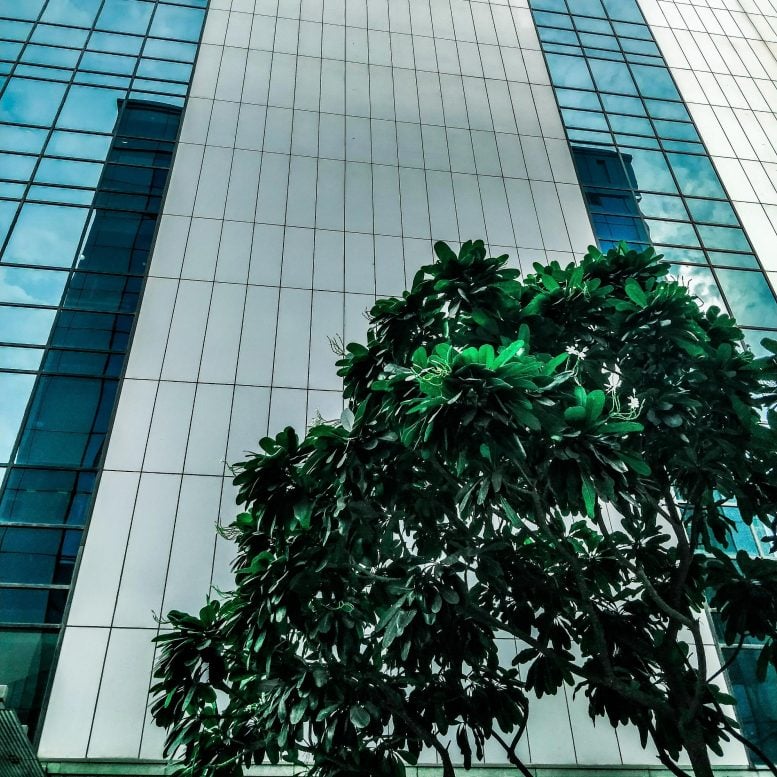
Individual trees in urban areas provide cooling during evening, research shows.
A single tree along a city street or in a backyard can provide measurable cooling benefits, according to a new study from American University. The research shows that “distributed” trees, those that are stand-alone and scattered throughout urban neighborhoods, can help to reduce evening heat. The research suggests that planting individual trees can be a strategy to mitigate urban heat, particularly in areas where land for parks can be scarce.
“There are plenty of good reasons to plant trees, but our study shows we shouldn’t underestimate the role that individual trees can play in mitigating heat in urban areas,” said Michael Alonzo, assistant professor of environmental science and lead author of the new study. “City planners can take advantage of the small spaces that abound in urban areas to plant individual trees.” The study is published in Environmental Research Letters.
Evening and Nighttime Cooling from Distributed Trees
While urban parks provide important mid-day cooling for residents and visitors, the key to cooling from individual trees happens in the evening. In the new study, which was conducted in Washington, D.C., cooling benefits from distributed trees were found to occur around 6 or 7 p.m. and after sunset. The study revealed lower temperatures in neighborhoods where at least half the area was covered by canopy from distributed trees. Temperatures were 1.4 degrees Celsius (2.52 degrees Fahrenheit) cooler in the evening compared with areas with few trees. Even in the predawn hour, areas with only modest distributed canopy cover (about 20 percent of the area) were cooler than those with no trees, showing that on average, afternoon and evening cooling effects last well into the night, Alonzo added.
To arrive at the findings, Alonzo and his colleagues examined air temperature readings. The data was collected over one hot summer day in 2018, across different areas in Washington, D.C. and at multiple times throughout the day, resulting in more than 70,000 air temperature readings. In their analysis, Alonzo and his colleagues examined tree canopy over paved surfaces, over unpaved surfaces, and both patches such as parks, and distributed trees, such as those one might plant in their back or front yards.
The new study confirms that planting individual trees should be considered as part of a strategy to combat rising temperatures in urban areas. In hot summer months many cities across the United States turn into “heat islands.” Due to the urban heat island effect, urban areas, with fewer green spaces and higher amounts of impervious surface, get hotter compared to their rural surroundings.
Expanding Tree Equity and Access in Cities
In urban areas, people are more likely to live adjacent to distributed trees rather than parks. In D.C., there are many places to plant individual trees where canopy will shade paved or unpaved surfaces: on streets with single family homes, streets with rowhouses, backyard or small park plantings, Alonzo said. This opens up avenues for increasing the racial and socioeconomic equity of tree planting, but more effort is required to first reduce impervious surface cover in the most built-up residential and commercial districts, Alonzo added. The top five trees along D.C.’s streets include several species of maples, oaks and elms, all of which provide plentiful shade.
Climate studies show that urban temperatures are warming at all times of day including evenings. Yet studying the cooling benefits from individual trees, as well as their benefits during evening hours, has not been widely researched, Alonzo said, and this is an area scientists should continue to explore. More research will be needed in other locations in the United States and under different weather conditions. Alonzo also plans to conduct more research and has collected air temperature readings by bicycle around D.C. during the pandemic.
Though the study was conducted in D.C., Alonzo said the findings are likely applicable along the East Coast or in other cities with a similar climate.
“Evenings are not quite the respite from heat that we once had,” Alonzo said. “These distributed trees do help the city cool off in the evening and that’s important for human health.”
Reference: “Spatial configuration and time of day impacts the magnitude of urban tree canopy cooling” by Michael Alonzo, Matthew E Baker, Yuemeng Gao and Vivek Shandas, 9 July 2021, Environmental Research Letters.
DOI: 10.1088/1748-9326/ac12f2
Never miss a breakthrough: Join the SciTechDaily newsletter.
Follow us on Google and Google News.
1 Comment
This isn’t exactly news. My best friend in high school went on to get a master’s degree in environmental studies in the early-1970s. His thesis was on the urban heat island effect and the role of trees in its mitigation. We have known about the problem and the tree solution for at least 50 years.
However, it hasn’t caught on. Perhaps because many people are insulated from the heat by air conditioning and worry about other things. Probably zoning regulations play a role because most cities don’t want people treating city land as though it were private property. Trees surrounded by pavement need to be watered, pruned, and treated if they become diseased; the leaves create extra costs for a city to clean them up in the Fall. The solution exists, but there needs to be a political will to apply the solution. Thus far, there hasn’t been one. They have other priorities.