
Honoring a Trailblazing Paleontologist
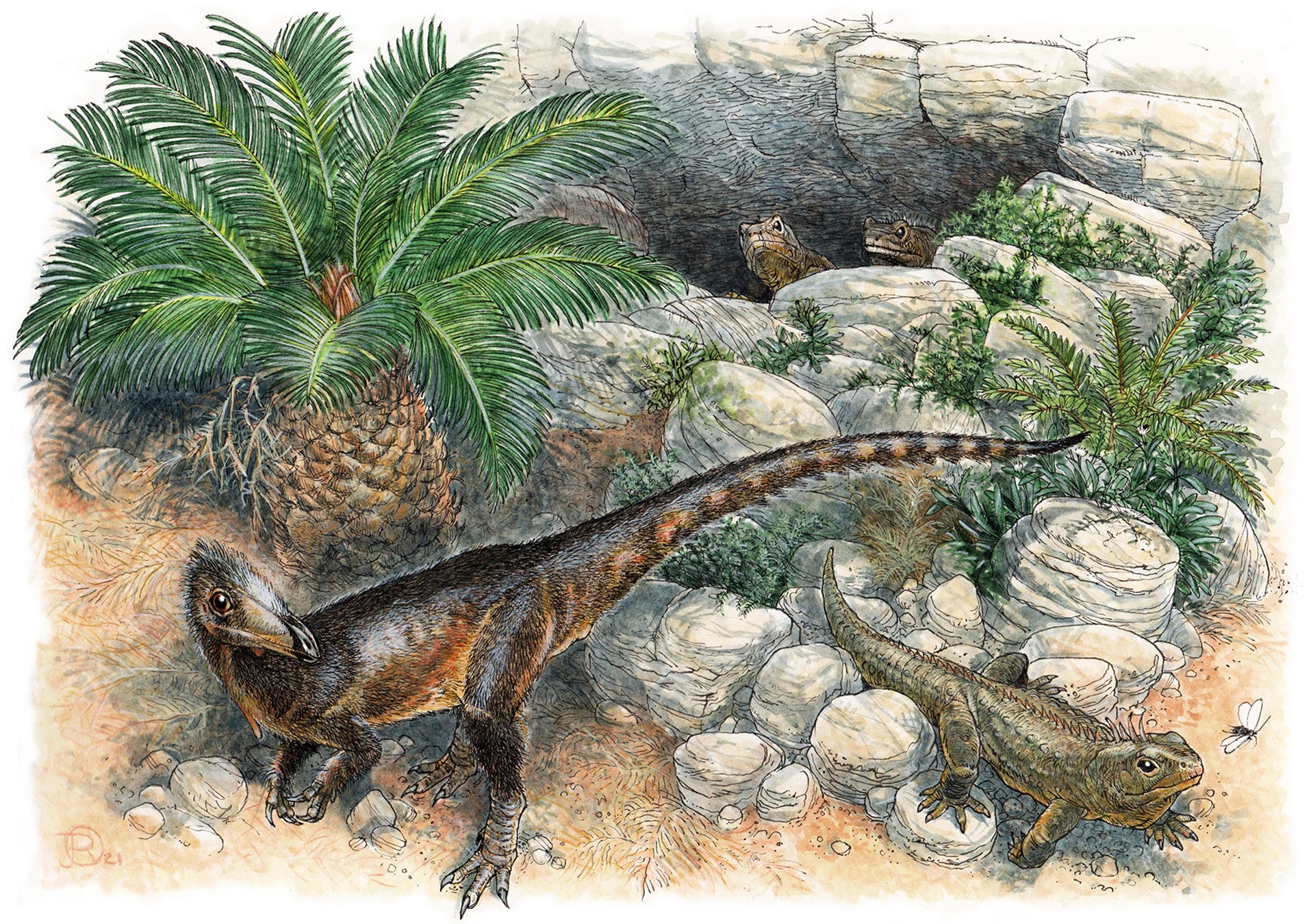
The oldest-known meat-eating dinosaur discovered in the UK has been named in honor of trailblazing Museum scientist Angela Milner, who passed away in August 2021.
The small carnivorous dinosaur lived over 200 million years ago in what is now Wales. Discovered in a quarry in the 1950s, it was initially thought to be part of a different group of dinosaurs altogether, but scientists have now realized it represents an entirely new species, Pendraig milnerae.
Its name honors both its Welsh origins and Angela Milner, a paleontologist at the Museum who was the driving force behind its Dinosaurs gallery and who named a variety of new species herself.
As well as being a leading light in the field for decades, the naming also reflects Angela’s help in relocating the dinosaur after it went missing in the Museum for many years.
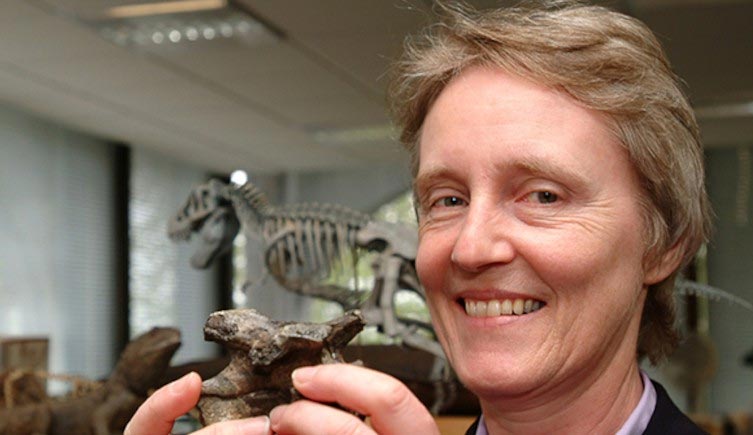
Dr. Susannah Maidment, a senior researcher in paleobiology at the Museum who studied under Angela, says, ‘I told her that I couldn’t find it, and so she went away and about three hours later she had it.
‘She found it in a drawer of crocodile material, and she must have had the specimen in her mind’s eye from when she had previously looked through it. This paper would not have been possible without her.’
The new species has been described in the journal Royal Society Open Science.
Missing in Action
The new species has something of a mysterious past, having been lost, found, and renamed over the last 40 years.
It was originally discovered at Pant-y-ffynnon in southern Wales, in a type of deposit known as a fissure fill. This is where remains fell into crevices before being covered over and fossilizing.
Over the years these fissure fills have provided a variety of fossils dating to the Triassic Period, giving researchers a look at the early evolutionary history of mammals, crocodiles, and dinosaurs.
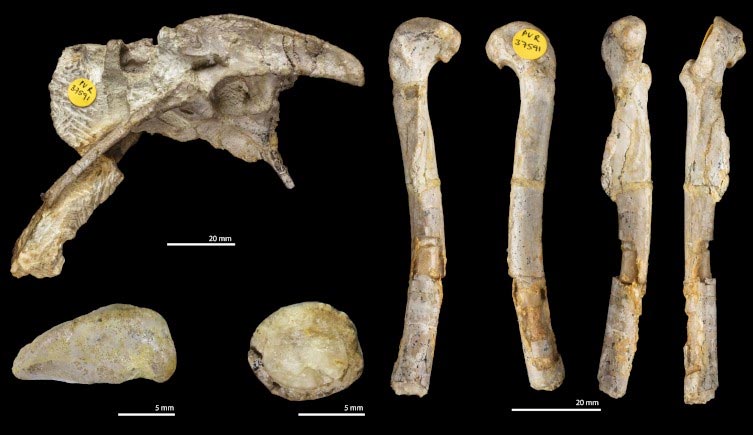
In 1952 a few of the dinosaur’s bones, including parts of the back, legs, and hips, were discovered from one of the fissures. Though it may not have been much to go on, the researchers were able to discern that the animal was probably a coelophysoid. This was a smaller, carnivorous dinosaur with a long, narrow snout, common to the Late Triassic and Early Jurassic.
The species is the oldest-known theropod dinosaur found in the UK and represents a major leap in our understanding of the early evolution of Europe’s dinosaurs.
Dr. Stephan Spiekman, a research fellow at the Museum and the paper’s lead author, says, ‘There is no obvious character that set this species apart. It has a certain combination of several characters that are unique amongst its group, which showed to us it was clearly a new species.’
It is thought that the small size of P. milnerae could be because the bones come from a juvenile. The adult animal may have grown larger than the specimen discovered in Wales, but due to the process of fossilization, this can’t be confirmed.
This is further complicated by its presumed habitat, which is thought to have been an island archipelago. Species living on islands often get smaller due to the reduced resources available for them, as well as a lack of larger predators. This shrinking is a process known as island dwarfism.
Because of this, there has been a lot of uncertainty around the exact identity of the dinosaur.
Fossils of juvenile animals often don’t show all the distinctive features that help set a species apart from another. In the case of this dinosaur, this has caused a lot of confusion over the years, with scientists in the 1990s initially describing it as a species of Syntarsus.
However, this name was dropped shortly afterward after scientists decided the Syntarsus species were actually related to other groups and reassigned them, so further study was required.
But when scientists went to look for the bones to re-evaluate it in the wake of these changes, the remains were not where the researchers thought they were. The hunt for the bones would require help from an expert in paleontology and an old hand at the Museum, and so the researchers turned to Dr Angela Milner.
‘Claw Blimey’
Angela was an influential figure in paleontology during and after her four-decade-long career. She was a specialist in tetrapods (four-legged vertebrates) including mammals, reptiles, and amphibians.
In 1976 she joined the Museum as a curator and began expanding her research across a range of dinosaurs. In 1983, she and fellow paleontologist Alan Charig formally described the newly discovered Baryonyx walkeri, a large carnivorous dinosaur whose distinctive giant hand claw led to the headline ‘Claw blimey! A new dinosaur!’ in The Sun newspaper.
In addition to the new research she led, Angela’s years at the Museum gave her a deep understanding of how best to educate the public on dinosaurs. She was instrumental in developing the Museum’s Dinosaurs gallery, showcasing many iconic species including some she had been involved in naming.
Angela’s work across so many areas of the Museum proved inspirational to those who worked with her.
Susannah says, ‘Angela was really important in the Museum for many years. She was not only the premier dinosaur researcher but also in a senior position when women didn’t have those roles in the museum, so for me as a student it was really important.
‘She really inspired me and was incredibly helpful when I joined the Museum. She went out of her way to show me the ropes, and that goes for me and so many others, including three of us on this paper.’
The species was named in Angela’s honour, joining a number of other species, such as Veterupristisaurus milneri, that also bear her name. This includes a species of spinosaurid dinosaur, Riparovenator milnerae, which was recently named after her.
The researchers now hope to dig deeper into the life of P. milnerae and the fauna it lived alongside, to prove whether its size was a result of island dwelling.
Reference: “Pendraig milnerae, a new small-sized coelophysoid theropod from the Late Triassic of Wales” by Stephan N. F. Spiekman, Martín D. Ezcurra, Richard J. Butler, Nicholas C. Fraser and Susannah C. R. Maidment, 6 October 2021, Royal Society Open Science.
DOI: 10.1098/rsos.210915
Never miss a breakthrough: Join the SciTechDaily newsletter.
Follow us on Google and Google News.
3 Comments
And how, exactly, did they determine that this creature was “Oldest Meat-Eating Dinosaur” in the UK? Is our science that accurate? Really?
This must be “Wee Rex”
The femur looks like a gator it’s a coelophysis it’s a early dinosaur.tetanuran femur look different that what I herd.gator is the last living dinosaur clearly it is most advance dinosaur ever it’s alive.I do not think tetanuran is closely related to 4 finger dinosaur yeah ceratosaurus has the most sensoritive face in the animal kingdom like the gator tetanuran .it’s convergent evolution a lot of primitive dinosaur have advance feature