
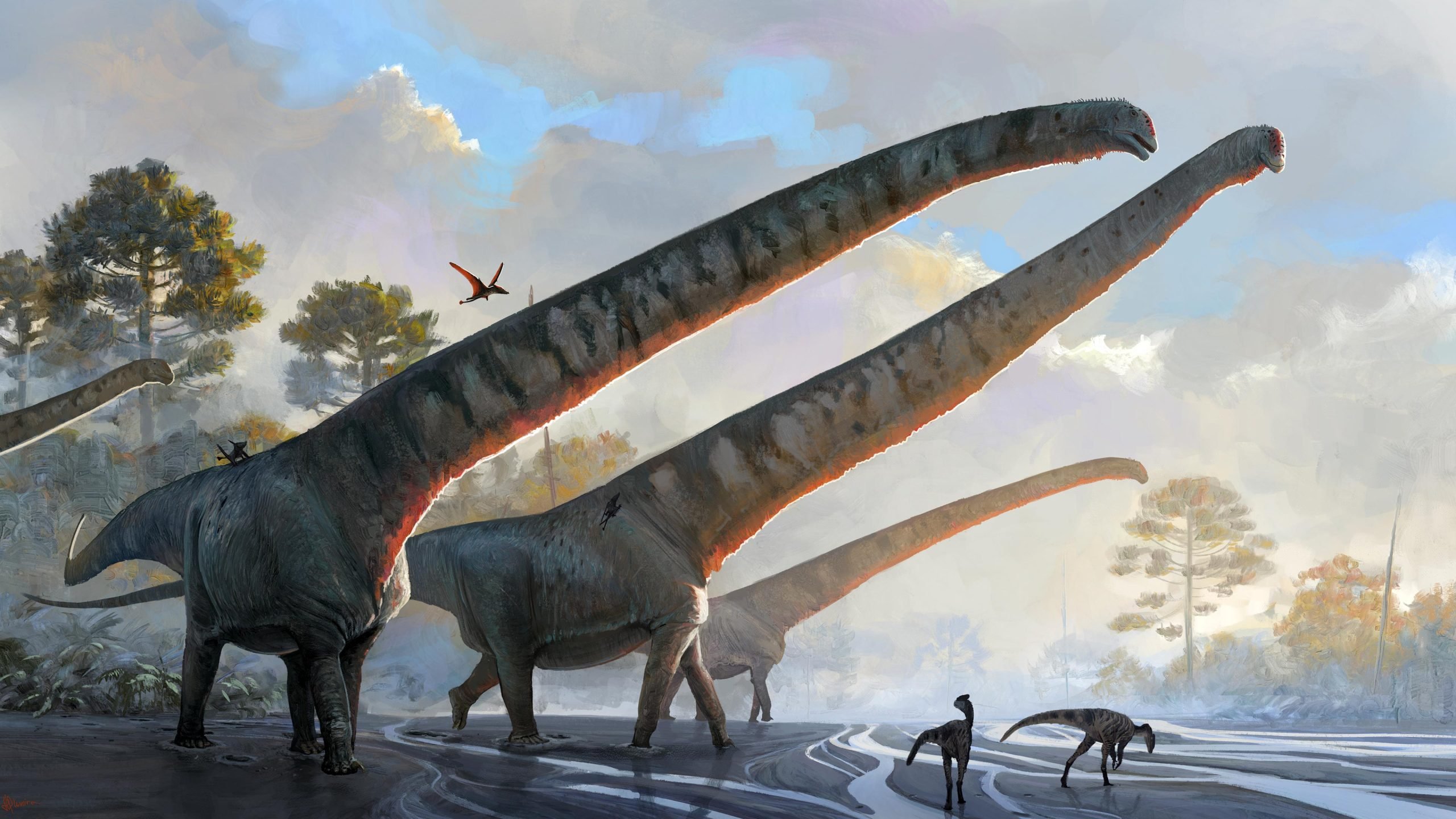
Sauropods like Mamenchisaurus evolved extraordinarily long necks to maximize food intake. Air sacs and lightweight bones were key to their success, allowing for unparalleled energy efficiency and heat regulation.
An international team led by paleontologist Dr. Andrew J. Moore from Stony Brook University has discovered that Mamenchisaurus sinocanadorum, a Late Jurassic Chinese sauropod dinosaur, had a 50-foot long neck. The team, which included Prof. Paul Barret from London’s Natural History Museum, aimed to document the diversity and evolutionary history of the Mamenchisauridae family, a group of long-necked sauropod dinosaurs that lived in East Asia and other parts of the world during the Middle Jurassic to the Early Cretaceous period, about 174-114 million years ago. The discovery sheds light on the fascinating world of sauropod dinosaurs.
With their long necks and formidable bodies, sauropod dinosaurs have captured people’s imagination since the first relatively complete fossils were discovered in the United States in the late 1800s. The original specimen that the Natural History Museum’s Dippy was cast from was among these discoveries.
Now an international team led by Stony Brook University paleontologist Dr. Andrew J. Moore, and including Prof. Paul Barret, Merit Researcher, from the London’s Natural History Museum, has reported that a Late Jurassic Chinese sauropod known as Mamenchisaurus sinocanadorum sported a 50-foot (15-meter) long neck.
The revelation comes as part of a paper that aims to document the diversity and evolutionary history of the family Mamenchisauridae, a group of particularly long-necked sauropod dinosaurs that roamed East Asia and possibly other parts of the world from the Middle Jurassic to the Early Cretaceous (approximately 174–114 million years ago).
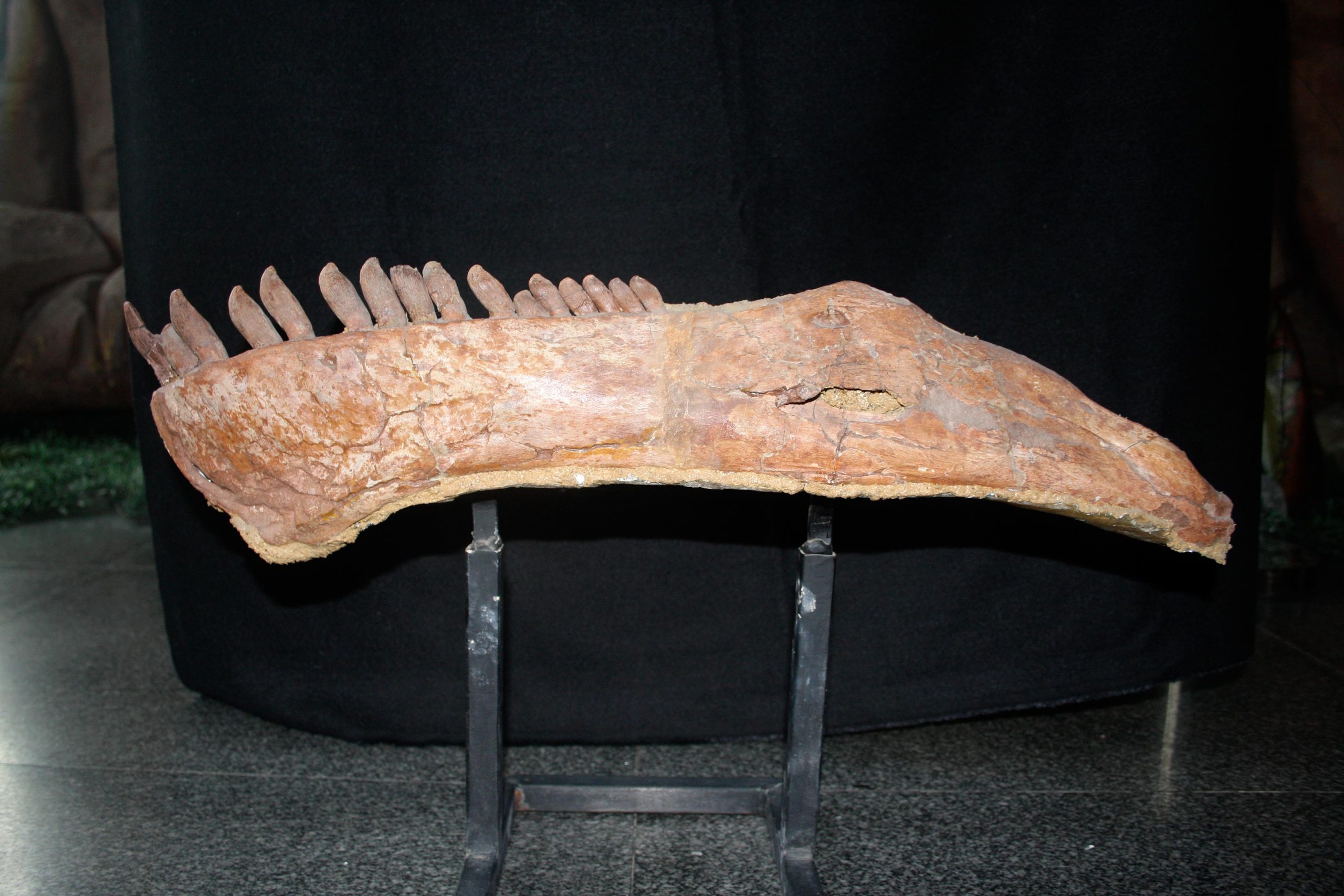
Mamenchisaurus sinocanadorum was discovered in approximately 162-million-year-old rocks from the Xinjiang Uyghur Autonomous Region of northwest China in 1987 by the China–Canada Dinosaur Project team, for which it was named in 1993. At approximately 15.1 meters, its neck was more than six times longer than the necks of giraffes and 1.5 times the length of a double-decker bus! This potentially makes it the longest neck of any animal to have ever existed.
The Evolutionary Advantage of Long Necks
For sauropods, the long neck was one of the keys to achieving large body size. To power such a large body, sauropods had to be efficient at gathering food, and that’s exactly what a long neck was built for. A sauropod could stand in one spot and graze the surrounding vegetation, conserving energy while taking in tons of food. Having a long neck probably also allowed sauropods to shed excess body heat by increasing their surface area, much like the ears of elephants. This lifestyle was exceptionally successful with the sauropod lineage appearing early in dinosaur evolutionary history and persisting until the final days of the Mesozoic, when an asteroid wiped out most of the dinosaurs, except for the relatives of modern birds.
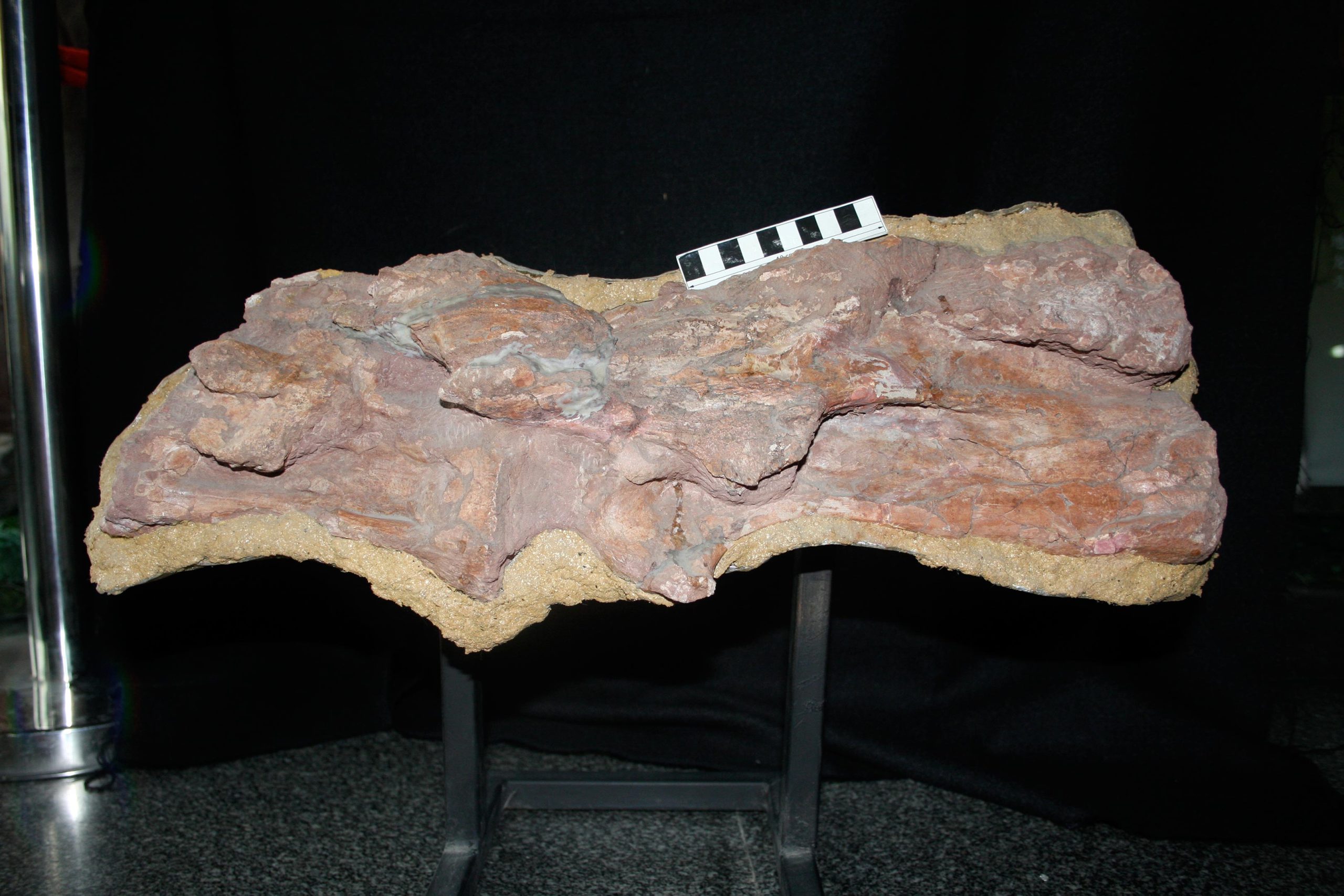
The question of which sauropod had the longest neck is not a simple one to answer. The largest sauropods tend to be some of the most poorly known as it is very hard to completely bury such a large animal in sediment, the first stage required for fossilization. Poor preservation of these specimens and their closest relatives often makes estimates of their neck length speculative.
Although Mamenchisaurus sinocanadorum is known only from a handful of bones from the neck and skull, the research team was able to reconstruct its evolutionary relationships and thus make comparisons to the unusually complete skeletons of its closest relatives. This allowed them to conclude that Mamenchisaurus sinocanadorum had a neck approximately 15.1 meters long, the longest of any known sauropod.
Lead author Dr. Andrew J. Moore, Stony Brook University paleontologist, said, “All sauropods were big, but jaw-droppingly long necks didn’t evolve just once.
“Mamenchisaurids are important because they pushed the limits on how long a neck can be and were the first lineage of sauropods to do so. With a 15-meter-long neck, it looks like Mamenchisaurus sinocanadorum might be a record-holder – at least until something longer is discovered.”

Structural Adaptations for Stability and Weight
The question of how sauropods managed to evolve such long necks and large bodies without collapsing under their own weight has puzzled scientists since their discovery. When studying Mamenchisaurus the team was able to use computed-tomography (CT) scanning to reveal that the vertebrae were lightweight and hollow with air spaces comprising about 69–77% of their volume, similar to the lightly built skeletons of birds. However, such featherweight skeletons would also be more prone to injury. To combat this Mamenchisaurus had 4-meter-long rod-like neck ribs, bony extensions of the vertebrae that created overlapping bundles of rods on either side of the neck. These bundles would have stiffened the neck of Mamenchisaurus sinocanadorum, increasing its stability.
The remaining mystery of Mamenchisaurus and many other long-necked sauropods is understanding just how they drew air down these long necks all the way to their lungs.
Prof. Paul Barrett, Merit Researcher, Natural History Museum London explains, “Like all other sauropod dinosaurs, Mamenchisaurus had a complex breathing apparatus that included not only the lungs, but also numerous balloon-like air sacs. These were connected to the lungs and windpipe but spread throughout the interior of the animal’s neck, chest, and abdomen.
“Taken in combination, these air sacs had a much greater volume than the lungs, and they even went inside the bones, hollowing them out. This extra space would have helped these gigantic sauropods to move the large volume of air in the lengthy windpipe that would have occupied their extraordinary necks.”
While Mamenchisaurus sinocanadorum is now thought to have the longest neck of any dinosaur it was still not the biggest dinosaur. That title is held by a species in the titanosaur group and dinosaur fans will get the chance to see the colossal titanosaur Patagotitan mayorum, one of the largest known creatures to have ever walked our planet, this summer at London’s Natural History Museum.
Reference: “Re-assessment of the Late Jurassic eusauropod Mamenchisaurus sinocanadorum Russell and Zheng, 1993, and the evolution of exceptionally long necks in mamenchisaurids” by Andrew J. Moore, Paul M. Barrett, Paul Upchurch, Chun-Chi Liao, Yong Ye, Baoqiao Hao and Xing Xu, 15 March 2023, Journal of Systematic Palaeontology.
DOI: 10.1080/14772019.2023.2171818
The new paper Re-assessment of the Late Jurassic eusauropod Mamenchisaurus sinocanadorum Russell and Zheng, 1993, and the evolution of exceptionally long necks in mamenchisaurids is published in the Journal of Systematic Palaeontology. The research was funded by numerous organisations including the United States National Science Foundation, The Royal Society of London, and the National Natural Science Foundation of China.
Never miss a breakthrough: Join the SciTechDaily newsletter.
Follow us on Google and Google News.
7 Comments
I thought it was NASA or Disney propaganda. My wife (whose neck is VERY long), claims that the these are the remains at the other end of the curve. How about info on the term sinocanadiensis? This is ominous, when the #1 power is so anxious to ingratiate a pipsqueak mini-state like Canada. I’m sure the beast is not amused. LOVE YOUR REPORTING. I couldn’t drink my tea without it. We will give you our next P.R. assignment. GBU.
Asteroid did not wiped out most dinosaur it was superior dinosaur spinosauridae who did that mesoeucrocodylia have superior technology that why the gator is king of the dinosaur bird have no link to dinosaur .bird basipterygoid process is not homologue to reptile basipteygoid process not the same most bird jaw muscle are on the palatine reptile are on the pterygoid .the primitive bird maniraptoran still looking for there basipterygoid process they think it mite be some where in the basipterygoid . The vomer most archosaur it is fuse so most thecodont Read about allosaurus fuse vomer.
What an absurd-looking creature! No doubt. Its nickname should be “TIPPY”. My submission: It walked backwards, with its tail raised in the air; dragging its head on the ground. Excellent camouflage! That nasty attacking T-Rex would get a mouthful of TAIL, while Tippy ran the other way!
Alas! And last but not least: The Artist Rendering depicts this creature standing on dry land; head held High. PERHAPS it should be depicted standing in swampy land, up to its pretty neck in primal ooze… “sorta-kind of” similar to the manner in which Vegan Hippos solve the problem of excessive body mass. In said contingency, this creature would necessarily be a sedentary BROWSER. As such, “Old Stick-in-the-mud” MIGHT be a more appropriate moniker.
🐄
MOO!
Hey, Babe ! Nevermind that other guy ! Mine’s bigger !
It’s remarkable how much the process of evolution can anticipate what will be needed to complete a new species. And leave no intermediates.
T.rex has the muscle intramandibularis a very advance unique feature in mesoeucrocodylia it’s found in eusuchian mesoeucrocodylia like modern crocodilian probaly to crush bone better the different between early mesoeucrocodylia like spinosaurus or gator type early mesoeucrocodilian the back teeth is smaller in eusuchian they have better bite force so back teeth is bigger .the expert on sauropod I ask why t.rex has this gator feature if dinosaur and modern crocodilian are not link but they are link in fact gator is a tyrannosaur like spinosauridae and allosaurus.we know birds does not have this feature no other animal it’s unique to dinosaur I know other news cliam turtle and birds have it the tendon is more complex in gator that does not change over time bird tendon is like mammal it’s not like dinosaur.
Basipterygoid process link is Jo repository.si.edu .deinocheirus scapulocoracoid fusion is common in theropod in the dinosaur eoraptor they lack fusion in herrerasaurus ceratosaurus t.rex allosaurus megaraptor aerosteon neovenator coelophysis it is fuse in the tetanuran dinosaur modern crocodilian it is fuse a bird flight feature mostly in early birds in today birds mostly flightless bird .so when scapulocoracoid is not fuse it is primitive for dinosaur.allso fuse in dinosauriformies sphenosuchus rauisuchus.