
Close Menu
    Facebook X (Twitter) Instagram
    SciTechDaily
    • Biology
    • Chemistry
    • Earth
    • Health
    • Physics
    • Science
    • Space
    • Technology
    Facebook X (Twitter) Pinterest YouTube RSS
    SciTechDaily
    Home»Health»Bio-Inspired Slow-Release System: Mimicking Nature To Provide Long-Lasting Local Anesthesia
    Health

    Bio-Inspired Slow-Release System: Mimicking Nature To Provide Long-Lasting Local Anesthesia

    By Boston Children's HospitalOctober 16, 2021No Comments4 Mins Read
    Facebook Twitter Pinterest Telegram LinkedIn WhatsApp Email Reddit
    Share
    Facebook Twitter LinkedIn Pinterest Telegram Email Reddit
    Tetrodotoxin Delivery to Nerve Sodium Channels via Bioinspired Nanofibers
    The bio-inspired nanofibers carry two peptides (shown as arrays of blue and violet dots) that are modified from peptides on tetrodotoxins’ natural binding site on voltage-gated sodium channels. These adapted peptides bind to tetrodotoxin (shown as gold hexagons) and release it when the nanofibers are injected near the nerve, providing prolonged local anesthesia. Credit: Fantastic Color/Nature Biomedical Engineering

    Bio-inspired slow-release system for site 1 sodium channel blockers mimics the anesthetics’ natural receptors in the body.

    Site 1 sodium channel blockers such as tetrodotoxin and saxitoxin are small-molecule drugs with powerful local anesthetic properties. They provide pain relief without toxic effects on local nerves and muscles, and are an attractive alternative to opioids. But injected by themselves, they can easily float away, causing severe systemic toxicity.

    Encapsulating these drugs in safe delivery systems has been a challenge: Because they are extremely water soluble, they tend to exit into the surrounding water in the body.

    “The toxicity becomes dose-limiting, and you can’t get a long-lasting nerve block,” says Daniel Kohane, MD, PhD, director of the Laboratory for Biomaterials and Drug Delivery at Boston Children’s Hospital and vice chair for research in the Department of Anesthesiology, Critical Care and Pain Medicine.

    Tianjiao Ji, PhD, a former postdoc in Kohane’s lab, had an idea for a biomimetic system that would release local anesthetics slowly, prolonging their effect. As described in the September issue of Nature Biomedical Engineering, the system mimics the body’s own receptors for the anesthetic. The mimics grab onto the drug and the system, once in place, slowly releases the anesthetic, providing prolonged nerve blockade with minimal toxicity.
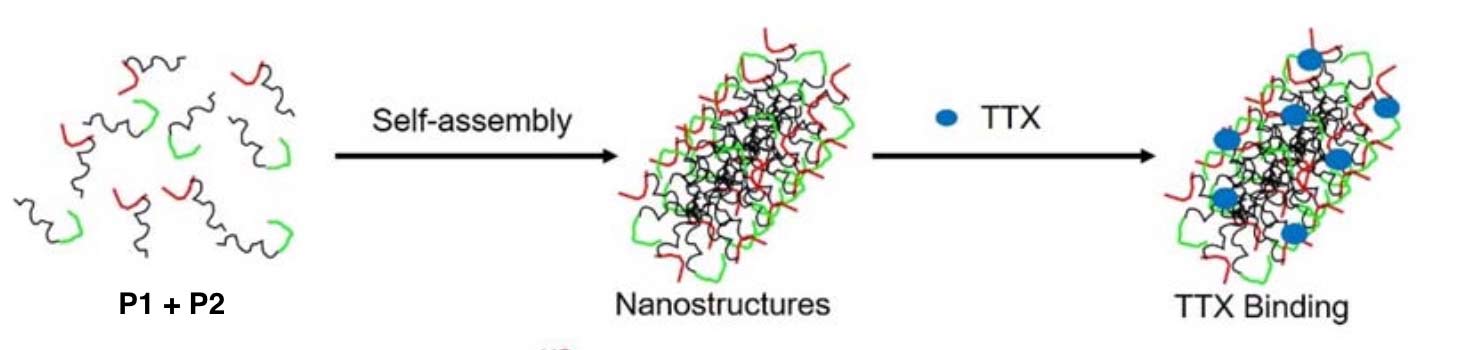
    Creating Slow Release Anesthetic
    This schematic shows the peptides P1 and P2 with hydrophobic modifications that enable them to self-assemble into nanostructures that bind to tetrodotoxin (TTX). Credit: Tianjiao Ji, PhD, Kohane lab in Nature Biomedical Engineering, September 13, 2021

    The Kohane lab has created many slow-release systems, including ones to deliver tetrodotoxin, but this one is the first to hijack nature’s design. Although tetrodotoxin and saxitoxin were the test anesthetics, the approach could potentially be applied to other drug delivery systems.

    Taking Cues From Nature

    To create the slow-release system, Ji, with co-first author Yang Li, PhD, and other lab members, began with a mixture of two peptide sequences, P1 and P2. Both peptides are part of the actual sodium ion channel; when tetrodotoxin is delivered to the nerve, it binds simultaneously to both peptides.

    The team then modified P1 and P2 with long chains of hydrophobic (water-repelling) molecules. This caused the resulting molecules to assemble themselves into nanostructures with the two peptides positioned together, mimicking the way they’re positioned on the sodium channel. The peptide pairs take up the anesthetic, just as they would on the sodium channel itself.

    “When you add the hydrophobic chains, the peptides form a long fiber with thousands of P1s and P2s waving around,” Kohane explains. “Each set of peptides binds one tetrodotoxin molecule. Think of the peptides like hands — if you’re trying to catch tetrodotoxin, you need two hands to come together to hold it.”

    When this structure is injected near the target nerve, the tetrodotoxin slowly releases itself by diffusion and other processes, and binds to P1 and P2 on the nerve itself.

    Putting the Design To Work

    The team then put the tetrodotoxin-bearing nanostructures to the test, injecting them near the sciatic nerves of live rats. The anesthetic stayed in place longer than free tetrodotoxin, with no toxic tissue reaction, and neurobehavioral tests in the animals showed that the nerve block lasted for as long as 16 hours.

    “By hijacking nature’s design, we created a synthetic receptor for anesthetic drugs that acts as a delivery and release system,” says Ji.

    The team has patented their approach. “In theory, it could be applied to different drugs and other receptor–drug interactions,” Kohane says.

    Reference: “Delivery of local anaesthetics by a self-assembled supramolecular system mimicking their interactions with a sodium channel” by Tianjiao Ji, Yang Li, Xiaoran Deng, Alina Y. Rwei, Abraham Offen, Sherwood Hall, Wei Zhang, Chao Zhao, Manisha Mehta and Daniel S. Kohane, 13 September 2021, Nature Biomedical Engineering.
    DOI: 10.1038/s41551-021-00793-y

    The study was funded by the National Institutes of Health (R35 GM131728) and an Anesthesia Research Distinguished Trailblazer Award.

    Never miss a breakthrough: Join the SciTechDaily newsletter.
    Follow us on Google and Google News.

    Anesthesiology Biomedical Engineering Boston Children's Hospital Pharmaceuticals
    Share. Facebook Twitter Pinterest LinkedIn Email Reddit

    Related Articles

    Revolutionary Smart Drug-Delivering Bandage Developed by Polish Scientists

    Curing the Incurable: The AI + Atomic Design Revolution in Nanomedicine

    New Technology Could Make Missing Important Doses of Medicines and Vaccines a Thing of the Past

    Weighing Cancer Cells To Personalize Drug Choices and Help With Treatment Decision-Making

    Biological Engineers Find a New Target for Malaria Drugs – Could Kill Drug-Resistant Parasites

    Bacteria Reprogrammed to Make Designer Molecule Used in Pharmaceutical Drugs

    Seaweed Extract Outperforms Remdesivir in Blocking COVID-19 Virus in Cell Studies

    MIT Biological Engineers Solve An Arthritis Drug Mystery

    MIT Study Measures the Effects of Low Doses of Radiation on DNA

    Leave A Reply Cancel Reply

    • Facebook
    • Twitter
    • Pinterest
    • YouTube

    Don't Miss a Discovery

    Subscribe for the Latest in Science & Tech!

    Trending News

    Millions Take These IBS Drugs, But a New Study Finds Serious Risks

    Scientists Unlock Hidden Secrets of 2,300-Year-Old Mummies Using Cutting-Edge CT Scanner

    Bread Might Be Making You Gain Weight Even Without Eating More Calories

    Scientists Discover Massive Magma Reservoir Beneath Tuscany

    Europe’s Most Active Volcano Just Got Stranger – Here’s Why Scientists Are Rethinking It

    Alzheimer’s Symptoms May Start Outside the Brain, Study Finds

    Millions Take This Popular Supplement – Scientists Discover a Concerning Link to Heart Failure

    The Universe Is Expanding Too Fast and Scientists Can’t Explain Why

    Follow SciTechDaily
    • Facebook
    • Twitter
    • YouTube
    • Pinterest
    • Newsletter
    • RSS
    SciTech News
    • Biology News
    • Chemistry News
    • Earth News
    • Health News
    • Physics News
    • Science News
    • Space News
    • Technology News
    Recent Posts
    • Simple Blood Test May Predict Alzheimer’s Years Before Brain Scans Show Signs
    • Scientists Say Adding This Unusual Seafood to Your Diet Could Reverse Signs of Aging
    • U.S. Waste Holds $5.7 Billion Worth of Crop Nutrients
    • Scientists Say a Hidden Structure May Exist Inside Earth’s Core
    • Doctors Surprised by the Power of a Simple Drug Against Colon Cancer
    Copyright © 1998 - 2026 SciTechDaily. All Rights Reserved.
    • Science News
    • About
    • Contact
    • Editorial Board
    • Privacy Policy
    • Terms of Use

    Type above and press Enter to search. Press Esc to cancel.