
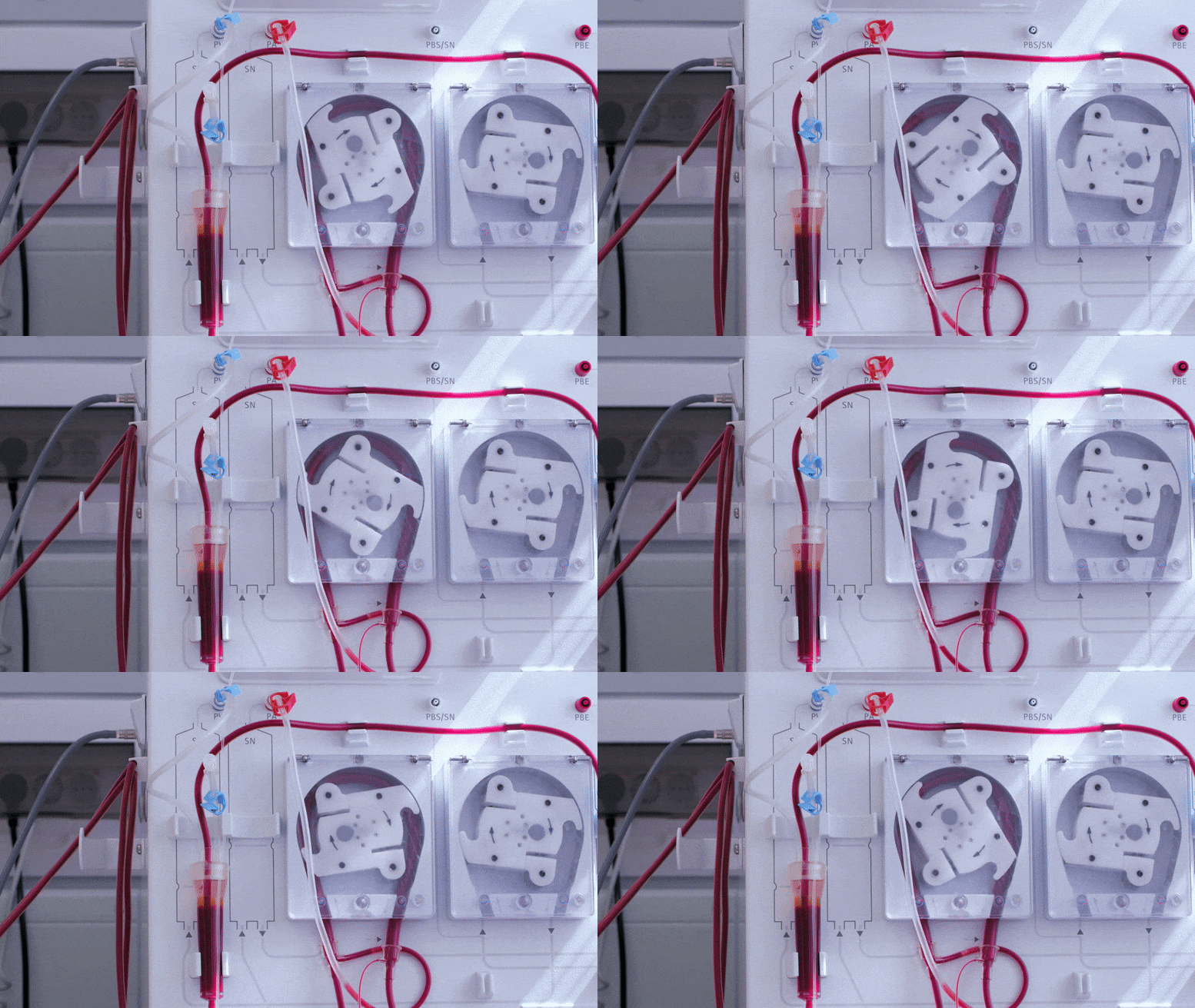
A mathematical model of the body’s interacting physiological and biochemical processes shows that it may be more effective to replace red blood cell transfusion with transfusion of other fluids that are far less in demand.
Blood transfusions save lives, yet the precious fluid is in desperately short supply, not just in the U.S. but around the globe. But what if transfusions don’t always require blood?
A new mathematical model of the body’s interacting physiological and biochemical processes – including blood vessel expansion, blood thickening and flow-rate changes in response to the transfusion of red blood cells – shows that patients with anemia, or blood with low oxygen levels, can be effectively treated with transfusions of blood substitutes that are more readily available.
The research, co-authored by scientists at Stanford University and the University of California, San Diego (UCSD), was published on October 14, 2021, in the Journal of Applied Physiology.
Hidden Costs and Risks of Traditional Transfusions
Using a different fluid could also eliminate a harmful consequence of blood transfusion: Blood use has been observed to lower lifespan by 6 percent per unit transfused per decade because of its adverse side effects.
“Instead of real blood, we can use a substitute that can lower the costs and eliminate blood transfusion’s negative effects,” said lead study author Weiyu Li, a PhD student in energy resources engineering at Stanford’s School of Earth, Energy & Environmental Sciences (Stanford Earth).
Transfusion is a common procedure for transferring blood components directly to anemic patients’ circulation. Red blood cells are uniquely equipped to perform the function of carrying oxygen, which is why they are used for transfusions for patients experiencing anemia. But the process of obtaining, storing and delivering the correct, sanitary blood type for each patient is also intensive and costly. Moreover, the supply of blood that is available falls far short of the demand: The global deficit across all countries without enough supply totals about 100 million units of blood per year.
“You could deliver more goods, in this case, oxygen, with less – that’s actually the basic idea of sustainability,” said senior study author Daniel Tartakovsky, a professor of energy resources engineering at Stanford Earth. “It’s all about how to do more with less.”
Transfusion of red blood cells is done to improve the likelihood that oxygen vital to organ and tissue function will be delivered. However, the process also thickens the blood, and that increased viscosity can be a problem, according to the research. The new model shows that during transfusion, some patients’ blood vessels do not dilate and, since their blood has been thickened by additional red blood cells, it is more viscous and does not circulate as easily to deliver oxygen. For these patients, treating anemia with a 2-unit transfusion – currently, the most frequently used transfusion quantity – would reduce blood flow, regardless of the state of anemia, according to the model.
Plasma Expanders as a Promising Substitute
However, for many people, transfusion causes blood vessels to dilate, thereby increasing circulation and delivering more oxygen to the body. The findings reveal the advantage of anemic patients whose blood vessels dilate during transfusion. The model suggests that either abstaining from transfusion or transfusing alternative fluids known as plasma expanders, which prompt blood vessels to dilate, may be a more effective way to increase oxygen delivery. Plasma expanders consist of solutions of high-molecular-weight starch dissolved in normal saline; they have been in use in transfusion medicine for several decades and have proven to be effective in experimental studies.
“At present, blood transfusion is determined by addressing the wrong target, namely restoring oxygen-carrying capacity,” said co-author Marcos Intaglietta, a professor and founder of the bioengineering discipline at UCSD. “But the logical target of a blood transfusion is restoring oxygen-delivery capacity.”
Lower Costs, Fewer Risks
Projections of the team’s results show that safe and low-cost blood substitutes can decrease the overall cost of blood transfusion by 10 times, while significantly lowering the negative aspects of the process. Their model of the body’s circulatory processes was derived from previously published experiments on how mammals react to transfusion.
“Our mathematical model identifies natural physiological processes that explain the conclusion of multiple observational studies: People can get the benefit of blood transfusion without using blood,” Tartakovsky said. “But nothing really comes out of modeling alone – it has to be grounded in observations, investigational studies and experience.”
The co-authors hope their findings will lead to clinical trials that test the capacity for non-blood alternatives to increase oxygen delivery. To date, there have not been consistent results from rigorous medical trials that support the notion that small amounts of blood are more effective than just adding human plasma, according to the study authors.
“This is the first model to consider all of these effects,” Li said. “I hope people have a chance to see our results and decide whether they could be used to treat patients.”
Reference: “A model of anemic tissue perfusion after blood transfusion shows critical role of endothelial response to shear stress stimuli” by Weiyu Li, Amy G. Tsai, Marcos Intaglietta and Daniel M. Tartakovsky, 14 October 2021, Journal of Applied Physiology.
DOI: 10.1152/japplphysiol.00524.2021
Tartakovsky is also a member of Bio-X. Amy Tsai of UC San Diego is a co-author on the paper.
This research was supported in part by the Air Force Office of Scientific Research under award number FA9550-21-1-0381.
Never miss a breakthrough: Join the SciTechDaily newsletter.
Follow us on Google and Google News.