
Close Menu
    Facebook X (Twitter) Instagram
    SciTechDaily
    • Biology
    • Chemistry
    • Earth
    • Health
    • Physics
    • Science
    • Space
    • Technology
    Facebook X (Twitter) Pinterest YouTube RSS
    SciTechDaily
    Home»Space»Juno Spacecraft Reveals Jupiter’s Great Red Spot Extends Deeper Than Expected Into Giant Planet
    Space

    Juno Spacecraft Reveals Jupiter’s Great Red Spot Extends Deeper Than Expected Into Giant Planet

    By American Association for the Advancement of Science (AAAS)November 14, 2021No Comments3 Mins Read
    Facebook Twitter Pinterest Telegram LinkedIn WhatsApp Email Reddit
    Share
    Facebook Twitter LinkedIn Pinterest Telegram Email Reddit
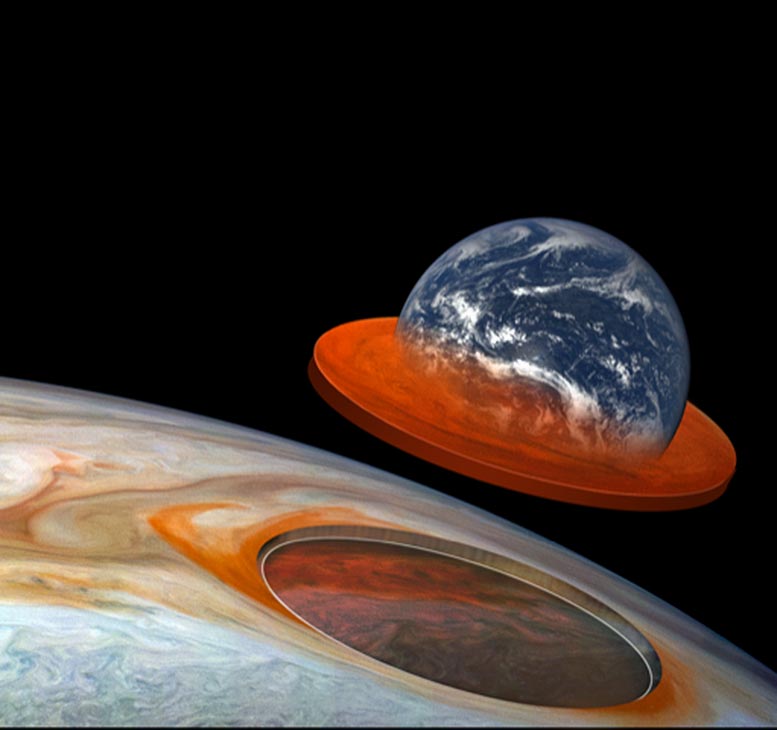
    Jupiter Great Red Spot Earth Comparison
    This illustration combines an image of Jupiter from the JunoCam instrument aboard NASA’s Juno spacecraft with a composite image of Earth to depict the size and depth of Jupiter’s Great Red Spot. Credit: JunoCam Image data: NASA/JPL-Caltech/SwRI/MSSS; JunoCam Image processing by Kevin M. Gill (CC BY); Earth Image: NASA

    Juno data reveal the Great Red Spot reaches 500 km deep, much shallower than Jupiter’s surrounding jets but deeper than expected.

    Jupiter’s iconic Great Red Spot (GRS) – a 16,000-kilometer-wide (10,000-mile-wide) tempest that has been churning in the planet’s atmosphere for several centuries – extends deeper into the gas giant than previously expected, researchers report in a pair of studies that present new data from the Juno spacecraft.

    The findings reveal new insights into Jovian meteorology and its links to the planet’s deeper interior. Large storms and bands of rotating winds abound in Jupiter’s atmosphere, including the exemplary GRS – a storm so massive it could swallow Earth whole. However, it’s unclear whether these storms are confined to the uppermost parts of the planet’s atmosphere or extend deeper into the planet.

    In a pair of studies, Scott Bolton and colleagues and Marzia Parisi and colleagues use microwave and gravity measurements, respectively, from the Juno spacecraft to characterize Jupiter’s atmospheric vortices, including the GRS. Bolton et al. used Juno’s Microwave Radiometer (MWR) instrument to investigate the vertical structure of the GRS as well as two other storms and find that they extend below the altitude at which water and ammonia are expected to condense – or the planet’s cloud level. This is particularly true for the GRS. According to the authors, this suggests the presence of small-scale dynamic processes, such as precipitation and downdrafts, at much deeper levels than previously expected, which may indicate a connection between Jupiter’s interior and deep atmosphere.

    Parisi et al. examined the gravity signature of the GRS and further constrained its depth. Within the gravity measurements taken as Juno flew above the GRS, Parisi et al. detected fluctuations in the planet’s gravitational field caused by the storm. They found that, although the GRS is deeply rooted within the atmosphere, it’s far shallower than the surrounding zonal jets that power the GRS, which extend much deeper.

    According to the findings, the depth of the GRS is no more than 500 (kilometers) km (310 mi) deep while the surrounding jets extend to depths approaching 3,000 km. 

    For more on this and related research, see NASA’s Juno Probe Offers First 3D View of Jupiter’s Atmosphere, Inner Workings of Great Red Spot.

    References:

    “The depth of Jupiter’s Great Red Spot constrained by Juno gravity overflights” by Marzia Parisi, Yohai Kaspi, Eli Galanti, Daniele Durante, Scott J. Bolton, Steven M. Levin, Dustin R. Buccino, Leigh N. Fletcher, William M. Folkner, Tristan Guillot, Ravit Helled, Luciano Iess, Cheng Li, Kamal Oudrhiri and Michael H. Wong, 28 October 2021, Science.
    DOI: 10.1126/science.abf1396

    “Microwave observations reveal the deep extent and structure of Jupiter’s atmospheric vortices” by S. J. Bolton, S. Levin, T. Guillot, C. Li, Y. Kaspi, G. Orton, M. H. Wong, F. Oyafuso, M. Allison, J. Arballo, S. Atreya, H. N. Becker, J. Bloxham, S. Brown, L. N. Fletcher, E. Galanti, S. Gulkis, M. Janssen, A. Ingersoll, J. L. Lunine, S. Misra, P. Steffes, D. Stevenson, J. H. Waite, R. K. Yadav and Z. Zhang, 28 October 2021, Science.
    DOI: 10.1126/science.abf1015

    Never miss a breakthrough: Join the SciTechDaily newsletter.
    Follow us on Google and Google News.

    American Association for the Advancement of Science Juno Spacecraft Jupiter Planets
    Share. Facebook Twitter Pinterest LinkedIn Email Reddit

    Related Articles

    Strange New Auroral Feature Discovered on Jupiter

    Jupiter’s Spectacular Ultraviolet “Dawn Storm” Auroras Are Surprisingly Earth-Like

    Dark Origins of One of Jupiter’s Grand Light Shows Revealed by NASA’s Juno Spacecraft

    NASA’s Juno Mission Expands Into the Future – To Explore Jupiter and Its Rings and Moons

    Cyclones at Jupiter’s North Pole Appear As Swirls of Striking Colors

    Juno Spacecraft Captures Astonishing High-Altitude Hazes on Jupiter

    Amazing Look at Jupiter’s Incredible Storms Using Ground and Space Observations

    Jupiter Water Mystery Updated With Findings From NASA’s Juno Spacecraft

    Juno Spacecraft Completes First Trajectory Correction Maneuver

    Leave A Reply Cancel Reply

    • Facebook
    • Twitter
    • Pinterest
    • YouTube

    Don't Miss a Discovery

    Subscribe for the Latest in Science & Tech!

    Trending News

    Giant Crocodylians Ruled South America’s Ancient Food Chain

    Breakthrough in a Bizarre Galaxy Could Help Unlock the Mystery of Dark Matter

    Just 4 Minutes of Daily Strength Training Can Quadruple Fitness in Older Adults

    Almost All Plant-Based Meat Alternatives Contain Mycotoxins, Study Finds

    Astronomers Detect a Record-Breaking “Cosmic Laser” From 8 Billion Light-Years Away

    A 47-Year-Old Scientist Tracked Himself for Months – His Biological Age Fell to 32

    Construction Crew Uncovers Giant 20-Meter Dinosaur in Brazil

    30 Years of Hurricane Data Reveal 4 Warning Signs Before Storms Strengthen

    Follow SciTechDaily
    • Facebook
    • Twitter
    • YouTube
    • Pinterest
    • Newsletter
    • RSS
    SciTech News
    • Biology News
    • Chemistry News
    • Earth News
    • Health News
    • Physics News
    • Science News
    • Space News
    • Technology News
    Recent Posts
    • Scientists Develop an Implant That Could Help the Body Clock Recover From Jet Lag Faster
    • Adults Taking More Vitamin D Scored 13% Higher on a Cognitive Test
    • A 20-Year Study Finds Preschool Can Influence Success for Years
    • 55-Million-Year-Old Penguin Fossils Preserve Clues to a Warmer Antarctica
    • A 35,000-Year-Old Neanderthal Pelvis May Explain Why Men and Women Walk Differently
    Copyright © 1998 - 2026 SciTechDaily. All Rights Reserved.
    • Science News
    • About
    • Contact
    • Editorial Board
    • Privacy Policy
    • Terms of Use

    Type above and press Enter to search. Press Esc to cancel.