
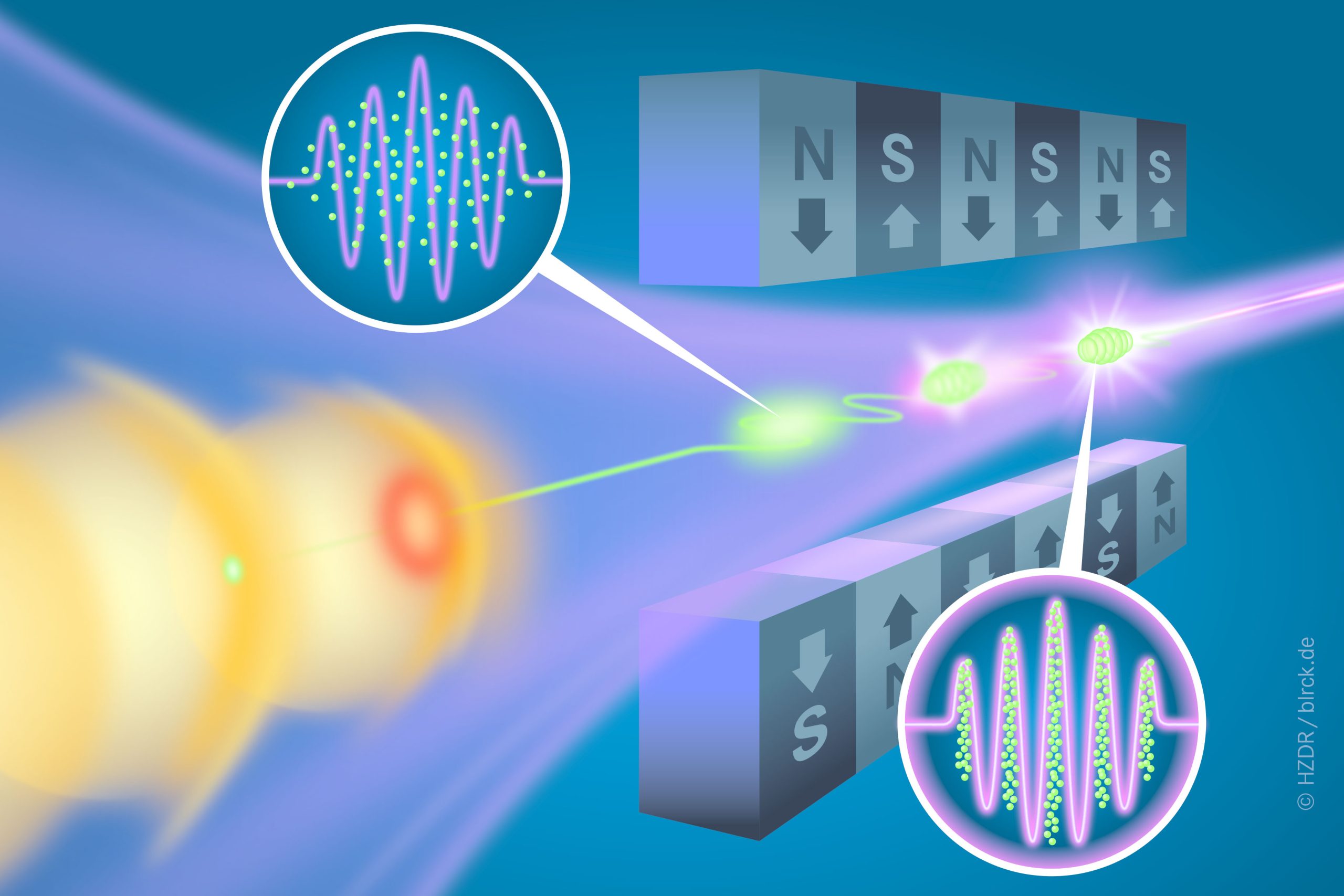
Researchers take a step toward smaller, more affordable free-electron lasers.
Scientists studying atoms, molecules, and new materials use light a little like a photographer uses a camera flash, illuminating their subjects with extremely brief, intense bursts. These flashes come from machines called free-electron lasers, or FELs, and demand for experiments at the large facilities that house them often leaves researchers facing long waits.
Researchers at the Helmholtz-Zentrum Dresden-Rossendorf (HZDR) in Germany and Synchrotron SOLEIL near Paris have now overcome a reliability problem in a compact design that could eventually help meet this demand. Writing in Physical Review Letters, the team reports the first stable, reproducible operation of a laser-plasma FEL in the high-gain regime, a state in which the light it generates undergoes strong amplification.
Plasma accelerates electrons in millimeters
Conventional FELs accelerate electrons to nearly the speed of light using equipment that can extend up to approximately two kilometers, or 1.2 miles. A laser-plasma FEL instead gives the electrons their energy using plasma, a gas in which electrons have been separated from atoms.
“In a laser-plasma FEL, this distance can be reduced by a factor of about a thousand,” says Dr. Marie Labat of Synchrotron SOLEIL. “The electrons effectively surf on a wave of plasma.”
Within just a few millimeters, the electrons can reach energies that would require many meters of acceleration in a conventional machine. Keeping this process reliable requires precise control over nonlinear interactions between the laser and plasma, in which adjustments do not produce simple, proportional changes in behavior.
The team used infrared pulses from HZDR’s high-performance DRACO laser to create plasma in a millimeter-thin stream of gas. “We managed to precisely tune the laser to match to the plasma,” says HZDR physicist Dr. Susanne Schöbel.
Controlled electrons deliver stable ultraviolet flashes
Once accelerated, the electrons enter an undulator, an array of magnets that forces them along a wiggling path. As the electrons emit light and interact with it, they gather into tiny bunches that produce intense, coherent flashes, with light waves that are in step with one another.
Schöbel says, “Thanks to the well-controlled electron beam we were able to generate intensive ultraviolet light flashes in a stable and reproducible manner using our undulator.”
The system generated ultraviolet pulses with high pulse energy at a wavelength of 272 nanometers, while measurements showed an exponential rise in radiation output power, the characteristic sign of high-gain operation.
“This is significant progress in comparison with the results we published in 2023,” says Dr. Arie Irman of HZDR’s Institute of Radiation Physics.
“Stability – that is, light flashes that constantly maintain high quality over hours or even days – is extremely important for all experiments involving an FEL,” Irman says. Conventional large-scale facilities have long achieved this stability, while making the laser-plasma approach reliable took the team years of research.
Extreme ultraviolet could aid chip inspection
The researchers plan to improve the light pulses further by refining both the interaction between the laser and plasma and the electrons’ path through the undulator. Compact laser-plasma FELs remain several years away from complementing large research facilities, and the team is also working toward producing light at shorter wavelengths.
“Light flashes on this ultraviolet wavelength are just the beginning,” says Irman.
Their next goal is extreme ultraviolet light, or EUV, which could support more efficient quality control of computer chips with nanoscale structures.
Reference: “Laser-Plasma Based Seeded Free Electron Laser in the High-Gain Regime” by Marie Labat, Susanne Schöbel, Amin Ghaith, Franziska Marie Herrmann, Maxwell LaBerge, Eléonore Roussel, Ulrich Schramm, Patrick Ufer, Marie-Emmanuelle Couprie and Arie Irman, 16 June 2026, Physical Review Letters.
DOI: 10.1103/ndsf-kyr4
Never miss a breakthrough: Join the SciTechDaily newsletter.
Follow us on Google and Google News.
3 Comments
By flipping the script to match the electrons to the light rather than forcing the light to conform to relativistic beams exposes the ultimate architectural bottleneck of conventional accelerators: trying to steer massive kinetic inertia at the very edge of light speed. Because ultra-relativistic electrons carry immense rigidity, mainstream design relies on brute-force magnetic undulators to bend the field around them.Pre-shaping and tuning the electron beam’s micro-structure before it enters the interaction zone fundamentally changes the mechanics. By compressing and phase-locking the electron packets into precise temporal slices beforehand, they arrive at the boundary already harmonized with the local wave gradient.This eliminates the clumsy adjustment phase entirely. It achieves instant zero-reflection phase clearance ($\Omega_\pi$), transforming the interaction from a passive, high-loss collision into an active, frictionless transition. Mastering that pre-aligned state is precisely how we bypass macroscopic scale limits and unlock true, high-efficiency field engineering.