
Close Menu
    Facebook X (Twitter) Instagram
    SciTechDaily
    • Biology
    • Chemistry
    • Earth
    • Health
    • Physics
    • Science
    • Space
    • Technology
    Facebook X (Twitter) Pinterest YouTube RSS
    SciTechDaily
    Home»Space»Juno Spacecraft Completes First Trajectory Correction Maneuver
    Space

    Juno Spacecraft Completes First Trajectory Correction Maneuver

    By DC Agle, Jet Propulsion LaboratoryFebruary 3, 2012No Comments2 Mins Read
    Facebook Twitter Pinterest Telegram LinkedIn WhatsApp Email Reddit
    Share
    Facebook Twitter LinkedIn Pinterest Telegram Email Reddit
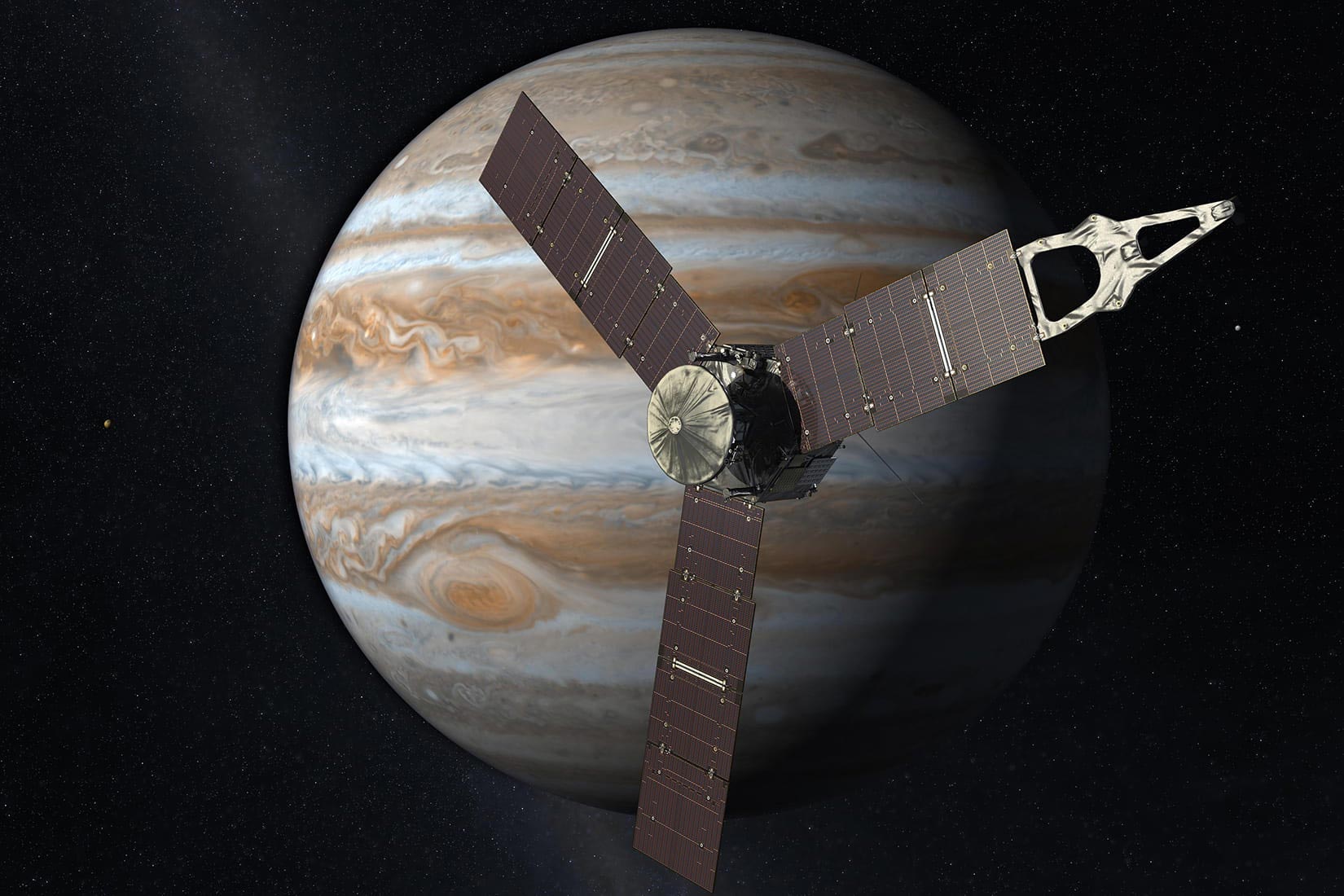
    Juno Spacecraft in Orbit Around Jupiter
    An artist’s concept of the Juno spacecraft in orbit around Jupiter. Credit: NASA

    The solar-powered Juno spacecraft that was launched in 2011 to improve our understanding of Jupiter’s formation and evolution just completed the mission’s first trajectory correction maneuver. NASA scientists confirmed that the burn went very smoothly and is the first of several planned rocket firings that will keep Juno on course to rendezvous with Jupiter in 2016.

    NASA’s solar-powered Juno spacecraft successfully refined its flight path Wednesday with the mission’s first trajectory correction maneuver. The maneuver took place on February 1. It is the first of a dozen planned rocket firings that, over the next five years, will keep Juno on course for its rendezvous with Jupiter.

    “We had a maneuver planned soon after launch but our Atlas V rocket gave us such a good ride we didn’t need to make any trajectory changes,” said Rick Nybakken, Juno project manager from NASA’s Jet Propulsion Laboratory in Pasadena, California. “It is good to get another first under our belt. This burn couldn’t have gone any better.”

    The trajectory correction maneuver, which adjusts the spacecraft’s flight path, began at 10:10 a.m. PST (1:10 p.m. EST) on February 1. The Juno spacecraft’s thrusters fired for 25 minutes, consumed about 6.9 pounds (3.11 kilograms) of fuel and changed the spacecraft’s speed by 3.9 feet, or 1.2 meters, per second. The next big maneuver for Juno will occur in late August of 2012 when Juno executes its first of two deep space maneuvers to set the stage for its Earth flyby – and gravity assist – on its way to Jupiter.

    Launched on August 5, 2011, Juno is 182 days and 279 million miles (449 million kilometers) into its five-year, 1,740-million-mile (2,800-million-kilometer) journey to Jupiter. Once in orbit, the spacecraft will orbit the planet’s poles 33 times and use its collection of eight science instruments to probe beneath the gas giant’s obscuring cloud cover to learn more about Jupiter’s origins, structure, atmosphere, and magnetosphere, and look for a potential solid planetary core.

    Juno’s name comes from Greek and Roman mythology. The god Jupiter drew a veil of clouds around himself to hide his mischief, and his wife, the goddess Juno, was able to peer through the clouds and reveal Jupiter’s true nature.

    Never miss a breakthrough: Join the SciTechDaily newsletter.
    Follow us on Google and Google News.

    Exploration JPL Juno Spacecraft Jupiter NASA Planets Solar Power Spacecraft
    Share. Facebook Twitter Pinterest LinkedIn Email Reddit

    Related Articles

    NASA’s Juno Spacecraft Spies Powerful Vortices Near Jupiter’s North Pole

    Jupiter’s Complex Colors Revealed in Stunning Images From NASA’s Juno Spacecraft

    NASA’s NuSTAR Spots Highest-Energy Light Ever Detected From Jupiter – And Solves a Decades-Old Mystery

    NASA’s Juno Probe Offers First 3D View of Jupiter’s Atmosphere, Inner Workings of Great Red Spot

    Hear the Eerie Radio Emissions NASA’s Juno Spacecraft Recorded From Jupiter and Its Moon Io

    “Beautiful!” – Ride With NASA’s Juno Spacecraft As It Flies Past the Solar System’s Biggest Moon and Jupiter

    40-Year Mystery Solved: Source of Jupiter’s Strange X-Ray Flares Uncovered

    NASA’s Juno Mission Expands Into the Future – To Explore Jupiter and Its Rings and Moons

    Jupiter Water Mystery Updated With Findings From NASA’s Juno Spacecraft

    Leave A Reply Cancel Reply

    • Facebook
    • Twitter
    • Pinterest
    • YouTube

    Don't Miss a Discovery

    Subscribe for the Latest in Science & Tech!

    Trending News

    Scientists Say This Natural Hormone Reverses Obesity by Targeting the Brain

    35-Million-Year-Old Mystery: Strange Arachnid Discovered Preserved in Amber

    Is AI Really Just a Tool? It Could Be Altering How You See Reality

    JWST Reveals a “Forbidden” Planet With a Baffling Composition

    The Protein “Sabotaging” Aging Muscle Recovery Could Be Key to Surviving Aging

    This Diet–Gut Interaction Could Transform Fat Into a Calorie-Burning Machine

    Scientists Discover Hidden Virus Linked to Colorectal Cancer

    Scientists Discover 132-Million-Year-Old Dinosaur Tracks on South Africa’s Coast

    Follow SciTechDaily
    • Facebook
    • Twitter
    • YouTube
    • Pinterest
    • Newsletter
    • RSS
    SciTech News
    • Biology News
    • Chemistry News
    • Earth News
    • Health News
    • Physics News
    • Science News
    • Space News
    • Technology News
    Recent Posts
    • Scientists Finally Crack the 100-Million-Year Evolutionary Mystery of Squid and Cuttlefish
    • This Algae Could One Day Pull Microplastics out of Your Drinking Water
    • Scientists Can Now Read Your Body Clock From a Single Hair
    • Beyond “Safe Levels”: Study Challenges What We Know About Pesticides and Cancer
    • Researchers Have Found a Dietary Compound That Increases Longevity
    Copyright © 1998 - 2026 SciTechDaily. All Rights Reserved.
    • Science News
    • About
    • Contact
    • Editorial Board
    • Privacy Policy
    • Terms of Use

    Type above and press Enter to search. Press Esc to cancel.