
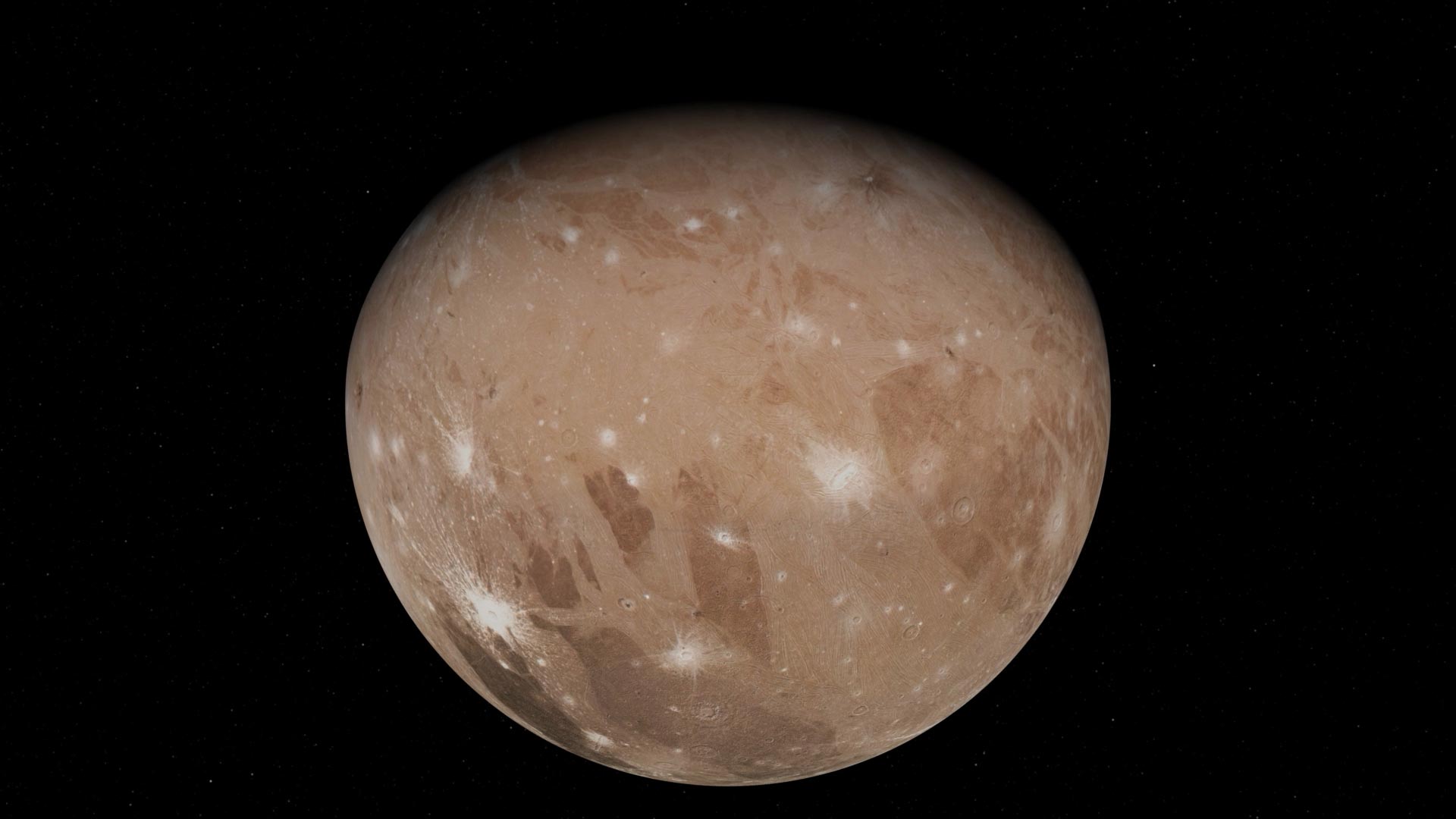
The Juno probe flew closer to Jupiter’s largest moon, Ganymede, than any other spacecraft in more than two decades, offering dramatic glimpses of both the icy orb and the gas giant.
On June 7, 2021, NASA’s Juno spacecraft flew closer to Jupiter’s ice-encrusted moon Ganymede than any spacecraft has in more than two decades. Less than a day later, Juno made its 34th flyby of Jupiter, racing over its roiling atmosphere from pole to pole in less than three hours. Using the spacecraft’s JunoCam imager, the mission team has put together this animation to provide a “starship captain” point of view of each flyby.
“The animation shows just how beautiful deep space exploration can be,” said Scott Bolton, principal investigator for Juno from the Southwest Research Institute in San Antonio. “The animation is a way for people to imagine exploring our solar system firsthand by seeing what it would be like to be orbiting Jupiter and flying past one of its icy moons. Today, as we approach the exciting prospect of humans being able to visit space in orbit around Earth, this propels our imagination decades into the future, when humans will be visiting the alien worlds in our solar system.”
On June 7, 2021, NASA’s Juno spacecraft flew closer to Jupiter’s ice-encrusted moon Ganymede than any spacecraft in more than two decades. Less than a day later, Juno made its 34th flyby of Jupiter. This animation provides a “starship captain” point of view of each flyby. For both worlds, JunoCam images were orthographically projected onto a digital sphere and used to create the flyby animation. Synthetic frames were added to provide views of approach and departure for both Ganymede and Jupiter. Credit: NASA/JPL-Caltech/SwRI/MSSS
The 3:30-minute-long animation begins with Juno approaching Ganymede, passing within 645 miles (1,038 kilometers) of the surface at a relative velocity of 41,600 mph (67,000 kph). The imagery shows several of the moon’s dark and light regions (darker regions are believed to result from ice sublimating into the surrounding vacuum, leaving behind darkened residue) as well as the crater Tros, which is among the largest and brightest crater scars on Ganymede.
It takes just 14 hours, 50 minutes for Juno to travel the 735,000 miles (1.18 million kilometers) between Ganymede and Jupiter, and the viewer is transported to within just 2,100 miles (3,400 kilometers) above Jupiter’s spectacular cloud tops. By that point, Jupiter’s powerful gravity has accelerated the spacecraft to almost 130,000 mph (210,000 kph) relative to the planet.
Among the Jovian atmospheric features that can be seen are the circumpolar cyclones at the north pole and five of the gas giant’s “string of pearls” – eight massive storms rotating counterclockwise in the southern hemisphere that appear as white ovals. Using information that Juno has learned from studying Jupiter’s atmosphere, the animation team simulated lightning one might see as we pass over Jupiter’s giant thunderstorms.
The camera’s point of view for this time-lapse animation was generated by citizen scientist Gerald Eichstädt, using composite images of Ganymede and Jupiter. For both worlds, JunoCam images were orthographically projected onto a digital sphere and used to create the flyby animation. Synthetic frames were added to provide views of approach and departure for both Ganymede and Jupiter.
As planned, the gravitational pull of the giant moon has affected Juno’s orbit, resulting in the reduction of its orbital period from 53 days to 43 days. The next flyby of Jupiter, the 35th of the mission, is scheduled for July 21.
More About the Mission
Jet Propulsion Laboratory (JPL), a division of Caltech in Pasadena, California, manages the Juno mission for the principal investigator, Scott J. Bolton, of the Southwest Research Institute in San Antonio. Juno is part of NASA’s New Frontiers Program, which is managed at NASA’s Marshall Space Flight Center in Huntsville, Alabama, for the agency’s Science Mission Directorate in Washington. Lockheed Martin Space in Denver built and operates the spacecraft.
Never miss a breakthrough: Join the SciTechDaily newsletter.
Follow us on Google and Google News.
6 Comments
One set of clouds on the plant looked like a rider on a horse. May have just been me and the way
I see things!!
Those images are so amazing. Watching that got me to thinking what adventures in space will be undertaken in my grand children’s lifetime. Then my thoughts went to how I would like to, upon my death, be set adrift in space to spend eternity there.
I thought for a quick moment the flashes of light were objects striking the planet, but quickly realized it was lightning flashes from the storms. God is an amazing artist.
Were the lightning flashes seen in the Jovan storms real or digitally added?
Just found the answer on NASA’s website: “Using information that Juno has learned from studying Jupiter’s atmosphere, the animation team simulated lightning one might see as we pass over Jupiter’s giant thunderstorms.”
It looks like the moon was occupied at some point. It also looks like the landscape after a battle.