
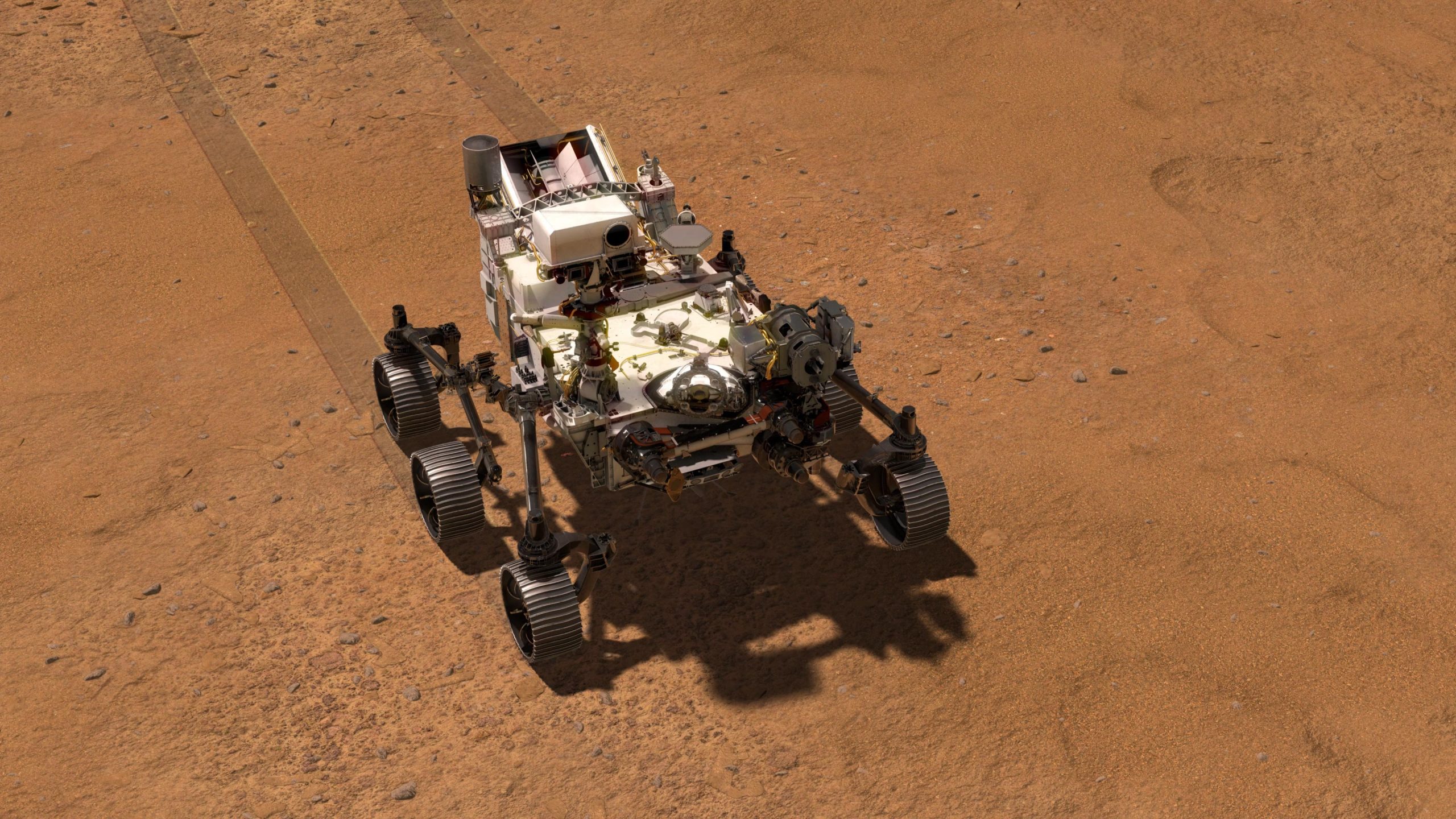
Three abrasions and four sample cores later, the rover has finally departed the Séítah area and is embarking on the return leg of the crater floor campaign. One major difference between the “out” trip and this return trip is the pace of Perseverance’s driving. As we drove towards Séítah earlier in the mission, our average daily drive distance was shorter, in part because we were doing scientific reconnaissance at important stops along the way, and in part because we were still learning how to maximize drive efficiency with our rover. Now, on the return trip back to Octavia E. Butler Landing, we are speeding back!
Since leaving Séítah a few days ago, Perseverance has already logged two massive, record-setting 240+ meter (790+ feet) drives on sols 340 and 341. These drives set the record for the longest single-sol total distance recorded by any martian rover (243.3 m or 798 ft) and the single-sol Autonav record by any martian rover (226.5 m or 743 ft). If this is a sign of future drives to come, we’ll be zooming through the rest of the crater floor campaign to the delta in no time.
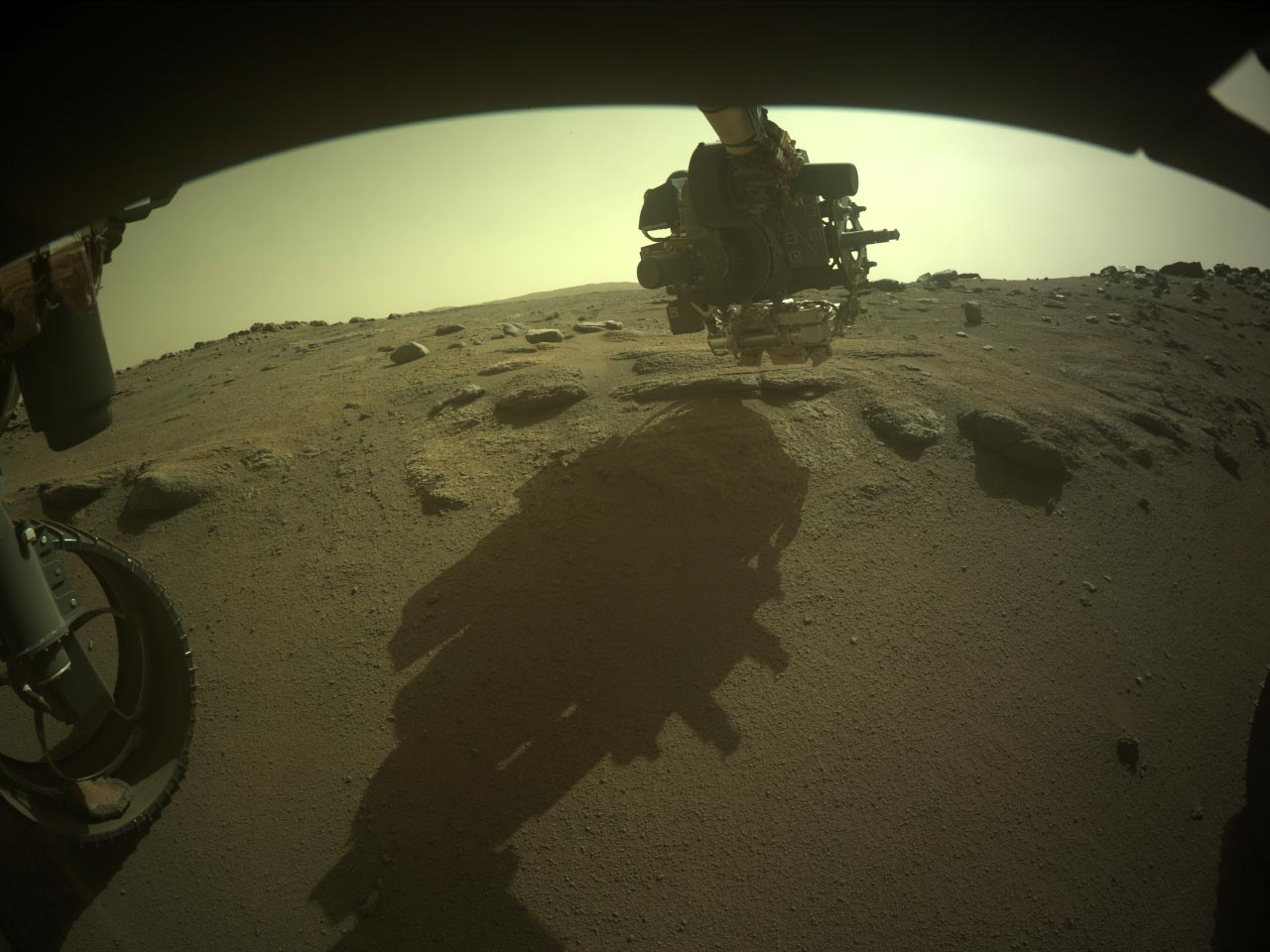
So where are we right now? We are currently in front of an outcrop called “Rimplas,” for a quick abrasion and proximity science pit stop on our way back (a future stop will be to acquire our last samples from the crater floor – stay tuned for a future blog post!). This location is close to where Perseverance was on sol 177 almost 170 sols ago, near the Artuby outcrop where we saw intriguing layered rocks. We now understand these layered rocks to be a part of the Artuby “member” (a group of rocks with common characteristics) that underlie the Rochette caprock member which was sampled in our first rock cores. These enigmatic layers have not yet been abraded and studied in detail with the PIXL, SHERLOC, and WATSON instruments, hence our current stop. Here’s to hoping that we’ll have our 6th abrasion patch later this week!
Written by Vivian Sun, Science Operations Systems Engineer, Staff Scientist at NASA/JPL
Never miss a breakthrough: Join the SciTechDaily newsletter.
Follow us on Google and Google News.
4 Comments
thnx for giving us this knowing .
Hi there Arsham1054!
I forgot your screen name again. Can you repeat it for me?
Babu G. Ranganathan*
(B.A. Bible/Biology)
POSSIBLY MILLIONS OF TONS OF VOLCANIC EARTH SOIL REACHED MARS (Newsweek)
A Newsweek article of September 21, 1998, p.12 mentions the high possibility of Earth life on Mars because of millions of tons of Earth soil ejected into space from ancient volcanic explosions. “We think there’s about 7 million tons of earth soil sitting on Mars”, says USC scientist Kenneth Nealson. “You have to consider the possibility that if we find life on Mars, it could have come from the Earth” [Weingarten, T., Newsweek, September 21, 1998, p.12]. This may also explain why life forms may exist on Venus, again because they originated from Earth.
In the Earth’s past there was powerful volcanic activity which could have easily spewed dirt and rocks containing microbes and life into outer space which not only could have eventually reached Mars but also ended up traveling in orbit through space that we now know as meteors, comets, and asteroids. This would mean life forms found in meteorites originated from Earth in the first place.
Secular scientists have a different explanation from creationist scientists on the volcanic eruptions of the Earth’s past. Creation scientists believe, as Genesis teaches, that as the fountains of the deep were opened to release water for the world-wide flood the force of the eruptions could have indeed spewed great amounts of earth soil into space.
Life could not have evolved. A partially evolved cell would quickly disintegrate under the effects of random forces of the environment, especially without the protection of a complete and fully functioning cell membrane. A partially evolved cell cannot wait millions of years for chance to make it complete and living! In fact, it couldn’t have even reached the partially evolved state.
Having the right conditions and raw material for life do not mean that life can originate or arise by chance. Stanley Miller, in his famous experiment in 1953, showed that individual amino acids (the building blocks of life) could come into existence by chance. But, it’s not enough just to have amino acids. The various amino acids that make-up life must link together in a precise sequence, just like the letters in a sentence, to form functioning protein molecules. If they’re not in the right sequence the protein molecules won’t work. It has never been shown that various amino acids can bind together into a sequence by chance to form protein molecules. Even the simplest cell is made up of many millions of various protein molecules.
The probability of just an average size protein molecule arising by chance is 10 to the 65th power. Mathematicians have said any event in the universe with odds of 10 to 50th power or greater is impossible! The late great British scientist Sir Frederick Hoyle calculated that the odds of even the simplest cell coming into existence by chance is 10 to the 40,000th power! How large is this? Consider that the total number of atoms in our universe is 10 to the 82nd power.
Also, what many don’t realize is that Miller had a laboratory apparatus that shielded and protected the individual amino acids the moment they were formed, otherwise the amino acids would have quickly disintegrated and been destroyed in the mix of random energy and forces involved in Miller’s experiment.
Miller’s experiment produced equally both left-handed and right-handed amino acids, but all living things strictly require only left-handed amino acids. If a right-handed amino acid gets into the chain the protein won’t work.
There is no innate chemical tendency for the various amino acids to bond with one another in a sequence. Any one amino acid can just as easily bond with any other. The only reason at all for why the various amino acids bond with one another in a precise sequence in the cells of our bodies is because they’re directed to do so by an already existing sequence of molecules found in our genetic code.
Of course, once you have a complete and living cell then the genetic code and biological machinery exist to direct the formation of more cells, but how could life or the cell have naturally originated when no directing code and mechanisms existed in nature? Read my Internet article: HOW FORENSIC SCIENCE REFUTES ATHEISM.
Visit my newest Internet site: THE SCIENCE SUPPORTING CREATION
Author of popular Internet article, TRADITIONAL DOCTRINE OF HELL EVOLVED FROM GREEK ROOTS
* I have had the privilege of being recognized in the 24th edition of Marquis “Who’s Who In The East” for my writings on religion and science, and I have given successful lectures (with question and answer time afterwards) defending creation from science before evolutionist science faculty and students at various colleges and universities.
Babu is babbling again. I’ll make it simple for you. There is no god.