
Close Menu
    Facebook X (Twitter) Instagram
    SciTechDaily
    • Biology
    • Chemistry
    • Earth
    • Health
    • Physics
    • Science
    • Space
    • Technology
    Facebook X (Twitter) Pinterest YouTube RSS
    SciTechDaily
    Home»Science»Inherent Complexity of the Wheat Genome
    Science

    Inherent Complexity of the Wheat Genome

    By SciTechDailyDecember 4, 2012No Comments3 Mins Read
    Facebook Twitter Pinterest Telegram LinkedIn WhatsApp Email Reddit
    Share
    Facebook Twitter LinkedIn Pinterest Telegram Email Reddit
    bread-wheat
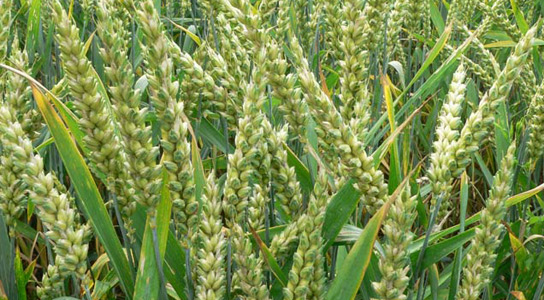
    A preliminary sequence of the bread wheat genome could help breeding efforts. Credit: H. F. Schwartz/Colorado State University

    An international team has produced a rough draft of wheat’s DNA sequence. The draft identifies many of its genes and makes it possible to identify thousands of potential genetic changes that could improve this crop. It’s been long considered one of the most important crop genomes.

    The scientists published their findings in the journal Nature. This could yield tremendous opportunities to improve the crop. Wheat is the world’s most widely grown crop and feeds a substantial part of the population. Yet scientists have struggled with its complex genetics as there are two kinds of wheat, bread wheat (Triticum aestivum) and pasta wheat (durum), which have different DNA sequences. Pasta wheat is a hybrid of two wild grasses and has two genomes, one from each of its ancestors.

    Bread wheat has three genomes. It is the result of the hybridization of the pasta wheat with a third grass species. This study focuses on the bread wheat genome, which has six times as much DNA as the human genome. Bread wheat passes each of its three genomes to the next generation. This is unlike corn, which melded two ancestral genomes into one. The biggest problem has been trying to work out which gene comes from which genome.

    The scientists had to sequence millions of DNA fragments from one variety of bread wheat. Then, they pieced together just the fragments containing genes. The genomes of the two ancestors of wheat were also sequenced and used to assign to two-thirds of the 95,000 genes that were found to each of the three genomes. Genes were grouped together based upon their similarity. The classes expanded in some cases because of hybridization, while in others, they shrank. As a result, bread wheat has more storage, defense response and energy metabolism proteins than its ancestors.

    Other bread wheat varieties were also sequenced in order to pinpoint the differences in their genes. These differences could represent potential improved traits, like drought resistance, which could be bred into new lines of wheat.

    The genome isn’t complete, but it’s the beginning of a useful analysis since nearly all of the features can be seen. Now, geneticists will have to understand their connectedness.

    Reference: “Analysis of the bread wheat genome using whole-genome shotgun sequencing” by Rachel Brenchley, Manuel Spannagl, Matthias Pfeifer, Gary L. A. Barker, Rosalinda D’Amore, Alexandra M. Allen, Neil McKenzie, Melissa Kramer, Arnaud Kerhornou, Dan Bolser, Suzanne Kay, Darren Waite, Martin Trick, Ian Bancroft, Yong Gu, Naxin Huo, Ming-Cheng Luo, Sunish Sehgal, Bikram Gill, Sharyar Kianian, Olin Anderson, Paul Kersey, Jan Dvorak, W. Richard McCombie, Anthony Hall, Klaus F. X. Mayer, Keith J. Edwards, Michael W. Bevan and Neil Hall, 28 November 2012, Nature.
    DOI: 10.1038/nature11650

    Never miss a breakthrough: Join the SciTechDaily newsletter.
    Follow us on Google and Google News.

    DNA Genetics Genome Plants
    Share. Facebook Twitter Pinterest LinkedIn Email Reddit

    Related Articles

    CRISPR Breakthrough Unlocks the Genetic Blueprint for Super-Sized Produce

    Scientists Reveal Millennia-Old Secrets of the World’s Most Popular Coffee Species

    Stickleback Fish Used Pre-Existing Genes to Go from Saltwater to Freshwater Environments

    Genetic Clues to Van Gogh’s Teddy Bear Sunflower Florets Uncovered

    Faster and Cheaper Genomics Technique Ready for Takeoff

    3-D Image Shows How DNA Packs Itself into a “Fractal Globule”

    Researcher Studies Root Growth to Develop Hardier, Weather-resistant Crops

    Researchers Complete Genome Sequence of a Denisovan Human Finger Bone

    Researchers Discover Chloroplast Genomes Transfer from Plant to Plant

    Leave A Reply Cancel Reply

    • Facebook
    • Twitter
    • Pinterest
    • YouTube

    Don't Miss a Discovery

    Subscribe for the Latest in Science & Tech!

    Trending News

    Black Hole Shredded a Massive Star in the Most Powerful Stellar Explosion Ever Seen

    Building the Brain Requires Millions of Dangerous DNA Breaks

    Endless Supply of Cancer-Fighting Immune Cells Unlocked by USC Scientists

    XRISM Reveals Galaxy-Shaping Winds Erupting From a Supermassive Black Hole

    New Molecule Restores the Brain’s Natural Defenses Against Alzheimer’s

    Could Creatine Boost More Than Muscles? It May Also Help Depression

    Scientists Discover a Natural Molecule That Could Help Prevent Vision Loss

    Scientists Thought Royal Jelly Made Queen Bees. They Were Wrong

    Follow SciTechDaily
    • Facebook
    • Twitter
    • YouTube
    • Pinterest
    • Newsletter
    • RSS
    SciTech News
    • Biology News
    • Chemistry News
    • Earth News
    • Health News
    • Physics News
    • Science News
    • Space News
    • Technology News
    Recent Posts
    • Astronomers Detect the Hidden Process That May Trigger Star Birth
    • Decades-Old Dark Matter Explanation Fails Its Most Direct Test Yet
    • Astronomers Find a New Clue for Detecting Runaway Supermassive Black Holes
    • Bacteria Turn Toxic Uranium Into a Surprisingly Stable Compound
    • “One in a Million” Find: Soft Tissue Discovered in 450-Million-Year-Old Fossil
    Copyright © 1998 - 2026 SciTechDaily. All Rights Reserved.
    • Science News
    • About
    • Contact
    • Editorial Board
    • Privacy Policy
    • Terms of Use

    Type above and press Enter to search. Press Esc to cancel.