
While studying DNA from plants’ green chloroplasts, researchers at Max Planck Institute of Molecular Plant Physiology in Potsdamare discovered that a transfer of chloroplasts genomes can occur in contact zones between plants. Researchers believe these findings will help scientists further understand of evolution and breeding of new plant varieties since the new chloroplast genome can be handed down to the next generation plants.
Plant scientists were confounded by the fact that the DNA extracted from the plants’ green chloroplasts sometimes showed the greatest similarities when related species grew in the same area. They tried to explain this phenomenon, for which they coined the term “chloroplast capture” with the assumption that every once in a while those normally sexually incompatible species crossed and produced offspring with a new combination of nuclear and chloroplast genomes. Now, scientists around Ralph Bock from the Max Planck Institute of Molecular Plant Physiology in Potsdam discovered that a transfer of entire chloroplasts, or at least their genomes, can occur in contact zones between plants. Inter-species crossing is not necessary. The new chloroplast genome can even be handed down to the next generation and, thereby, give a plant new traits. These findings are of great importance to the understanding of evolution as well as the breeding of new plant varieties.
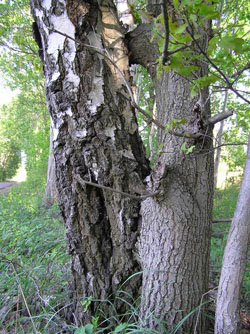
Many wooden plants, especially fruit and rose trees, are deliberately damaged by gardeners. They chop off branches or cut dents into the bark in order to put parts of another plant into the slots. The reason behind such gardening measures is to reproduce varieties with an especially high yield. According to the classic Mendelian Laws, only parts of the progeny show the same traits as their parents. The rest of the offspring will most likely be less valuable. By putting one branch of a successful apple variety onto a new stock, the desired apple tree is easily cloned. But graft junctions do not always have to be man-made. Plants that simply grow in close vicinity to each other can fuse.
In those contact zones mentioned above, so-called horizontal gene transfers, the transfer of genes without sexual reproduction, can occur. For a long time, scientists believed that such a gene transfer was restricted to prokaryotes, organisms without nuclei. It was universally accepted that, for example, bacteria can exchange genes that are crucial to their survival, like the ones that transmit a resistance to antibiotics. Nowadays it is increasingly appreciated that this phenomenon is in fact not restricted to such organisms. It can also be observed at the contact zone between different animal tissues after an organ transplantation or – as shown here – between two fusing plants. In 2009, Ralph Bock and Sandra Stegemann discovered that genetic information stored in the green chloroplasts can be transferred to another plant by means of horizontal gene transfer. Their results were, at that time, restricted to the transfer of genes between plants of the same species.
In their new experiments, they grafted the sexually incompatible tobacco species Nicotiana benthamiana, a herbaceous species, and Nicotiana glauca, a tree tobacco, onto the cultivated tobacco Nicotiana tabacum. They equipped the nuclei of the two wild species N. benthamiana and N. glauca with genes that encoded a resistance to an antibiotic as well as the yellow fluorescent protein The cultivated tobacco, on the other hand, had chloroplasts that carried genes coding for a resistance to another antibiotic and a green fluorescent protein. After the successful fusion of the two plants the graft sites were excised and cultivated on a growth medium that contained both antibiotics. The antibiotics hinder cell division and lead to cell death; only those cells which contain both resistance genes can survive and proliferate. Due to the nature of the experiment, it would have to be cells from N. benthamiana or N. glauca that acquired chloroplasts, or the chloroplast genome, from N. tabacum. Indeed, new plantlets grew out of half the excised graft sites and under the microscope one could see the characteristic green and yellow glow.
“The results from the DNA analyses were especially interesting,” says Sandra Stegemann, first author of the paper. “We found a completely identical version of the chloroplast genome from N. tabacum in the two other species.” When mitochondria, another cell organelle with an individual genome, are transferred across species barriers, the result is often a mixture of the donor and recipient DNA. “The new chloroplasts had kept their entire genetic information and fully ousted the old ones. They were even inherited by the next generation,” Stegemann further explains.
Now scientists are trying to find the answer to the question of how exactly the chloroplasts leave their homes and find a new place to live. Do they migrate through the plasmodesmata, the narrow tunnels that connect neighboring plant cells? Or do enzymes locally remove the cell wall and allow small amounts of cytoplasm and cell organelles to pass from one cell to another? “As of now, we do not know how chloroplasts manage to get from one cell to the other,” says group leader Ralph Bock. “But the decisive point is that it happens and the discovery of this process offers a new explanation for important evolutionary processes and opens up new possibilities for plant breeders.” After all, the chloroplast DNA vitally contributes to the fitness of a plant and can provide crucial advantages.
Never miss a breakthrough: Join the SciTechDaily newsletter.
Follow us on Google and Google News.