
Researchers found that a gene mutation linked to blindness can also increase intelligence.
When genes mutate, it can result in severe diseases of the human nervous system. Neuroscientists at Leipzig University and the University of Würzburg have now used fruit flies to demonstrate how, apart from the negative effect, the mutation of a neuronal gene can have a positive effect – namely higher IQ in humans. They have published their findings in the prestigious journal Brain.
Synapses are the contact points in the brain via which nerve cells ‘talk’ to one another. Disruptions in this communication lead to nervous system diseases, since altered synaptic proteins, for example, can impair this complex molecular mechanism. This can cause mild symptoms, but also very severe disabilities in those affected.
Mutation Linked to Above-Average Intelligence
The interest of the two neurobiologists Professor Tobias Langenhan and Professor Manfred Heckmann, from Leipzig and Würzburg respectively, was aroused when they read in a scientific publication about a mutation that damages a synaptic protein. At first, the affected patients attracted scientists’ attention because the mutation caused them to go blind. However, doctors then noticed that the patients were also of above-average intelligence. “It’s very rare for a mutation to lead to improvement rather than loss of function,” says Langenhan, professor and holder of a chair at the Rudolf Schönheimer Institute of Biochemistry at the Faculty of Medicine.
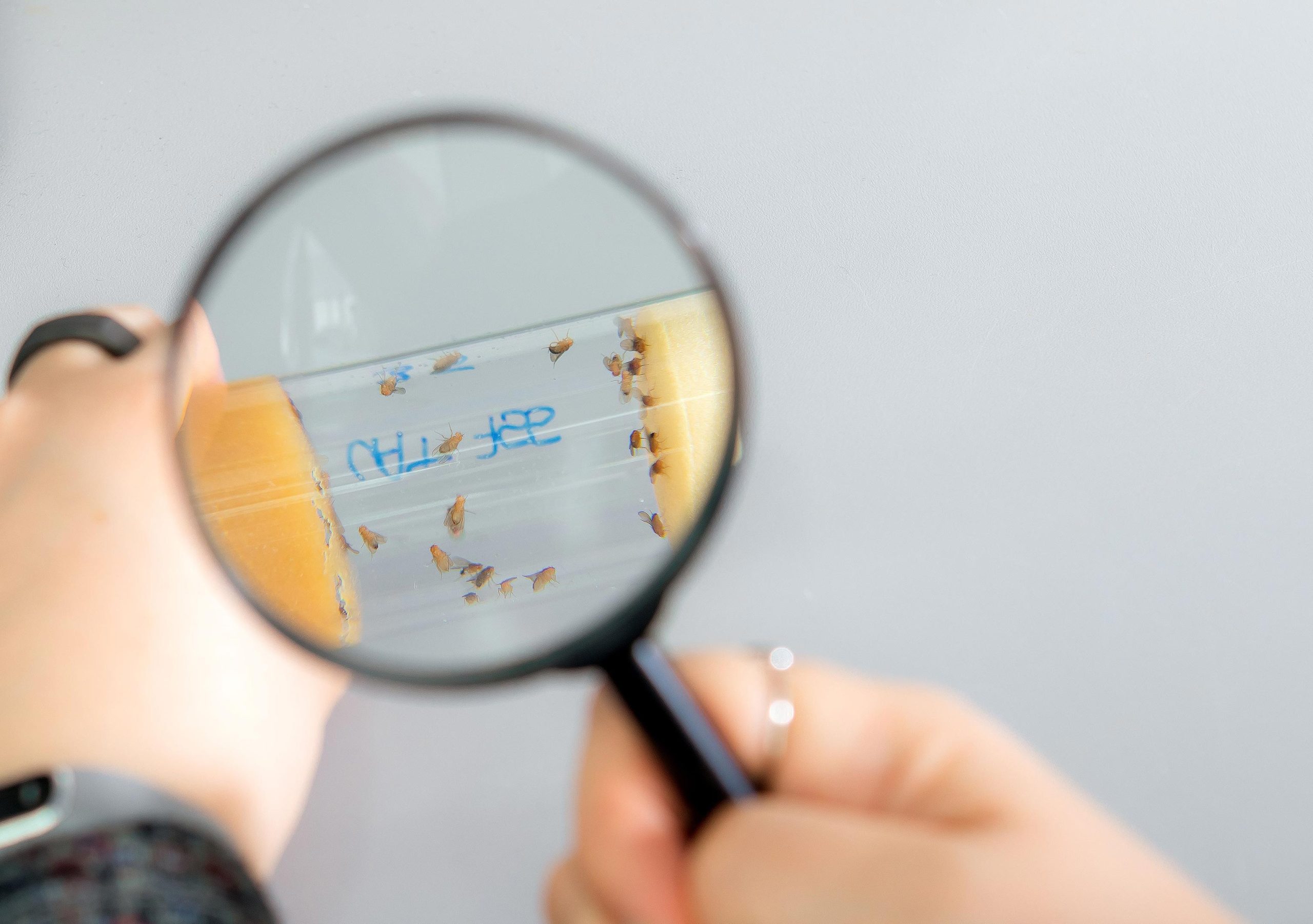
The two neurobiologists from Leipzig and Würzburg have been using fruit flies to analyze synaptic functions for many years. “Our research project was designed to insert the patients’ mutation into the corresponding gene in the fly and use techniques such as electrophysiology to test what then happens to the synapses. It was our assumption that the mutation makes patients so clever because it improves communication between the neurons which involve the injured protein,” explains Langenhan. “Of course, you can’t conduct these measurements on the synapses in the brains of human patients. You have to use animal models for that.”
“75 percent of genes that cause diseases in humans also exist in fruit flies”
First, the scientists, together with researchers from Oxford, showed that the fly protein called RIM looks molecularly identical to that of humans. This was essential in order to be able to study the changes in the human brain in the fly. In the next step, the neurobiologists inserted mutations into the fly genome that looked exactly as they did in the diseased people. They then took electrophysiological measurements of synaptic activity. “We actually observed that the animals with the mutation showed a much increased transmission of information at the synapses. This amazing effect on the fly synapses is probably found in the same or a similar way in human patients, and could explain their increased cognitive performance, but also their blindness,” concludes Professor Langenhan.

Molecular Insights into Enhanced Synaptic Transmission
The scientists also found out how the increased transmission at the synapses occurs: the molecular components in the transmitting nerve cell that trigger the synaptic impulses move closer together as a result of the mutation effect and lead to increased release of neurotransmitters. A novel method, super-resolution microscopy, was one of the techniques used in the study. “This gives us a tool to look at and even count individual molecules and confirms that the molecules in the firing cell are closer together than they normally are,” says Professor Langenhan, who was also assisted in the study by Professor Hartmut Schmidt’s research group from the Carl Ludwig Institute in Leipzig.
“The project beautifully demonstrates how an extraordinary model animal like the fruit fly can be used to gain a very deep understanding of human brain disease. The animals are genetically highly similar to humans. It is estimated that 75 percent of the genes involving disease in humans are also found in the fruit fly,” explains Professor Langenhan, pointing to further research on the topic at the Faculty of Medicine: “We have started several joint projects with human geneticists, pathologists and the team of the Integrated Research and Treatment Center (IFB) AdiposityDiseases; based at Leipzig University Hospital, they are studying developmental brain disorders, the development of malignant tumors and obesity. Here, too, we will insert disease-causing mutations into the fruit fly to replicate and better understand human disease.”
Reference: “The human cognition-enhancing CORD7 mutation increases active zone number and synaptic release” by Mila M. Paul, Sven Dannhäuser, Lydia Morris, Achmed Mrestani, Martha Hübsch, Jennifer Gehring, Georgios N. Hatzopoulos, Martin Pauli, Genevieve M. Auger, Grit Bornschein, Nicole Scholz, Dmitrij Ljaschenko, Martin Müller, Markus Sauer, Hartmut Schmidt, Robert J. Kittel, Aaron DiAntonio, Ioannis Vakonakis, Manfred Heckmann and Tobias Langenhan, 12 January 2022, Brain.
DOI: 10.1093/brain/awac011
Never miss a breakthrough: Join the SciTechDaily newsletter.
Follow us on Google and Google News.
7 Comments
“…This amazing effect on the fly synapses is probably found in the same or a similar way in human patients, and could explain their increased cognitive performance, but also their blindness,” Reporter fail! They did not follow up and ask how this likely causes blindness.
If I had to guess, I would guess that the neuron firing rate is too high and causes damage (neurons are very fast in the eye). But I should not have to guess. There could also be a mechanical problem where things don’t align. I wish the reporter had bothered to get the explanation.
… “It’s very rare for a mutation to lead to improvement rather than loss of function,” but if you think about it, the chimps are better at short term memory than humans… it looks like sometimes one needs to lose something to gain other things…
… and how come there are no other intelligent species on the Earth. The ones that can create intelligent observations about other creature intelligence, based on real evidence, not a narrative that is easy to produce from tin air…
The article was written by the fruit fly
Amazing research! Beyond better understanding a brain mechanism, they also produced a superinteligent fly…
… “It’s very rare for a mutation to lead to improvement rather than loss of function,” is a seemingly odd statement to make as the majority of mutations that occur have no affect or are beneficial.
Point one : YEAH. It’s rare for a mistake to be beneficial. But, it is also rare to be the smartest thing alive on the planet.
Think that through, if you can… Then we can start talking about important stuff. Like, how we got to be the smartest thing on the planet. Instead of the amazing (boring) fact that we are. And what happened to the competition… just exactly? I mean, if you don’t mind us wasting your time… Or would you rather go on and on and on about how unlikely it is for us to be… us. Here. Now. Boring the tears out of those of us who did this before kindergarten. It’s called the anthropomorphic principle. And it’s as old as the Sphinx. I am REALLY sorry this is the first you’ve heard of it. Because that makes you argumentative.
What? RUDE? Whose TIME are you wasting?