
Close Menu
    Facebook X (Twitter) Instagram
    SciTechDaily
    • Biology
    • Chemistry
    • Earth
    • Health
    • Physics
    • Science
    • Space
    • Technology
    Facebook X (Twitter) Pinterest YouTube RSS
    SciTechDaily
    Home»Chemistry»New Method Allows Scientists To Remove 95% of Nanoplastics
    Chemistry

    New Method Allows Scientists To Remove 95% of Nanoplastics

    By Shinshu UniversityJuly 26, 2022No Comments2 Mins Read
    Facebook Twitter Pinterest Telegram LinkedIn WhatsApp Email Reddit
    Share
    Facebook Twitter LinkedIn Pinterest Telegram Email Reddit
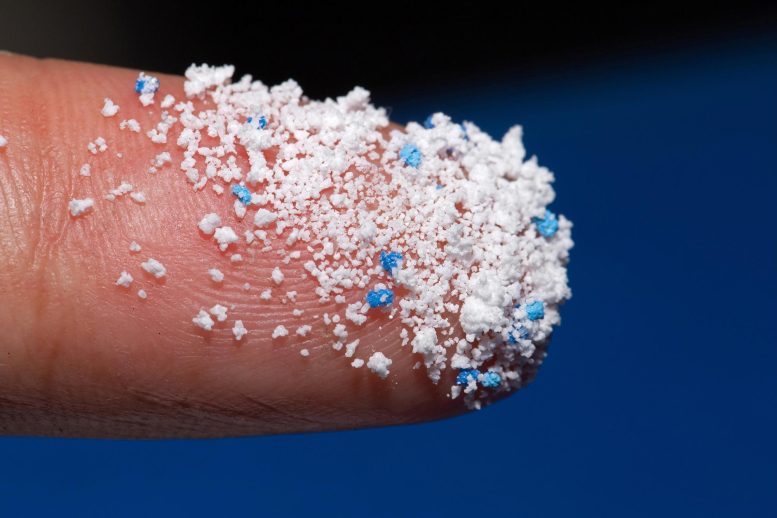
    Microplastic on Finger
    Plastic particles no larger than a micrometer are known as nanoplastics.

    Scientists Use Apples To Remove Nanoplastics

    Polystyrene Particles
    Top Image: Pectin Bottom Image: Polystyrene particles (Average Size: 100 nm). Credit: Hiroshi Moriwaki, Shinshu University

    Ecosystems are known to accumulate microplastics, and the breakdown of microplastics produces nanoplastics. Nanoplastics are plastic particles that are smaller than 100 nm that disperse in water in a colloidal state.

    Although nanoplastics may be more common than microplastics, their small size makes them difficult to thoroughly investigate and evaluate. However, nanoplastics have been discovered in zebrafish in a number of organs, including the brain, which may be a sign that they can pass the blood-brain barrier.

    Ninety percent of microplastics in urban areas are removed during the sewage treatment process. Microplastics are known to bond to biopolymers in the ocean and sink to the bottom.

    Nano Polystyrene Suspension
    Left image: The picture of a nano-polystyrene suspension (500 mg L−1, pH 7) (left) and the nano-polystyrene suspension after adding pectin (15 mg L−1) and Fe(III) (0.10 mM) after storage for 72 h (right). Right image: TEM image of the precipitate. Credit: Copyright © 2022 Elsevier Ltd. All Rights Reserved.

    Therefore, the research team at Shinshu University under the direction of Professor Hiroshi Moriwaki of the Department of Applied Biology, Faculty of Textile Science and Technology, proposed employing pectin, a biopolymer to attach to nanoplastics with the aid of iron or aluminum. They discovered that by employing coagulating sedimentation with pectin and iron with filter paper, they were able to remove 95% of the nanoplastics within the first 24 hours.

    The use of pectin was inspired by the abundance of apples in the prefecture of Nagano where Shinshu University is based. More information can be found by reading the paper which was published in the Journal of Environmental Chemical Engineering.

    Reference: “Interaction between nanoplastics and pectin, a water-soluble polysaccharide, in the presence of Fe(III) ion” by Hiroshi Moriwaki, Naoya Komori and Yoshitake Akiyama, 15 June 2022, Journal of Environmental Chemical Engineering.
    DOI: 10.1016/j.jece.2022.108054

    The study was funded by the Japan Society for the Promotion of Science.

    Never miss a breakthrough: Join the SciTechDaily newsletter.
    Follow us on Google and Google News.

    Microplastics Plastic Pollution Shinshu University
    Share. Facebook Twitter Pinterest LinkedIn Email Reddit

    Related Articles

    MIT Unveils a Biodegradable Alternative to Microplastic Beads

    The Great Disappearing Act: Scientists Discover Rapidly Degrading Bioplastic

    Transforming the Plastic Lifecycle Into a Circle

    Microplastic Pollution May Be Generated Simply by Opening Plastic Bags and Bottles

    LEGO Bricks Could Survive in the Ocean for Up to 1,300 Years

    Revealing the Structure of Bacterial Hitchhikers on Plastic Trash in the Ocean

    98% of Plastics Entering the Oceans Go Missing Each Year – Here’s the Likely Culprit

    Scientists Thought It Took Thousands of Years for Plastic to Decompose – It May Only Be Decades

    Four Billion Microplastic Particles Discovered in the Waters of Tampa Bay

    Leave A Reply Cancel Reply

    • Facebook
    • Twitter
    • Pinterest
    • YouTube

    Don't Miss a Discovery

    Subscribe for the Latest in Science & Tech!

    Trending News

    Stanford Scientists Discover a Remarkable Way To Rescue Dying Corals in Just Seven Weeks

    0 to 15 MPH in a Single Swipe: New Research Reveals How Ancient Giant Sea Monsters Ambushed Their Prey

    Late-Night Snacking Could Be Putting Your Liver at Risk

    40 Years of Superconductor Science Just Got Turned Upside Down by a Stunning Discovery

    A 50-Year-Old Mystery: Scientists Discover What May Have Killed Brazil’s Frogs

    Scientists Discover Exercise Changes the Body in Ways We Never Fully Understood

    Scientists Restore Memory in Mice With Alzheimer’s by Boosting a Single Brain Protein

    Scientists Create “Super Ice” That’s 10 Times Stronger and Rivals Concrete in Strength

    Follow SciTechDaily
    • Facebook
    • Twitter
    • YouTube
    • Pinterest
    • Newsletter
    • RSS
    SciTech News
    • Biology News
    • Chemistry News
    • Earth News
    • Health News
    • Physics News
    • Science News
    • Space News
    • Technology News
    Recent Posts
    • Scientists Discover a New Butterfly Species Hiding in Plain Sight
    • A Cave Full of Ancient Human Remains Has a Strange Secret: Where Are All the Males?
    • Common Chemicals Trigger Alarming Changes in Human Breast Tissue Models
    • A Deadly Virus Has Been Hiding in Brazil for 142 Years – and Scientists Just Uncovered a Hidden Danger
    • MIT Scientists Reprogram Immune Cells Inside the Body To Destroy Cancer
    Copyright © 1998 - 2026 SciTechDaily. All Rights Reserved.
    • Science News
    • About
    • Contact
    • Editorial Board
    • Privacy Policy
    • Terms of Use

    Type above and press Enter to search. Press Esc to cancel.