

A simple animal model shows how stimuli and states such as smells, stressors, and satiety converge in an olfactory neuron to guide food-seeking behavior.
Imagine you live across from a bakery. Sometimes you are hungry and therefore tempted when aromas waft through your window. However, other times satiety makes you uninterested. Sometimes popping over for a popover seems trouble-free, but sometimes your spiteful ex is there. Your brain balances many influences in determining what you’ll do.
An example of this working in a much simpler animal is detailed in a new MIT study. It highlights a potentially fundamental principle of how nervous systems integrate multiple factors to guide food-seeking behavior.
All animals share the challenge of weighing diverse sensory cues and internal states when formulating behaviors, but scientists know little about how this actually occurs. To gain deep insight, the research team based at The Picower Institute for Learning and Memory turned to the C. elegans worm, whose well-defined behavioral states and 302-cell nervous system make the complex problem at least tractable. They emerged with a case study of how, in a crucial olfactory neuron called AWA, many sources of state and sensory information converge to independently throttle the expression of a key smell receptor. The integration of their influence on that receptor’s abundance then determines how AWA guides roaming around for food.
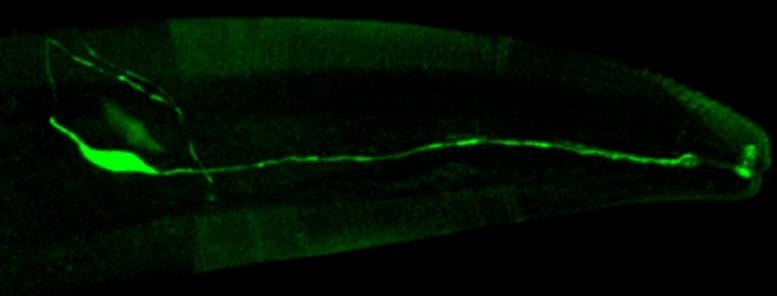
AWA Neurons and STR-44 Receptors
“In this study, we dissected the mechanisms that control the levels of a single olfactory receptor in a single olfactory neuron, based on the ongoing state and stimuli the animal experiences,” says senior author Steven Flavell, Lister Brothers Associate Professor in MIT’s Department of Brain and Cognitive Sciences. “Understanding how the integration happens in one cell will point the way for how it may happen in general, in other worm neurons and in other animals.”
MIT postdoc Ian McLachlan led the study, which was recently published in the journal eLife. He said the team didn’t necessarily know what they’d find out when they began.
“We were surprised to find that the animal’s internal states could have such an impact on gene expression at the level of sensory neurons — essentially, hunger and stress caused changes in how the animal senses the outside world by changing what sensory neurons respond to,” he says. “We were also excited to see that the chemoreceptor expression wasn’t just depending on one input, but depended on the sum total of external environment, nutritional status, and levels of stress. This is a new way to think about how animals encode competing states and stimuli in their brains.”
Hunger’s Impact on Sensory Perception
Indeed McLachlan, Flavell, and their team didn’t go looking specifically for the neuron AWA or the specific olfactory chemoreceptor, dubbed STR-44. Instead, those targets emerged from the unbiased data they collected when they looked at what genes changed in expression the most when worms were kept from food for three hours compared to when they were well-fed. As a category, genes for many chemosensory receptors showed huge differences. AWA proved to be a neuron with a large number of these up-regulated genes and two receptors, STR-44 and SRD-28, appeared especially prominent among those.
This result alone showed that an internal state (hunger) influenced the degree of receptor expression in a sensory neuron. McLachlan and his co-authors were then able to show that STR-44 expression also independently changed based on the presence of a stressful chemical, based on a variety of food smells, and on whether the worm had received the metabolic benefits of eating food. Further tests led by co-second author Talya Kramer, a graduate student, revealed which smells trigger STR-44, allowing the researchers to then demonstrate how changes in STR-44 expression within AWA directly affected food-seeking behavior. And yet more research identified the exact molecular and circuit means by which these varying signals get to AWA and how they act within the cell to change STR-44 expression.
Stress and Sensory Trade-offs
For example, in one experiment McLachlan and Flavell’s team showed that while both fed and hungry worms would wriggle toward the receptors’ favorite smells if they were strong enough, only fasted worms (which express more of the receptor) could detect fainter concentrations. In another experiment, they found that while hungry worms will slow down to eat upon reaching a food source even as well-fed worms cruise on by, they could make well-fed worms act like fasted ones by artificially overexpressing STR-44. Such experiments demonstrated that STR-44 expression changes have a direct effect on food-seeking.
Other experiments showed how multiple factors push and pull on STR-44. For instance, they found that when they added a chemical that stresses the worms, that ratcheted down STR-44 expression even in fasted worms. And later they showed that the same stressor suppressed the worms’ urge to wriggle toward the odor that STR-44 responds to. So just like you might avoid following your nose to the bakery, even when hungry, if you see your ex there, worms weigh sources of stress against their hunger when deciding whether to approach food. They do so, the study shows, based on how these different cues and states push and pull on STR-44 expression in AWA.
Decoding Neural Pathways and Molecular Levers
Several other experiments examined the pathways of the worm’s nervous system that bring sensory, hunger, and active eating cues to AWA. Technical assistant Malvika Dua helped to reveal how other food-sensing neurons affect STR-44 expression in AWA via insulin signaling and synaptic connections. Cues about whether the worm is actively eating come to AWA from neurons in the intestine that use a molecular nutrient sensor called TORC2. These, and the stress-detecting pathway, all acted on FOXO, which is a regulator of gene expression. In other words, all the inputs that affect STR-44 expression in AWA were doing so by independently pushing and pulling on the same molecular lever.
Flavell and McLachlan note that pathways such as insulin and TORC2 are present in not only other worm sensory neurons but also many other animals, including humans. Moreover, sensory receptors were up-regulated by fasting in more neurons than just AWA. These overlaps suggest that the mechanism they discovered in AWA for integrating information is likely at play in other neurons and maybe in other animals, Flavell says.
And, McLachlan adds, basic insights from this study could help inform research on how gut-brain signaling via TORC2 works in people.
“This is emerging as a major pathway for gut-to-brain signaling in C. elegans, and I hope it will ultimately have translational importance for human health,” McLachlan says.
Reference: “Diverse states and stimuli tune olfactory receptor expression levels to modulate food-seeking behavior” by Ian G McLachlan, Talya S Kramer, Malvika Dua, Elizabeth M DiLoreto, Matthew A Gomes, Ugur Dag, Jagan Srinivasan and Steven W Flavell, 31 August 2022, eLife.
DOI: 10.7554/eLife.79557
In addition to McLachlan, Flavell, Kramer, and Dua, the paper’s other authors are Matthew Gomes and Ugur Dag of MIT and Elizabeth DiLoreto and Jagan Srinivasan of Worcester Polytechnic Institute.
The JPB Foundation, the National Institutes of Health, the National Science Foundation, the McKnight Foundation, and the Alfred P. Sloan Foundation provided funding for the study.
Never miss a breakthrough: Join the SciTechDaily newsletter.
Follow us on Google and Google News.