
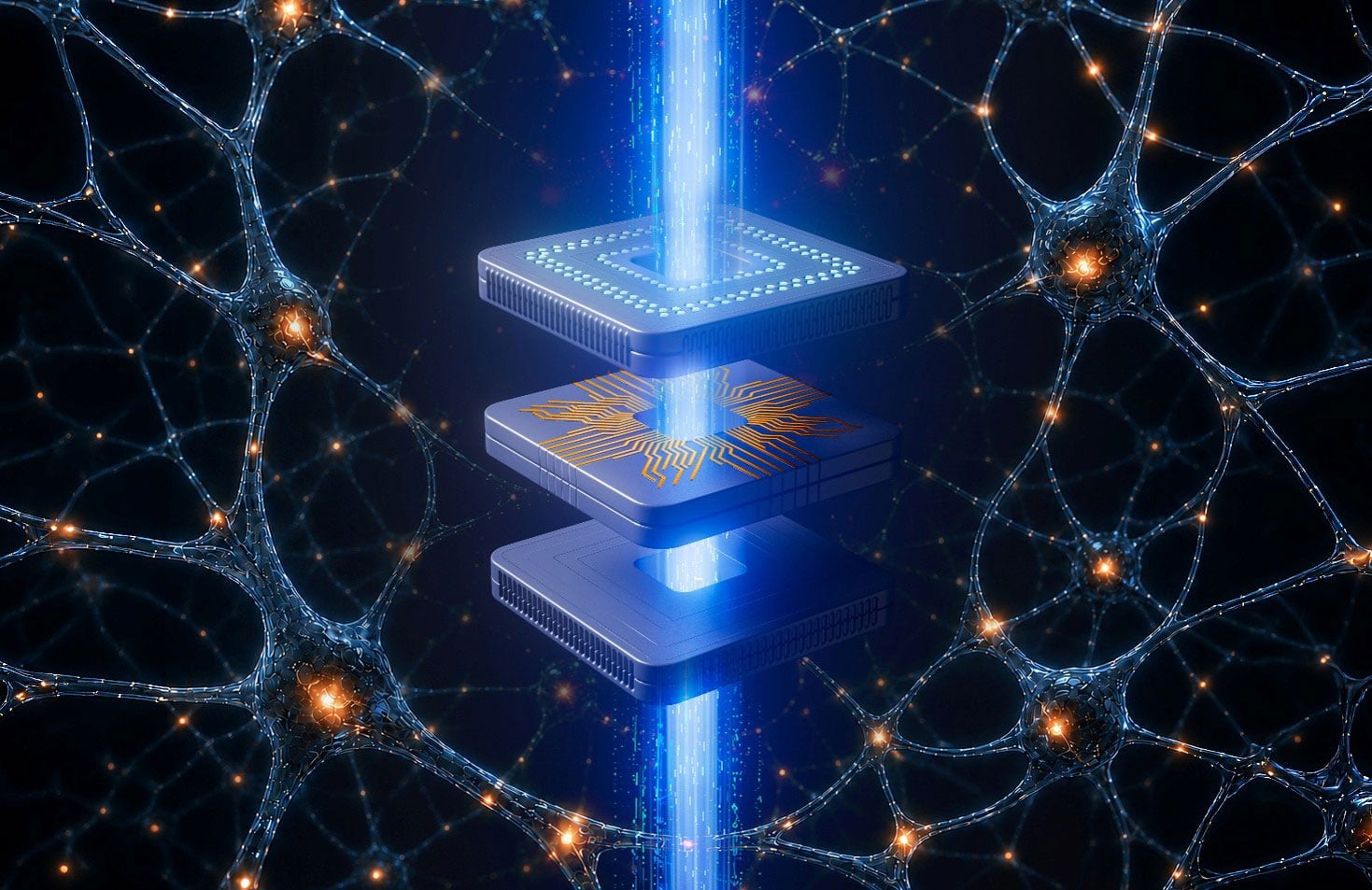
A breakthrough in brain-inspired electronics could lead to devices that process information and learn without relying on conventional computing architectures.
A single nanoscale electronic component can perform three different jobs, switching electrical current, storing information through resistance, and remembering past electrical activity through changes in capacitance. Researchers in Germany have demonstrated this versatility using unusual oxide materials, opening a possible path toward computer hardware that processes information and adapts more like the human brain.
Today’s artificial intelligence systems can consume enormous amounts of electricity, particularly during the training of large models. One reason researchers are exploring alternative hardware is that conventional computers typically separate memory from computation, requiring information to move between them. The brain operates differently. Its neurons communicate through synapses, connections that can change in response to repeated or intense signals. This ability to adapt, known as neuroplasticity, helps the brain learn from experience.
An Unusual Material Interface That Can Learn
A research team at the University of Würzburg, working within the Würzburg and Dresden Cluster of Excellence ctd.qmat, has developed electronic components that reproduce several important behaviors of neurons and synapses. Their approach uses complex oxides, materials whose electrical properties can be adjusted to support different functions within the same system.
The devices rely on two materials: lanthanum aluminate (LaAlO₃, or LAO for short) and strontium titanate (SrTiO₃, or STO for short). Both are electrical insulators individually, but when brought together, they form an extremely thin conductive layer at their interface. This layer, called a quasi-two-dimensional electron gas, allows electrons to move through a region confined to the boundary between the materials.
By carefully patterning the interface, researchers can create microscopic conductive pathways, sometimes described as “electron highways.” Electrical current can displace oxygen atoms within the structure, altering its resistance. These changes allow the device to be “trained” through electrical stimulation, providing a physical mechanism for storing information about previous activity.
Three Electronic Functions in One Tiny Device
Using this material platform, the Würzburg researchers created components that can act as a transistor, a memristor, or a memcapacitor. A transistor controls current flow, while a memristor stores information through changes in electrical resistance. A memcapacitor behaves differently: its ability to store electrical charge depends on its previous electrical state.
The researchers demonstrated that a single nanoscale component can provide any of these three functions depending on how it is connected electrically. This versatility could simplify the design of artificial neural networks built directly into electronic hardware.
“What makes our platform so exciting is that we can realize very different functions using the same material system. This brings us closer to hardware that not only computes but can also learn directly within the component and temporarily store information,” says Soumen Pradhan, a postdoctoral researcher at the Chair of Technical Physics in Würzburg.
Toward More Energy-Efficient Brain-Inspired Computing
“Brain-inspired computing” seeks to reproduce some of the brain’s information processing and learning mechanisms in electronic circuits. Rather than continually transferring data between separate processing and memory units, these systems aim to combine computation, information storage, and adaptation within individual components.
“Complex oxides are an especially exciting field for us because they combine many electronic properties in a single material platform. That is precisely what makes them so interesting for a new generation of energy-efficient and adaptable computer hardware,” says Ralph Claessen, spokesperson at JMU Würzburg for the Würzburg–Dresden Cluster of Excellence ctd.qmat and a co-author of the study.
Future Applications in Wearable Health Technology
One potential application is health monitoring. Wearable devices incorporating this type of adaptive electronics might eventually analyze physiological signals directly, without requiring separate computing hardware for every processing task.
Such “self-learning” sensors could potentially track heart rate, blood pressure, temperature, blood oxygen saturation, or blood glucose while adapting their responses to incoming data. Processing signals locally could also reduce the energy required to transfer information to external systems.
For now, these possibilities remain long-term goals. The research demonstrates the underlying electronic functions rather than a complete artificial intelligence system or medical sensor. Further development will be needed to establish whether the technology can deliver practical improvements in energy consumption, reliability, and performance.
Reference: “Oxide interface-based polymorphic electronic devices for neuromorphic computing” by Soumen Pradhan, Kirill Miller, Fabian Hartmann, Merit Spring, Judith Gabel, Berengar Leikert, Silke Kuhn, Martin Kamp, Victor Lopez-Richard, Michael Sing, Ralph Claessen and Sven Höfling, 9 April 2026, Nature Communications.
DOI: 10.1038/s41467-026-71642-2
Never miss a breakthrough: Join the SciTechDaily newsletter.
Follow us on Google and Google News.