
Close Menu
    Facebook X (Twitter) Instagram
    SciTechDaily
    • Biology
    • Chemistry
    • Earth
    • Health
    • Physics
    • Science
    • Space
    • Technology
    Facebook X (Twitter) Pinterest YouTube RSS
    SciTechDaily
    Home»Chemistry»Another Step Toward Lower Cost Alkaline Fuel Cells
    Chemistry

    Another Step Toward Lower Cost Alkaline Fuel Cells

    By Eric Gershon, Yale UniversityMarch 19, 2013No Comments3 Mins Read
    Facebook Twitter Pinterest Telegram LinkedIn WhatsApp Email Reddit
    Share
    Facebook Twitter LinkedIn Pinterest Telegram Email Reddit
    Palladium-Silver Alternative to Platinum
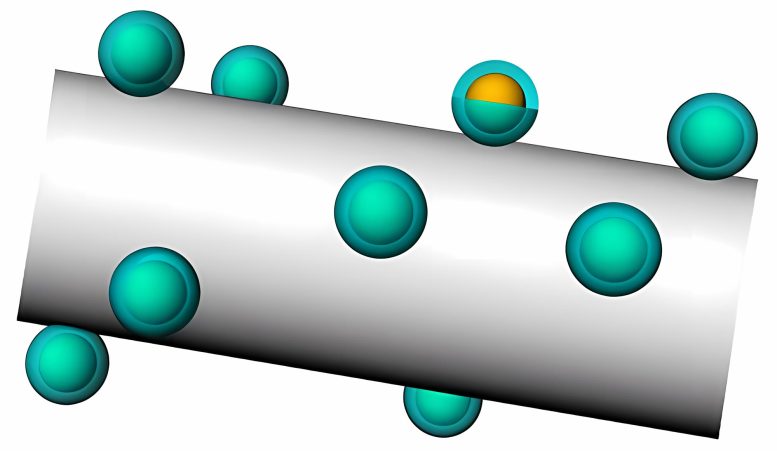
    A palladium-silver combination could serve as a lower-cost alternative to platinum in alkaline fuel cells, according to Yale researchers. Credit: Illustration by André Taylor lab/Yale

    In a newly published study, engineers synthesize a platinum-free catalyst for use in alkaline fuel cells, showing that silver-palladium multi-walled carbon nanotubes are almost as effective as platinum in low-temperature fuel cells.

    Researchers at Yale University have taken another step toward the development of low-temperature, lower-cost alkaline fuel cells, which are battery-like devices that convert oxygen and hydrogen into electricity and heat.

    In research recently published in the journal Applied Catalysis B: Environmental, Yale engineers report synthesizing a platinum-free catalyst for use in alkaline fuel cells by substituting less-costly palladium for platinum and combining it with silver.

    The catalyst is the part of the fuel cell that breaks down the fuel (alcohol or hydrogen, for example), setting in motion other chemical reactions that ultimately produce electricity and heat. Platinum has been the preferred catalyst material, but its scarcity has prevented the widespread use of fuel cells. The Yale researchers showed that a palladium-silver combination is almost as effective as platinum, making it a viable — and less expensive — alternative.

    “The high cost of platinum and other noble metals is one of the major hurdles for the commercialization of low-temperature fuel cells,” said André D. Taylor, assistant professor of chemical and environmental engineering at Yale and principal investigator of the research. “This catalyst architecture could reduce this cost by using palladium only in the shell region of the catalyst.”

    The researchers’ technique for making the catalyst’s thin palladium shell, called galvanic displacement, could be used for fabricating new materials with properties appropriate for a wide range of other applications, such as sensors, or battery materials.

    The new, platinum-free catalyst has a unique core-shell structure; the thin shell is palladium, and the core is silver. This allows for higher catalytic activity and greater tolerance for impurities than standard platinum-based catalysts. Particles of silver coated with palladium cover the surface of multi-walled carbon nanotubes, promoting the reduction of oxygen over the oxidation of alcohol, and facilitating desirable chemical reactions.

    The research results show that silver-palladium multi-walled carbon nanotubes are promising platinum-free cathode catalysts with desirable properties for oxygen reduction, as well as an improved tolerance to methanol and ethanol. Tolerance to alcohol is important due to fuel crossover in the fuel cell, which occurs by the diffusion across the membrane.

    Reference: “Silver palladium core–shell electrocatalyst supported on MWNTs for ORR in alkaline media” by Ryan C. Sekol, Xiaokai Li, Peter Cohen, Gustavo Doubek, Marcelo Carmo and André D. Taylor, 6 March 2013, Applied Catalysis B: Environmental.
    DOI: 10.1016/j.apcatb.2013.02.054

    Ryan C. Sekol is lead author. The paper, published on March 13, contains a complete list of co-authors.

    The National Science Foundation and Yale Climate Energy Initiative provided support for the research.

    Never miss a breakthrough: Join the SciTechDaily newsletter.
    Follow us on Google and Google News.

    Catalysts Fuel-cell Technology Nanotechnology Yale University
    Share. Facebook Twitter Pinterest LinkedIn Email Reddit

    Related Articles

    Cobalt-Graphene Catalyst Performs Nearly As Well as Platinum

    Dempsey’s Mechanism, Pathway that Catalysts Use to Generate Hydrogen

    New Nanocomposite Material Looks to Improve Fuel Cells

    Scientists Examine Platinum-Based Catalyst Design

    Nanorod Catalyst Provides Platinum Like Efficiency in MFCs at a Fraction of the Cost

    Multi-Walled Carbon Nanotubes May Eventually Replace Expensive Platinum Catalysts

    Automated System Has Promising Uses in Battery and Fuel Cell Production

    Zeolite Catalyst Creates P-Xylene From Biomass

    Gold Improves the Performance of Nanoparticle Fuel-Cell Reactions

    Leave A Reply Cancel Reply

    • Facebook
    • Twitter
    • Pinterest
    • YouTube

    Don't Miss a Discovery

    Subscribe for the Latest in Science & Tech!

    Trending News

    Hidden Brain Signals Could Predict Alzheimer’s Years Before Symptoms Appear

    The Solar System May Have a 6th Dwarf Planet – and It’s Been Hiding in Plain Sight

    New Research Identifies the Hidden Rules That Help Brain Cancer Evade Treatment

    Smiling Isn’t Always Good for You, Scientists Discover

    Scientists Discover Climate Change May Have Stopped Earth’s Next Ice Age

    Quantum Discovery Reveals Why More Powerful Lasers Can Actually Slow Atoms Down

    Einstein Was Right Again: Scientists Discover Chemical Bonds That Defy Textbook Rules

    NASA Space Telescope Meets Fiery End After Nearly 22 Years in Orbit

    Follow SciTechDaily
    • Facebook
    • Twitter
    • YouTube
    • Pinterest
    • Newsletter
    • RSS
    SciTech News
    • Biology News
    • Chemistry News
    • Earth News
    • Health News
    • Physics News
    • Science News
    • Space News
    • Technology News
    Recent Posts
    • Why Did Polynesians Suddenly Sail Across the Pacific After 1,700 Years? Scientists May Have Found the Answer
    • A Natural “Varnish” May Explain How 37,000-Year-Old Cave Art Survived
    • Scientists Just Found a Key Ingredient for Superconductivity at Room Temperature
    • Scientists Discover a Hidden Weakness in One of the Deadliest Cancers
    • Could Vitamin B12 Hold the Key to Treating a Rare Genetic Disorder?
    Copyright © 1998 - 2026 SciTechDaily. All Rights Reserved.
    • Science News
    • About
    • Contact
    • Editorial Board
    • Privacy Policy
    • Terms of Use

    Type above and press Enter to search. Press Esc to cancel.