
Close Menu
    Facebook X (Twitter) Instagram
    SciTechDaily
    • Biology
    • Chemistry
    • Earth
    • Health
    • Physics
    • Science
    • Space
    • Technology
    Facebook X (Twitter) Pinterest YouTube RSS
    SciTechDaily
    Home»Chemistry»Another Step Toward Lower Cost Alkaline Fuel Cells
    Chemistry

    Another Step Toward Lower Cost Alkaline Fuel Cells

    By Eric Gershon, Yale UniversityMarch 19, 2013No Comments3 Mins Read
    Facebook Twitter Pinterest Telegram LinkedIn WhatsApp Email Reddit
    Share
    Facebook Twitter LinkedIn Pinterest Telegram Email Reddit
    Palladium-Silver Alternative to Platinum
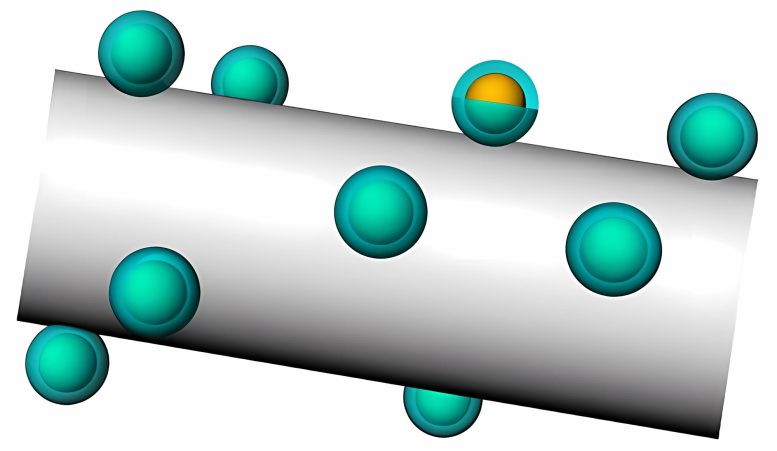
    A palladium-silver combination could serve as a lower-cost alternative to platinum in alkaline fuel cells, according to Yale researchers. Credit: Illustration by André Taylor lab/Yale

    In a newly published study, engineers synthesize a platinum-free catalyst for use in alkaline fuel cells, showing that silver-palladium multi-walled carbon nanotubes are almost as effective as platinum in low-temperature fuel cells.

    Researchers at Yale University have taken another step toward the development of low-temperature, lower-cost alkaline fuel cells, which are battery-like devices that convert oxygen and hydrogen into electricity and heat.

    In research recently published in the journal Applied Catalysis B: Environmental, Yale engineers report synthesizing a platinum-free catalyst for use in alkaline fuel cells by substituting less-costly palladium for platinum and combining it with silver.

    The catalyst is the part of the fuel cell that breaks down the fuel (alcohol or hydrogen, for example), setting in motion other chemical reactions that ultimately produce electricity and heat. Platinum has been the preferred catalyst material, but its scarcity has prevented the widespread use of fuel cells. The Yale researchers showed that a palladium-silver combination is almost as effective as platinum, making it a viable — and less expensive — alternative.

    “The high cost of platinum and other noble metals is one of the major hurdles for the commercialization of low-temperature fuel cells,” said André D. Taylor, assistant professor of chemical and environmental engineering at Yale and principal investigator of the research. “This catalyst architecture could reduce this cost by using palladium only in the shell region of the catalyst.”

    The researchers’ technique for making the catalyst’s thin palladium shell, called galvanic displacement, could be used for fabricating new materials with properties appropriate for a wide range of other applications, such as sensors, or battery materials.

    The new, platinum-free catalyst has a unique core-shell structure; the thin shell is palladium, and the core is silver. This allows for higher catalytic activity and greater tolerance for impurities than standard platinum-based catalysts. Particles of silver coated with palladium cover the surface of multi-walled carbon nanotubes, promoting the reduction of oxygen over the oxidation of alcohol, and facilitating desirable chemical reactions.

    The research results show that silver-palladium multi-walled carbon nanotubes are promising platinum-free cathode catalysts with desirable properties for oxygen reduction, as well as an improved tolerance to methanol and ethanol. Tolerance to alcohol is important due to fuel crossover in the fuel cell, which occurs by the diffusion across the membrane.

    Reference: “Silver palladium core–shell electrocatalyst supported on MWNTs for ORR in alkaline media” by Ryan C. Sekol, Xiaokai Li, Peter Cohen, Gustavo Doubek, Marcelo Carmo and André D. Taylor, 6 March 2013, Applied Catalysis B: Environmental.
    DOI: 10.1016/j.apcatb.2013.02.054

    Ryan C. Sekol is lead author. The paper, published on March 13, contains a complete list of co-authors.

    The National Science Foundation and Yale Climate Energy Initiative provided support for the research.

    Never miss a breakthrough: Join the SciTechDaily newsletter.
    Follow us on Google and Google News.

    Catalysts Fuel-cell Technology Nanotechnology Yale University
    Share. Facebook Twitter Pinterest LinkedIn Email Reddit

    Related Articles

    Cobalt-Graphene Catalyst Performs Nearly As Well as Platinum

    Dempsey’s Mechanism, Pathway that Catalysts Use to Generate Hydrogen

    New Nanocomposite Material Looks to Improve Fuel Cells

    Scientists Examine Platinum-Based Catalyst Design

    Nanorod Catalyst Provides Platinum Like Efficiency in MFCs at a Fraction of the Cost

    Multi-Walled Carbon Nanotubes May Eventually Replace Expensive Platinum Catalysts

    Automated System Has Promising Uses in Battery and Fuel Cell Production

    Zeolite Catalyst Creates P-Xylene From Biomass

    Gold Improves the Performance of Nanoparticle Fuel-Cell Reactions

    Leave A Reply Cancel Reply

    • Facebook
    • Twitter
    • Pinterest
    • YouTube

    Don't Miss a Discovery

    Subscribe for the Latest in Science & Tech!

    Trending News

    289-Million-Year-Old Reptile Mummy Reveals Origin of Human Breathing System

    New Brain Discovery Challenges Long-Held Theory of Teenage Brain Development

    Scientists Discover Plants “Scream” – We Just Couldn’t Hear Them Until Now

    Scientists Discover a Surprising Reason Intermittent Fasting Extends Life

    This Simple Fruit Wash Could Make Produce Safer and Last Days Longer

    Scientists Say Adding This Unusual Seafood to Your Diet Could Reverse Signs of Aging

    Scientists Say a Hidden Structure May Exist Inside Earth’s Core

    Doctors Surprised by the Power of a Simple Drug Against Colon Cancer

    Follow SciTechDaily
    • Facebook
    • Twitter
    • YouTube
    • Pinterest
    • Newsletter
    • RSS
    SciTech News
    • Biology News
    • Chemistry News
    • Earth News
    • Health News
    • Physics News
    • Science News
    • Space News
    • Technology News
    Recent Posts
    • Missing Medieval Relic of Legendary English King Found After Being Missing for 40 Years
    • New Study Challenges Long-Held Assumptions About Cancer and Aging
    • Major Review Finds Alzheimer’s Amyloid Drugs Offer No Real Benefit
    • Could This New Weight-Loss Pill Disrupt the Entire Market? Here’s What You Should Know About Orforglipron
    • Nearly 1 in 5 Gray Whales That Enter San Francisco Bay Die There
    Copyright © 1998 - 2026 SciTechDaily. All Rights Reserved.
    • Science News
    • About
    • Contact
    • Editorial Board
    • Privacy Policy
    • Terms of Use

    Type above and press Enter to search. Press Esc to cancel.