
Close Menu
    Facebook X (Twitter) Instagram
    SciTechDaily
    • Biology
    • Chemistry
    • Earth
    • Health
    • Physics
    • Science
    • Space
    • Technology
    Facebook X (Twitter) Pinterest YouTube RSS
    SciTechDaily
    Home»Technology»New Nanocomposite Material Looks to Improve Fuel Cells
    Technology

    New Nanocomposite Material Looks to Improve Fuel Cells

    By Institute of Bioengineering and NanotechnologyAugust 29, 2012No Comments3 Mins Read
    Facebook Twitter Pinterest Telegram LinkedIn WhatsApp Email Reddit
    Share
    Facebook Twitter LinkedIn Pinterest Telegram Email Reddit
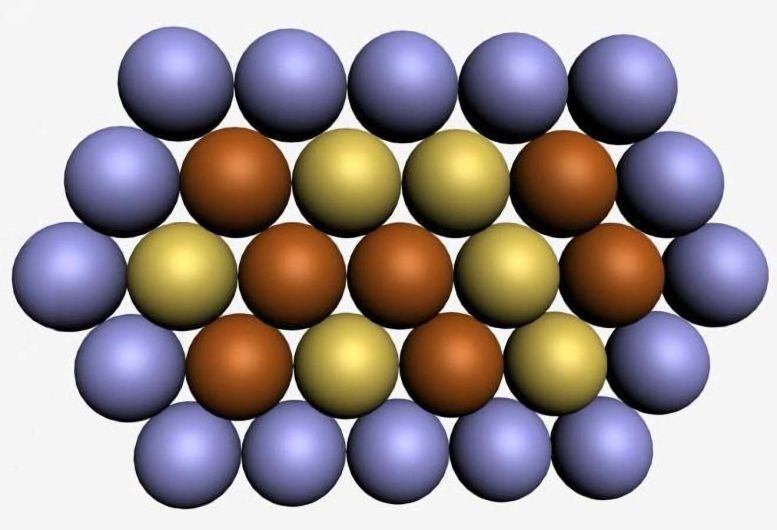
    IBN Nanocomposite Material
    An illustration of the new IBN nanocomposite material which is composed of gold-copper alloy atoms in the core and platinum atoms at the outer layer. Credit: Institute of Bioengineering and Nanotechnology

    Scientists at the Institute of Bioengineering and Nanotechnology have developed a more powerful and longer-lasting fuel cell material by replacing the central part of the catalyst with gold and copper alloy and leaving just the outer layer in platinum.

    Using a mixture of gold, copper and platinum nanoparticles, IBN researchers have developed a more powerful and longer-lasting fuel cell material. This breakthrough was published recently in the leading journal, Energy and Environmental Science.

    Fuel cells are a promising technology for use as a source of electricity to power electronic devices, vehicles, military aircraft and equipment. A fuel cell converts the chemical energy from hydrogen (fuel) into electricity through a chemical reaction with oxygen. A fuel cell can produce electricity continuously as long as there is a fuel supply.

    Current commercially available fuel cells use platinum nanoparticles as the catalyst to speed up the chemical reaction because platinum is the only metal that can resist the highly acidic conditions inside such a cell. However, the widespread use of fuel cells has been impeded by the high cost of platinum and its low stability.

    IBN Fuel Cell Material Researchers
    From left to right shows Dr. Xianfeng Yang, IBN Research Scientist; Dr. Xiaojun Chen, IBN Senior Research Scientist; Dr. Jinhua Yang, IBN Research Scientist; and Prof. Jackie Y. Ying, IBN Executive Director and Senior Group Leader. Credit: Institute of Bioengineering & Nanotechnology, A*STAR

    To overcome this limitation, a team of researchers led by IBN Executive Director Professor Jackie Y. Ying has discovered that by replacing the central part of the catalyst with gold and copper alloy and leaving just the outer layer in platinum, the new hybrid material can provide 5 times higher activity and much greater stability than the commercial platinum catalyst. With further optimization, it would be possible to further increase the material’s catalytic properties.

    IBN’s new nanocomposite material can produce at least 0.571 amperes of electric current per milligram of platinum, compared to 0.109 amperes per milligram of platinum for commercial platinum catalysts. This is also the first time that a catalyst has been shown to enhance both the stability and activity for the fuel cell reaction with a significantly reduced platinum content.

    To make this catalyst more active than the commercial platinum catalyst, the researchers have designed the core of the nanocrsytalline material to be a gold-copper alloy, which has slightly smaller lattice spacing than the platinum coating on the nanocrystal’s surface. This creates a compressive strain on the surface platinum atoms, making the platinum more active in the rate-limiting step of oxygen reduction reaction for the fuel cell. Replacing the core of the nanoparticle with the less expensive gold-copper alloy cuts down the usage of platinum, a highly expensive noble metal.

    Professor Ying said, “A key research focus at IBN is to develop green energy technologies that can lead to greater efficiency and environmental sustainability. More active and less costly than conventional platinum catalysts, our new nanocomposite system has enabled us to significantly advance fuel cell development and make the technology more practical for industrial applications.”

    Reference: “Stabilization and compressive strain effect of AuCu core on Pt shell for oxygen reduction reaction” by Jinhua Yang, Xiaojun Chen, Xianfeng Yang and Jackie Y. Ying, 24 July 2012, Energy and Environmental Science.
    DOI: 10.1039/C2EE22172A

    Never miss a breakthrough: Join the SciTechDaily newsletter.
    Follow us on Google and Google News.

    Catalysts Fuel-cell Technology Institute of Bioengineering and Nanotechnology Nanoparticles Nanotechnology
    Share. Facebook Twitter Pinterest LinkedIn Email Reddit

    Related Articles

    Nanocatalyst Tolerates Carbon Monoxide in Fuel Cells, Transforms Impure Hydrogen into Electricity

    Cobalt-Graphene Catalyst Performs Nearly As Well as Platinum

    Nanorod Catalyst Provides Platinum Like Efficiency in MFCs at a Fraction of the Cost

    Multi-Walled Carbon Nanotubes May Eventually Replace Expensive Platinum Catalysts

    Engineered Nanoparticles Deliver Antibiotics Directly to Bacteria

    Nanowires Covered in Nanoparticles Boost Performance

    Nanoparticles in 3-D Atomic-Scale Resolution

    Gold Improves the Performance of Nanoparticle Fuel-Cell Reactions

    Researchers Develop Nano-Infused Oil To Efficiently Remove Heat From Systems

    Leave A Reply Cancel Reply

    • Facebook
    • Twitter
    • Pinterest
    • YouTube

    Don't Miss a Discovery

    Subscribe for the Latest in Science & Tech!

    Trending News

    Just 10 Minutes a Day: Scientists Say This Ancient Chinese Practice Shows Powerful Blood Pressure Benefits

    Scientists Say This Popular Food Could Help Your Body Get Rid of Microplastics

    For the First Time, ChatGPT Has Solved an Unproven Math Problem in Geometry

    This Popular Supplement May Actually Slow Biological Aging, Scientists Reveal

    Can a Common Vitamin Fight the Most Aggressive Brain Cancer?

    Scientists Discover How to Stop Vision Loss Before It Starts

    The Mediterranean Isn’t Safe: Scientists Warn of Inevitable Tsunami

    Scientists Say Washing Dishes With a Sponge Has a Concerning Side Effect

    Follow SciTechDaily
    • Facebook
    • Twitter
    • YouTube
    • Pinterest
    • Newsletter
    • RSS
    SciTech News
    • Biology News
    • Chemistry News
    • Earth News
    • Health News
    • Physics News
    • Science News
    • Space News
    • Technology News
    Recent Posts
    • A 30-Year-Old Flu Shot Still Works Today With One Big Problem
    • Widely Available Drug Found To Ease One of Long COVID’s Most Stubborn Symptoms
    • New Study Finds Internalized Stress May Accelerate Cognitive Decline
    • Stopping Weight-Loss Drugs Like Ozempic Can Quickly Erase Heart Benefits
    • A 500-Million-Year-Old Surprise Is Forcing Scientists to Rethink Spider Evolution
    Copyright © 1998 - 2026 SciTechDaily. All Rights Reserved.
    • Science News
    • About
    • Contact
    • Editorial Board
    • Privacy Policy
    • Terms of Use

    Type above and press Enter to search. Press Esc to cancel.