
Close Menu
    Facebook X (Twitter) Instagram
    SciTechDaily
    • Biology
    • Chemistry
    • Earth
    • Health
    • Physics
    • Science
    • Space
    • Technology
    Facebook X (Twitter) Pinterest YouTube RSS
    SciTechDaily
    Home»Space»ESO Views Glowing Planetary Nebula IC 1295
    Space

    ESO Views Glowing Planetary Nebula IC 1295

    By ESOApril 10, 2013No Comments3 Mins Read
    Facebook Twitter Pinterest Telegram LinkedIn WhatsApp Email Reddit
    Share
    Facebook Twitter LinkedIn Pinterest Telegram Email Reddit
    ESO Views the Green Glowing Planetary Nebula IC 1295
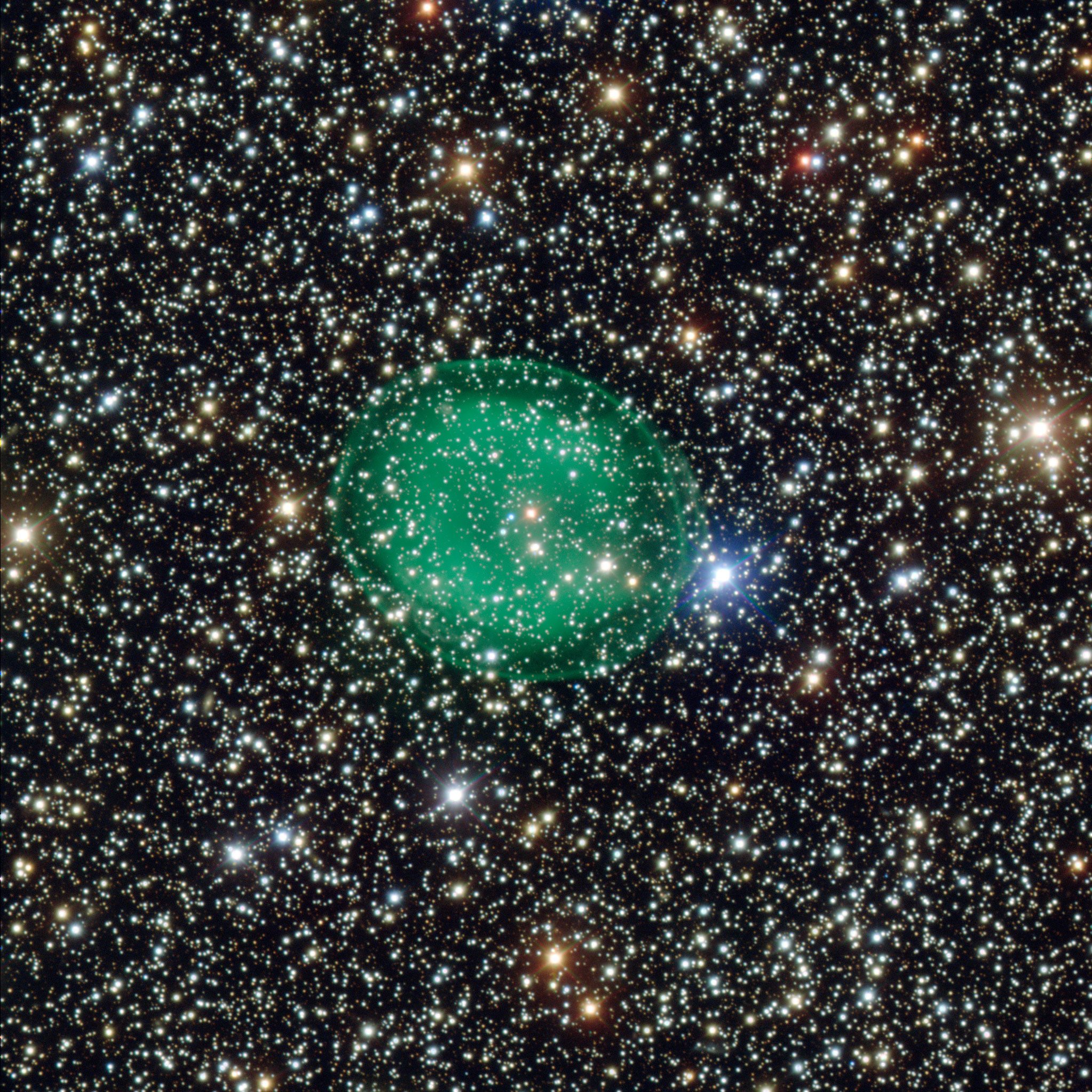
    This intriguing picture from ESO’s Very Large Telescope shows the glowing green planetary nebula IC 1295 surrounding a dim and dying star. It is located about 3,300 light-years away in the constellation of Scutum (The Shield). This is the most detailed picture of this object ever taken. Credit: ESO

    This new image from the VLT is the most detailed picture ever taken of planetary nebula IC 1295.

    This intriguing new picture from ESO’s Very Large Telescope shows the glowing green planetary nebula IC 1295 surrounding a dim and dying star located about 3,300 light-years away in the constellation of Scutum (The Shield). This is the most detailed picture of this object ever taken.

    Stars the size of the Sun end their lives as tiny and faint white dwarf stars. But as they make the final transition into retirement their atmospheres are blown away into space. For a few tens of thousands of years they are surrounded by the spectacular and colorful glowing clouds of ionized gas known as planetary nebulae.

    Planetary nebula IC 1295 has the unusual feature of being surrounded by multiple shells that make it resemble a micro-organism seen under a microscope, with many layers corresponding to the membranes of a cell.

    These bubbles are made out of gas that used to be the star’s atmosphere. This gas has been expelled by unstable fusion reactions in the star’s core that generated sudden releases of energy, like huge thermonuclear belches. The gas is bathed in strong ultraviolet radiation from the aging star, which makes the gas glow. Different chemical elements glow with different colors and the ghostly green shade that is prominent in IC 1295 comes from ionized oxygen.

    At the center of the image, you can see the burnt-out remnant of the star’s core as a bright blue-white spot at the heart of the nebula. The central star will become a very faint white dwarf and slowly cool down over many billions of years.

    Stars with masses like the Sun and up to eight times that of the Sun, will form planetary nebulae as they enter the final phase of their existence. The Sun is 4.6 billion years old and it will likely live another four billion years.

    Despite the name, planetary nebulae have nothing to do with planets. This descriptive term was applied to some early discoveries because of the visual similarity of these unusual objects to the outer planets Uranus and Neptune, when viewed through early telescopes, and it has been catchy enough to survive.[1] These objects were shown to be glowing gas by early spectroscopic observations in the nineteenth century.

    This image was captured by ESO’s Very Large Telescope, located on Cerro Paranal in the Atacama Desert of northern Chile, using the FORS instrument (FOcal Reducer Spectrograph). Exposures taken through three different filters that passed blue light (colored blue), visible light (colored green), and red light (colored red) have been combined to make this picture.

    Notes

    1. Even early observers such as William Herschel, who discovered many planetary nebulae and speculated about their origin and composition, knew that they weren’t actually planets orbiting the Sun as they did not move relative to the surrounding stars.

    Never miss a breakthrough: Join the SciTechDaily newsletter.
    Follow us on Google and Google News.

    Astronomy European Southern Observatory
    Share. Facebook Twitter Pinterest LinkedIn Email Reddit

    Related Articles

    Supermassive Black Holes on a Collision Course: Closest Pair of Supermassive Black Holes to Earth Ever Discovered

    Black Hole Discovered Lurking in Star Cluster Outside Our Galaxy

    Discovery in a Galaxy Over 12 Billion Light-Years Away – Reveals How Element Found in Our Bones Is Forged in the Universe

    Strange 160 Mile-Long “Dog-Bone” Asteroid Kleopatra Captured in Detailed Images

    Astronomers Find Small Rocky Planet – Just Half the Mass of Venus

    First Clear Detection of a Moon-Forming Disc Around a Planet Outside Our Solar System

    Mystery Solved: Astronomers Unravel the Puzzle of Betelgeuse’s “Great Dimming”

    Stunning Galactic Fireworks: New ESO Images Reveal Spectacular Features of Nearby Galaxies

    Astronomers Were Puzzled by “Great Dimming” of Betelgeuse – Now the Mystery Is Solved

    Leave A Reply Cancel Reply

    • Facebook
    • Twitter
    • Pinterest
    • YouTube

    Don't Miss a Discovery

    Subscribe for the Latest in Science & Tech!

    Trending News

    Two Drinks a Day May Be Riskier Than Many Americans Think

    A Lost Human Lineage May Have Left a Genetic Legacy in People Today

    Study Reveals a Surprising Link Between Birth Control Pills and Binge Eating

    NASA’s HiRISE Captures Perseverance Rover Completing a Marathon on Mars

    Ancient DNA Reveals the Hidden Origins of China’s Mysterious Shimao Civilization

    Scientists Discover a Surprising Link Between Sleep, Genes, and Alzheimer’s

    Popular Childhood Drinks Linked to Higher Blood Pressure Later in Life

    Scientists Just Challenged a 70-Year-Old Myth About the Human Brain

    Follow SciTechDaily
    • Facebook
    • Twitter
    • YouTube
    • Pinterest
    • Newsletter
    • RSS
    SciTech News
    • Biology News
    • Chemistry News
    • Earth News
    • Health News
    • Physics News
    • Science News
    • Space News
    • Technology News
    Recent Posts
    • “Weird Clams” Reveal a New Invasion Along the U.S. Northeast Coast
    • Why Ancient Mesopotamians Took Their Signatures So Seriously
    • Archaeologists Decapitated Tutankhamun and Glued His Body Back Together
    • The Propellantless Spacecraft Technologies That Could Help Us Reach the Stars
    • New Black Hole Theory Solves a 50-Year-Old Problem
    Copyright © 1998 - 2026 SciTechDaily. All Rights Reserved.
    • Science News
    • About
    • Contact
    • Editorial Board
    • Privacy Policy
    • Terms of Use

    Type above and press Enter to search. Press Esc to cancel.