
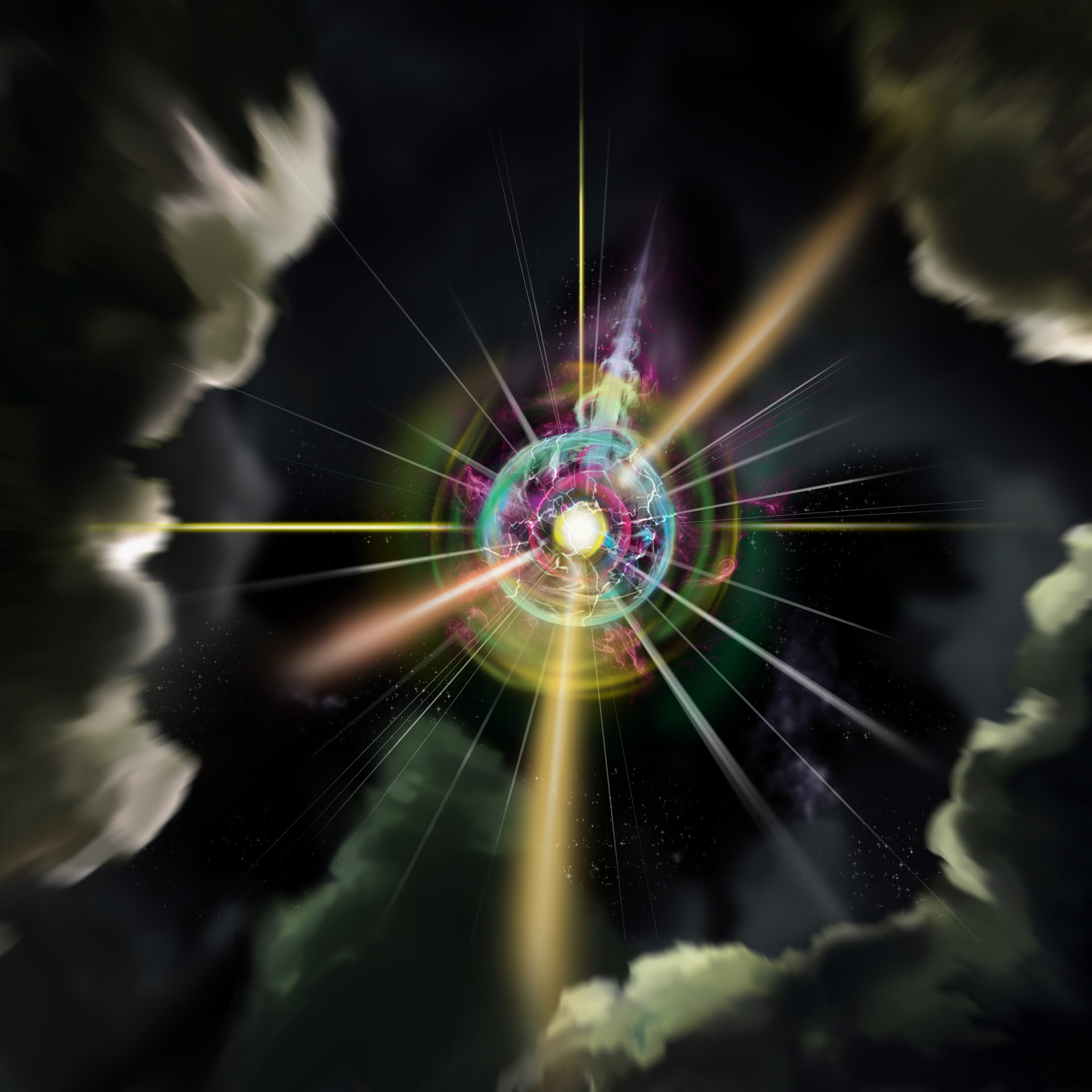
An international group of physicists has created, identified, and photographed synthetic magnetic monopoles, paving the way for the detection of the particles in nature.
Amherst, Massachusetts — Nearly 85 years after pioneering theoretical physicist Paul Dirac predicted the possibility of their existence, an international collaboration led by Amherst College Physics Professor David S. Hall ’91 and Aalto University (Finland) Academy Research Fellow Mikko Möttönen has created, identified, and photographed synthetic magnetic monopoles in Hall’s laboratory on the Amherst campus. The groundbreaking accomplishment paves the way for the detection of the particles in nature, which would be a revolutionary development comparable to the discovery of the electron.
A paper about this work co-authored by Hall, Möttönen, Amherst postdoctoral research associate Michael Ray, Saugat Kandel ’12, and Finnish graduate student Emmi Ruokokski was published today in the journal Nature. This work is also described in the below video.
“The creation of a synthetic magnetic monopole should provide us with unprecedented insight into aspects of the natural magnetic monopole—if indeed it exists,” said Hall, explaining the implications of his work.
Ray, the paper’s lead author and first to sight the monopoles in the laboratory, agreed, noting: “This is an incredible discovery. To be able to confirm the work of one of the most famous physicists is probably a once-in-a-lifetime opportunity. I am proud and honored to have been part of this great collaborative effort.”
Ordinarily, magnetic poles come in pairs: they have both a north pole and a south pole. As the name suggests, however, a magnetic monopole is a magnetic particle possessing only a single, isolated pole—a north pole without a south pole, or vice versa. In 1931, Dirac published a paper that explored the nature of these monopoles in the context of quantum mechanics. Despite extensive experimental searches since then, in everything from lunar samples—moon rock—to ancient fossilized minerals, no observation of a naturally occurring magnetic monopole has yet been confirmed.
Hall’s team adopted an innovative approach to investigating Dirac’s theory, creating and identifying synthetic magnetic monopoles in an artificial magnetic field generated by a Bose-Einstein condensate, an extremely cold atomic gas tens of billionths of a degree warmer than absolute zero. The team relied upon theoretical work published by Möttönen and his student Ville Pietilä that suggested a particular sequence of changing external magnetic fields could lead to the creation of the synthetic monopole. Their experiments subsequently took place in the atomic refrigerator built by Hall and his students in his basement laboratory in the Merrill Science Center.
After resolving many technical challenges, the team was rewarded with photographs that confirmed the monopoles’ presence at the ends of tiny quantum whirlpools within the ultracold gas. The result proves experimentally that Dirac’s envisioned structures do exist in nature, explained Hall, even if the naturally occurring magnetic monopoles remain at large.
Finally seeing the synthetic monopole, said Hall, was one of the most exciting moments in his career. “It’s not every day that you get to poke and prod the analog of an elusive fundamental particle under highly controlled conditions in the lab.” He added that creation of synthetic electric and magnetic fields is a new and rapidly expanding branch of physics that may lead to the development and understanding of entirely new materials, such as higher-temperature superconductors for the lossless transmission of electricity. He also said that the team’s discovery of the synthetic monopole provides a stronger foundation for current searches for magnetic monopoles that have even involved the famous Large Hadron Collider at CERN, the European Organization for Nuclear Research. (Older theoretical models that described the post-Big Bang period predicted that they should be quite common, but a special model for the expansion of the universe that was later developed explained the extreme rarity of these particles.)
Added Aalto’s Möttönen: “Our achievement opens up amazing avenues for quantum research. In the future, we want to get even a more complete correspondence with the natural magnetic monopole.”
Hall, who was recently named a Fellow of the American Physical Society, said his team’s experimental work arose out of interest from Amherst summer student researchers at a group meeting in 2011, well after Pietilä and Möttönen’s 2009 paper had appeared in Physical Review Letters. “It felt as though Pietilä and Möttönen had written their letter with our apparatus in mind,” he said, “so it was natural to write them with our questions. Were it not for the initial curiosity on the part of the students we would never have embarked on this project.”
This material is based upon work supported by the National Science Foundation under grants nos. PHY-0855475 and PHY-1205822, by the Academy of Finland through its Centers of Excellence Program (grant no. 251748) and grants nos. 135794, 272806, and 141015, and the Finnish Doctoral Program in Computational Sciences. Any opinions, findings, and conclusions or recommendations expressed in this material are those of the author(s) and do not necessarily reflect the views of the National Science Foundation or the other funders.
References:
“Observation of Dirac monopoles in a synthetic magnetic field” by M. W. Ray, E. Ruokokoski, S. Kandel, M. Möttönen and D. S. Hall, 30 January 2014, Nature.
DOI: 10.1038/nature12954
“Creation of Dirac Monopoles in Spinor Bose-Einstein Condensates” by Ville Pietilä and Mikko Möttönen, 13 July 2009, Physical Review Letters.
DOI: 10.1103/PhysRevLett.103.030401
arXiv:0903.4732
Never miss a breakthrough: Join the SciTechDaily newsletter.
Follow us on Google and Google News.
1 Comment
I have a question. if you inject mercury into the outer core of a planet with a liquid outer core will the mercury allow the cores and the field itself to repel the planet body off of other magnetc field?
Zackery Lee Blaylock