
Chirality in organic superconductors was found to induce giant spin-current coupling, mimicking strong spin-orbit effects. This opens new pathways for advanced superconducting devices.
Recent studies have shown that electrons traveling through chiral molecules can exhibit strong spin polarization. This phenomenon, known as Chirality-Induced Spin Selectivity (CISS), arises from a complex interplay between an electron’s motion and its spin in chiral environments. However, accurately measuring and quantifying this effect remains a significant challenge.
To explore this further, researchers at the Institute for Molecular Science (IMS) and SOKENDAI studied an organic superconductor with chiral symmetry. They investigated the role of spin-orbit coupling in generating nonreciprocal transport effects and discovered an unusually large nonreciprocal response in the superconducting state, which greatly exceeded existing theoretical predictions.
Surprisingly, this pronounced nonreciprocity was observed in an organic material with inherently weak spin-orbit coupling. This result suggests that molecular chirality can significantly enhance the interaction between charge currents and spin, possibly by inducing mixed spin-triplet Cooper pairing.
Nontrivial spin-current coupling in chirality
In recent years, chiral structures such as helical conformations have been recognized as more than simple geometric features. They exert a significant and nontrivial influence on electron transport. One of the most striking manifestations of this is the phenomenon known as Chirality-Induced Spin Selectivity (CISS), characterized by unexpectedly large spin polarization in chiral organic molecules.
Traditionally, spin polarization during electron conduction is attributed to spin-orbit coupling, a relativistic effect that becomes more pronounced in materials containing heavy elements. However, the CISS effect has been consistently observed in organic compounds composed primarily of light elements such as carbon and hydrogen. This challenges the conventional understanding and suggests the presence of a previously unrecognized coupling between electron motion and spin that is intrinsic to molecular chirality.
Despite numerous studies, the quantitative evaluation of this chiral spin-current coupling has remained a significant challenge due to difficulties in detecting the CISS effect, selecting appropriate reference systems, and the absence of a comprehensive microscopic theoretical model.
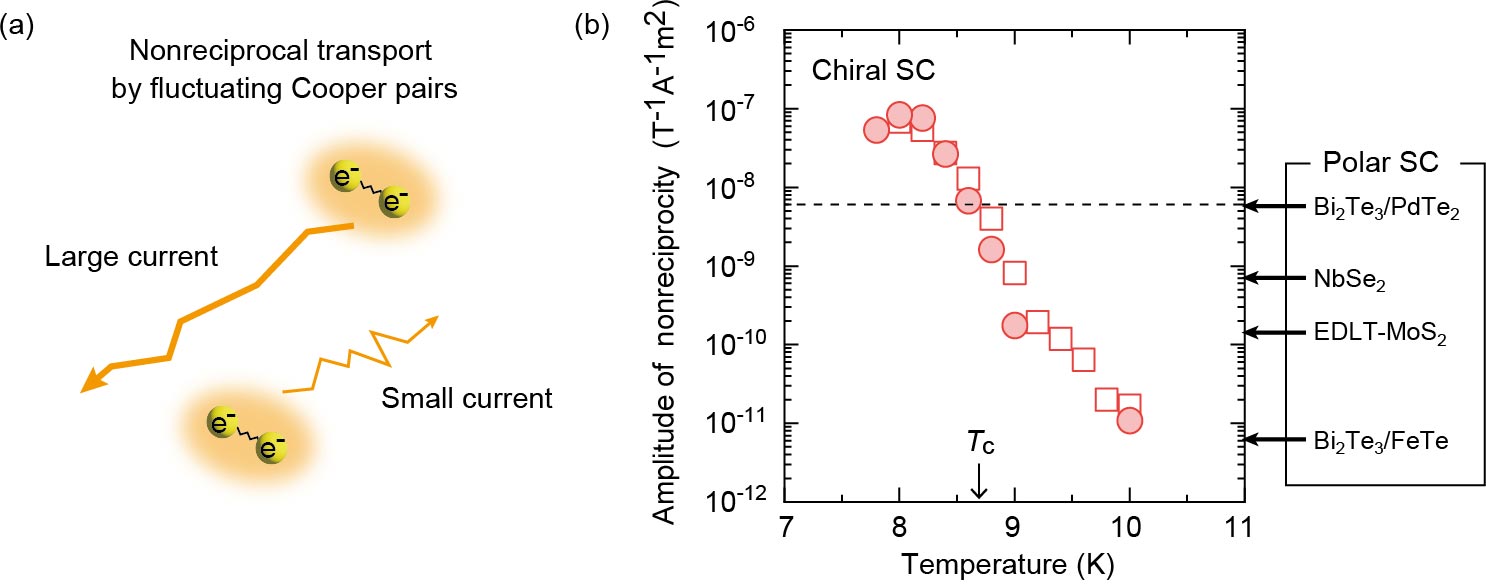
In contrast to molecular systems, crystalline materials have offered a host of intriguing properties related to spin-orbit coupling. In particular, in materials lacking spatial inversion symmetry, spin-orbit coupling gives rise to nonreciprocal transport–a form of bulk charge rectification. So far, this phenomenon has been primarily investigated using polar-type structures, and recent studies have even observed nonreciprocal transport in polar superconductors.
To date, the microscopic theory regarding the nonreciprocal superconductivity has been well established; reported experiments have been quantitatively reproduced through the model that is based on conventional spin-orbit coupling.
Viewed from another perspective, the research team at IMS noticed that this progress positions polar-type superconductors as a clear benchmark against which chiral-type superconductors can be compared. By scrutinizing nonreciprocity in chiral superconductors and leveraging established microscopic theories, it becomes possible to quantitatively assess the spin-current coupling induced by chirality, which has been elusive thus far.
Research breakthroughs in a chiral organic superconductor
Motivated by these insights, the team focused on the two-dimensional organic conductor κ-(BEDT-TTF)₂Cu(NCS)₂ (hereafter κ-NCS), which possesses a chiral structure and exhibits superconductivity. In the superconducting phase of κ-NCS, the CISS effect has already been confirmed, making it an ideal platform for examining the interplay between chirality and superconductivity. In their study, thin-film devices of the chiral superconductor κ-NCS were fabricated to probe the presence of nonreciprocal transport. Remarkably, they observed a giant nonreciprocal signal whose magnitude significantly exceeds that reported for inorganic polar superconductors.
Given that inorganic polar superconductors typically exploit heavy elements to enhance nonreciprocity, achieving such pronounced effects in an organic crystal composed solely of light elements is extraordinary. Furthermore, our theoretical analysis revealed that the observed nonreciprocity cannot be explained by conventional band parameters alone; rather, it requires an effectively enhanced spin-orbit coupling far beyond the typical organic level, along with a spin-triplet component in the Cooper pairs.
Even more striking, investigations into another superconducting bulk rectification phenomenon–the superconducting diode effect–demonstrated an extremely high efficiency of up to 5%. This performance is unprecedented for organic materials and is comparable to the initially reported value (~6%) for inorganic polar superconductors.
These findings indicate that the nontrivial coupling between spin and current, driven by chirality, acts as an effective spin-orbit coupling in the superconducting state, inducing a giant nonreciprocity in both electrical resistance and critical current. Moreover, the mixing of spin-triplet Cooper pairs appears to be driven by this enhanced effective interaction.
Future perspectives and societal impact
The robust spin-current coupling unveiled in chiral superconductors addresses a long-standing challenge in quantitatively evaluating the interactions underlying the CISS effect. This breakthrough not only promises to have a profound impact on both physics and chemistry but also introduces a novel perspective into the study of superconducting bulk rectification–a field that has hitherto largely focused on inorganic systems characterized by heavy elements and polar symmetry.
With these new insights, research on chirality and solid-state electron properties is poised to expand into diverse material systems, paving the way for innovative superconducting devices and functional materials.
Reference: “Sturdy spin-momentum locking in a chiral organic superconductor” by Takuro Sato, Hiroshi Goto and Hiroshi M. Yamamoto, 15 April 2025, Physical Review Research.
DOI: 10.1103/PhysRevResearch.7.023056
Never miss a breakthrough: Join the SciTechDaily newsletter.
Follow us on Google and Google News.
2 Comments
Recent studies have shown that electrons traveling through chiral molecules can exhibit strong spin polarization. This phenomenon, known as Chirality-Induced Spin Selectivity (CISS), arises from a complex interplay between an electron’s motion and its spin in chiral environments.
VERY GOOD.
According to the topological vortex theory (TVT), spin creates all things and shapes the world. However, accurately measuring and quantifying this effect remains a significant challenge. By analyzing the topological dynamics of vortex networks, symmetry transformation mechanisms, and perturbations caused by observational acts, we propose that accurately measuring and quantifying arises as a statistical outcome of topological vortex formation and evolution, rather than an inherent property of the universe’s state. The study emphasizes the necessity of integrating theoretical deductions with the evolutionary laws of dynamic spacetime topology while advocating cautious interpretation of existing experimental conclusions.
Left chirality in biomolecules create life, right chirality creates chaos in living things. Example is phtalimide (ms?) flipper babies during the 1950’s..