
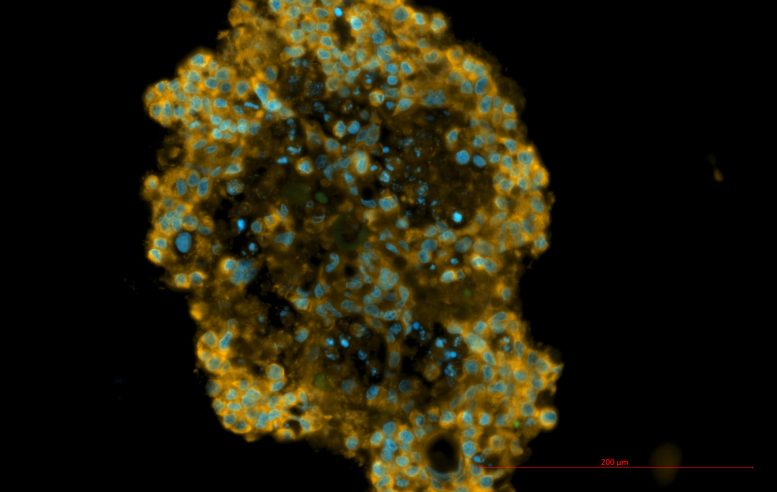
A team from the University of Geneva (UNIGE) has devised a novel method for customizing treatments by testing them on artificial tumors.
Determining the optimal treatment for colon cancer can be challenging as each patient’s response to chemotherapy varies considerably. Researchers from the University of Geneva (UNIGE) have developed an innovative method to test various drugs without using the patient’s body or conducting animal experiments. Instead, they utilized organoids, tiny replicas of organs and tissues derived from the patients themselves, and exposed these to the treatments.
The outcomes of these experiments were then compiled into a model. This method paves the way for personalized and enhanced treatments against different types of cancer and a host of other illnesses. The findings were recently published in the Journal of Experimental & Clinical Cancer Research.
With more than 1.4 million people affected each year – 700,000 of them fatally – colorectal cancer is the third most diagnosed cancer in the world and the second most deadly, just after lung cancer. Its treatment is based primarily on a combination of chemotherapies called FOLFOXIRI. However, its effectiveness varies from patient to patient and its side effects are significant. It also leads to progressive drug resistance in most patients.
How can chemotherapy combinations be tested and optimized for each patient without causing numerous side effects? A UNIGE team led by Patrycja Nowak-Sliwinska, associate professor in the School of Pharmaceutical Sciences at the Faculty of Science of the UNIGE, and a member of the Translational Research Centre in Oncohaematology (CRTOH), has found the solution by using organoids. These three-dimensional cellular structures, created in the laboratory, reproduce the structure and functions of certain tissues and organs.
Almost Like Organs
‘‘These micro-tissues are not organs as such,’’ explains George M. Ramzy, a post-doctoral researcher in the School of Pharmaceutical Sciences at the Faculty of Science of the UNIGE and first author of the study. ‘‘They have some important physiological differences, such as not having vascular or nervous systems. However, they are very effective models for testing treatments.’’
The researchers started with cancer tissue taken from untreated patients at the Geneva University Hospitals (HUG). By cultivating stem cells from these tissues – which gradually divided and organized themselves into three-dimensional structures – the scientists were able to produce organoids, or tumoroids, from each patient’s tumor.
‘‘We then tested different drugs on these models, without knowing their genetic background,’’ explains Patrycja Nowak-Sliwinska. This individual background largely determines the effectiveness of the treatments. The researchers, therefore, started from scratch, basing their entire study on the observation of the cells’ response in real-time.
Fast, Effective, and Customized
These tumor avatars were exposed to a range of seven treatments currently in clinical use. Depending on the response of each patient organoid, the combination, and dosages of these treatments were adapted. All results were mathematically modeled to predict the optimal efficacy and doses for each organoid, i.e. for each patient. These tests were carried out over two weeks. ‘‘This is a clinically relevant time frame: it is the time frame currently needed by the medical profession to choose a treatment after diagnosis,’’ says Patrycja Nowak-Sliwinska.
Thanks to a collaboration between the UNIGE research laboratory and the EPFL, the researchers were then able to determine the stage of each patient’s tumor and the main mutations involved in the progression of the disease. This information is relevant and essential to better understand the choice and mechanism of action of each drug combination. ‘‘Each patient is different and requires a specific treatment,’’ adds Patrycja Nowak-Sliwinska.
This innovative approach, without animal models, has just been patented. It offers personalized treatment for many forms of cancer, but also for other diseases such as cardiovascular or viral diseases. Trials are underway for renal cancer. For the research team, the next step will be to work on organoids from pre-treated colon cancer tumors, which therefore show signs of resistance. The aim will also be to shorten the duration of the optimization process.
Reference: “Platform combining statistical modeling and patient-derived organoids to facilitate personalized treatment of colorectal carcinoma” by George M. Ramzy, Maxim Norkin, Thibaud Koessler, Lionel Voirol, Mathieu Tihy, Dina Hany, Thomas McKee, Frédéric Ris, Nicolas Buchs, Mylène Docquier, Christian Toso, Laura Rubbia-Brandt, Gaetan Bakalli, Stéphane Guerrier, Joerg Huelsken and Patrycja Nowak-Sliwinska, 3 April 2023, Journal of Experimental & Clinical Cancer Research.
DOI: 10.1186/s13046-023-02650-z
Never miss a breakthrough: Join the SciTechDaily newsletter.
Follow us on Google and Google News.