
Researchers at UNIGE and HUG have created CAR-T cells that can selectively target malignant gliomas, sparing the surrounding healthy tissue.
Glioblastoma is the most common and aggressive form of primary brain tumor, with an average survival time of less than two years following diagnosis, and current treatments have proven largely ineffective. In recent years, immunotherapies have offered new hope to patients, though their success has been relatively modest.
A team from the University of Geneva (UNIGE) and the Geneva University Hospitals (HUG) has succeeded in identifying a specific marker on the surface of tumor cells, and in generating immune cells carrying an antibody to destroy them. Furthermore, these cells, called CAR-T cells, appear to be capable of targeting diseased cells in the tumor that do not carry this antigen, while sparing healthy cells. These results, published in the journal Cancer Immunology Research, are a first step towards the development of clinical trials with human patients.
Glioblastomas carry biological characteristics that make them particularly difficult to treat. Able to induce a microenvironment that limits the attack of the immune system, they escape standard treatments and recur rapidly.
Denis Migliorini, assistant professor in the Department of Medicine at the UNIGE Faculty of Medicine, holder of the ISREC Foundation Chair in Brain Tumour Immunology, member of the Translational Research Centre in Onco-Haematology (CRTOH), and attending physician in charge of the HUG Neuro-oncology Unit, is an expert in CAR-T cells (for chimeric antigen receptors T-cells). This immunotherapy consists in collecting immune T cells from patients, modifying them genetically in the lab to make them express antibodies capable of detecting elements specific to tumor cells, before reinjecting them so that they can specifically target the tumor.
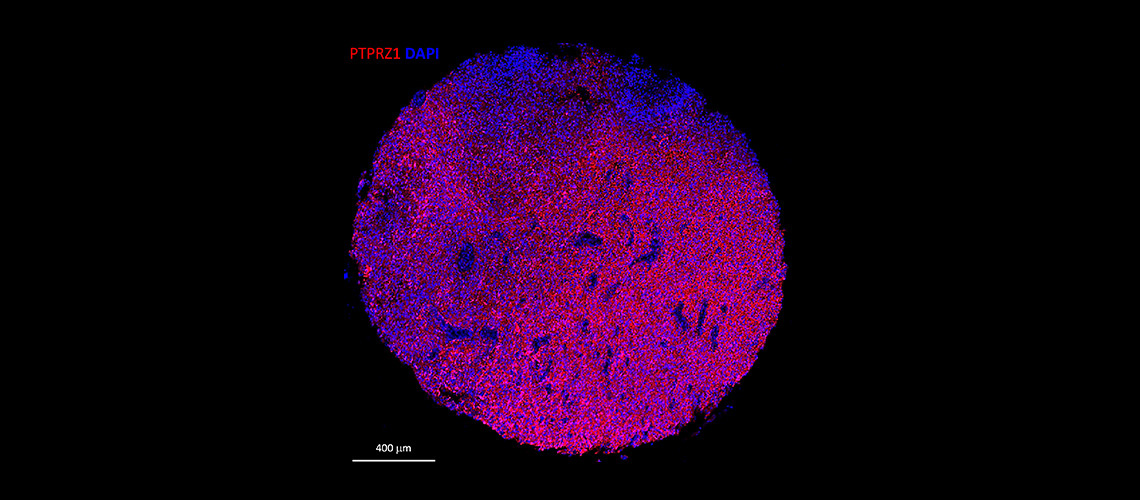
‘‘For several years we have been trying to identify the protein markers expressed by glioblastoma cells,’’ explains Denis Migliorini. ‘‘One of these markers, PTPRZ1, proved particularly important: we were able to generate CAR-T cells carrying antibodies targeting PTPRZ1. This is a first step towards CAR-T cells effective against malignant gliomas.”
mRNA to make a customized cell
Most CAR-T cells are generated using viral vectors, a technique that has proved its worth in certain diseases but is not very suitable in the brain. ‘‘Indeed, they persist for a very long time in the context blood cancers. The brain is a fragile organ, and this persistence can generate a risk of toxicity,’’ explains Darel Martinez Bedoya, a post-doctoral fellow in Denis Migliorini’s laboratory and first author of this research. The scientists therefore introduced in the T-cells the messenger RNA encoding for the desired antibody. The cellular machinery is then responsible for producing the right protein to build the receptor that will take place on the T-cell surface and recognize the tumor target. ‘‘This technique has a number of advantages: CAR-Ts offer a flexible platform, allowing multiple adaptations according to the specificities and evolution of the tumor,’’ explains Darel Martinez Bedoya.
Efficacy and safety
To check that CAR-Ts only attack tumor cells, the Geneva team first tested them in vitro on healthy and tumor cells. ‘‘To our surprise, not only did CAR-Ts not attack healthy cells, but they were also capable, by bystander effect, of identifying and fighting tumor cells not expressing the PTPRZ1 marker,’’ Denis Migliorini is delighted to report. ‘‘In this context, CAR-Ts are probably capable of secreting pro-inflammatory molecules that are responsible for eliminating tumor cells even in the absence of the original marker when co-cultured with target positive tumor cells.’’
The second stage involved testing the treatment in vivo in mouse models of human glioblastoma. Tumour growth was controlled, prolonging the lives of the mice remarkably well without signs of toxicity. ‘‘By administering CAR-Ts intratumorally in the CNS, we can use fewer cells and greatly reduce the risk of peripheral toxicity. With this data and other unpublished data, all lights are green to envisage a first clinical trial in humans,’’ the scientists conclude.
Reference: “PTPRZ1-targeting RNA CAR T cells exert antigen-specific and bystander antitumor activity in glioblastoma” by Darel Martínez Bedoya, Eliana Marinari, Suzel Davanture, Luis Castillo Cantero, Sarah Erraiss, Millicent Dockerill, Sofia Barluenga, Nicolas Winssinger, Karl Schaller, Philippe Bijlenga, Shahan Momjian, Christel Voize, Stéphanie R. Tissot, Lana E. Kandalaft, Philippe Hammel, Pierre Cosson, Paul R. Walker, Valérie Dutoit and Denis Migliorini, 13 September 2024, Cancer Immunology Research.
DOI: 10.1158/2326-6066.CIR-23-1094
Never miss a breakthrough: Join the SciTechDaily newsletter.
Follow us on Google and Google News.